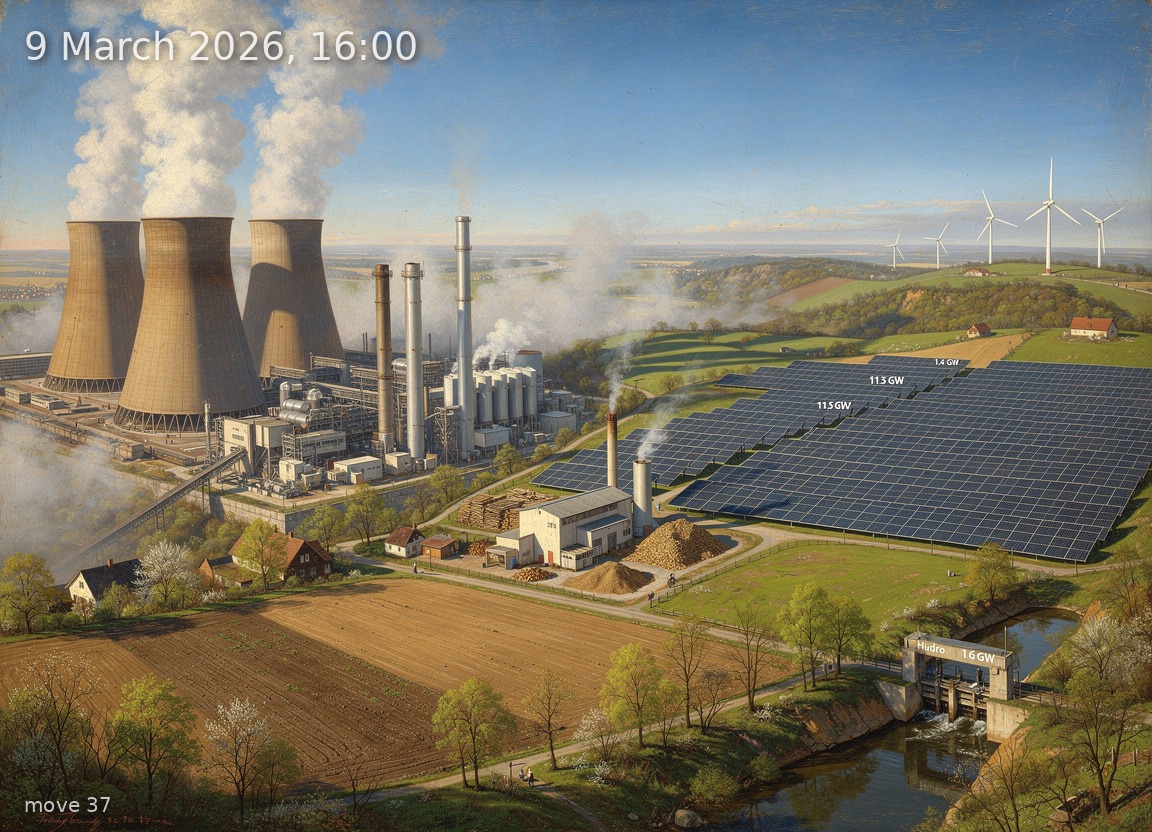
Clear skies drive 11.5 GW solar, but near-zero wind and 12.1 GW brown coal leave Germany importing 19.8 GW at extreme prices.
Back
Generation mix
Wind onshore 4%
Wind offshore 1%
Solar 29%
Biomass 11%
Hydro 4%
Natural gas 20%
Brown coal 31%
49%
Renewable share
1.7 GW
Wind (on + offshore)
11.5 GW
Solar
39.2 GW
Total generation
-19.9 GW
Net import
143.4 €/MWh
Day-ahead price
16.7°C / 7 km/h
Temp / Wind speed
Open-Meteo, Kassel (51.3°N 9.5°E)
0% / 260.5 W/m²
Cloud cover / Radiation
353
gCO₂/kWh
Image prompt
Brown coal 12.1 GW dominates the left third of the scene as a massive lignite power complex with four hyperbolic cooling towers billowing thick white-grey steam plumes into the sky; solar 11.5 GW occupies the centre-right as vast fields of aluminium-framed crystalline silicon photovoltaic panels glinting sharply under direct afternoon sun; natural gas 7.9 GW appears centre-left as a cluster of modern combined-cycle gas turbine plants with tall slender exhaust stacks emitting shimmering heat haze; biomass 4.3 GW sits in the mid-ground as a wood-chip-fed industrial plant with a modest chimney trailing pale smoke; hydro 1.6 GW is rendered as a small concrete dam and powerhouse nestled in rolling terrain at right; wind onshore 1.4 GW appears as a handful of three-blade turbines on a distant ridge, their rotors barely turning in the still air. The scene is set at 4 PM on a warm early-spring afternoon in central Germany — full bright daylight, completely cloudless deep blue sky, direct sun casting crisp shadows from the west-northwest. The landscape shows early spring greening: pale green buds on deciduous trees, fresh grass emerging among brown fields, temperature suggesting shirt-sleeve weather at 16.7°C. Despite the beautiful weather, the atmosphere feels oppressive and heavy — a thick industrial haze clings to the horizon from the lignite complex, the air shimmering with heat from the gas turbines, conveying the economic tension of €143/MWh electricity. High-voltage transmission pylons stretch away toward every horizon, symbolising the massive import flows sustaining the grid. Highly detailed oil painting in the tradition of 19th-century German Romantic landscape painters — rich saturated colour, visible impasto brushwork, atmospheric perspective with golden afternoon light contrasting against industrial smoke — rendered with meticulous engineering accuracy for each technology. No text, no labels.