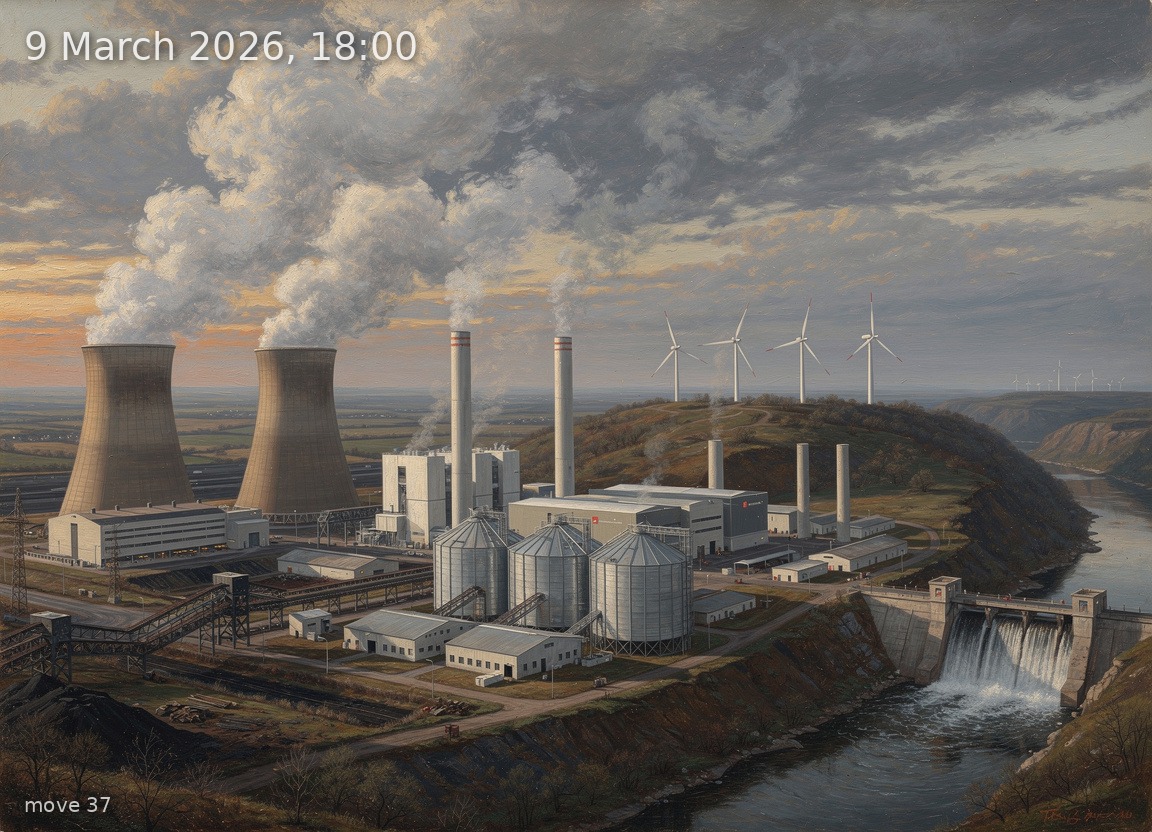
Brown coal and gas dominate a 32 GW domestic supply as calm winds and sunset force 31 GW of net imports at extreme prices.
Back
Generation mix
Wind onshore 6%
Wind offshore 1%
Solar 0%
Biomass 14%
Hydro 6%
Natural gas 34%
Brown coal 38%
27%
Renewable share
2.4 GW
Wind (on + offshore)
0.1 GW
Solar
32.0 GW
Total generation
-31.0 GW
Net import
244.0 €/MWh
Day-ahead price
15.3°C / 4 km/h
Temp / Wind speed
Open-Meteo, Kassel (51.3°N 9.5°E)
7% / 30.2 W/m²
Cloud cover / Radiation
482
gCO₂/kWh
Records
#1
Import Peak
Image prompt
Brown coal 12.3 GW dominates the left third of the scene as a massive lignite power station with four hyperbolic cooling towers belching thick white-grey steam plumes into the dusk sky; natural gas 11.0 GW fills the centre-left as three compact CCGT units with tall single exhaust stacks venting shimmering heat haze; biomass 4.5 GW appears centre-right as a cluster of industrial biomass plants with cylindrical wood-chip silos and short square chimneys emitting pale smoke; wind onshore 2.0 GW is rendered as a sparse row of five three-blade turbines on a distant ridge, blades barely turning in the still air; hydro 1.8 GW appears as a concrete dam with modest spillway in the far right middle ground; wind offshore 0.3 GW is a tiny pair of turbines on the extreme right horizon over a sliver of grey sea; solar 0.1 GW is represented by a single small rooftop array on a farmhouse, panels dark and catching no light. The sky is a dusk scene at 18:00 in early March — a narrow band of deep orange-red glow clings to the lower horizon, rapidly fading upward into darkening slate-blue and indigo; the upper sky is nearly clear with only 7% wispy cloud. The atmosphere feels heavy, oppressive, and ominous, reflecting the 244 EUR/MWh crisis price — a brooding amber-tinged haze hangs over the industrial facilities. Early spring landscape with bare-branched trees just beginning to bud, pale green grass, temperature around 15°C suggesting mild but cooling evening air. Transmission towers with high-voltage lines stretch across the scene symbolising the enormous import flows. Rendered as a highly detailed oil painting in the tradition of 19th-century German Romantic landscape painters — rich saturated colour, visible expressive brushwork, deep atmospheric perspective with layered recession from industrial foreground to distant horizon. Each energy technology depicted with meticulous engineering accuracy: turbine nacelles and lattice towers, aluminium-framed PV panels, lignite hyperbolic cooling towers with correct proportions, CCGT exhaust stacks with heat shimmer. The mood evokes Caspar David Friedrich's sublime tension between human industry and the vast indifferent sky. No text, no labels.