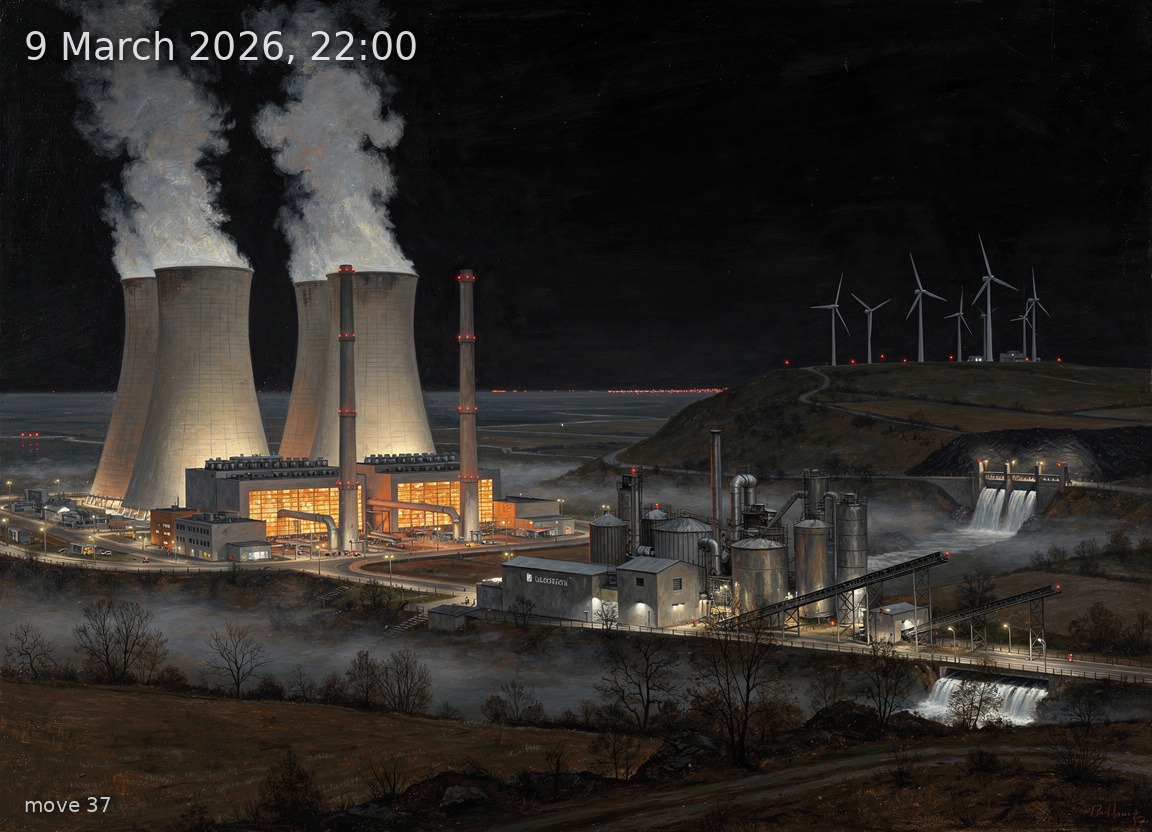
Brown coal and natural gas dominate night generation while 18.3 GW net imports fill a massive supply gap at extreme prices.
Back
Generation mix
Wind onshore 11%
Wind offshore 1%
Solar 0%
Biomass 15%
Hydro 5%
Natural gas 32%
Brown coal 35%
32%
Renewable share
3.3 GW
Wind (on + offshore)
0.0 GW
Solar
27.2 GW
Total generation
-18.2 GW
Net import
143.3 €/MWh
Day-ahead price
6.2°C / 5 km/h
Temp / Wind speed
Open-Meteo, Kassel (51.3°N 9.5°E)
0% / 0.0 W/m²
Cloud cover / Radiation
449
gCO₂/kWh
Image prompt
Brown coal 9.7 GW dominates the left third of the scene as a massive lignite power station complex with four hyperbolic cooling towers belching thick white steam plumes into the black night sky; natural gas 8.8 GW fills the centre-left as two large CCGT plant blocks with tall slim exhaust stacks emitting shimmering heat haze, their turbine halls glowing with interior sodium-orange light; biomass 4.1 GW appears centre-right as a cluster of industrial biomass boiler buildings with squat chimneys and woodchip conveyors lit by floodlights; wind onshore 2.9 GW is represented by a small group of three-blade turbines on a ridge in the right background, their red aviation warning lights blinking faintly, rotors nearly still in the calm air; hydro 1.4 GW appears as a small illuminated dam spillway visible in the far right distance; wind offshore 0.4 GW is suggested by a faint cluster of tiny red lights on the far horizon. The sky is completely black—deep starless night at 22:00, no twilight, no sky glow—with only artificial illumination from the industrial facilities casting harsh pools of amber and white light across the landscape. A low ground fog clings to a flat central German terrain with bare early-spring trees and dormant brown grass, temperature near 6°C. The atmosphere is heavy and oppressive, almost suffocating, reflecting the extreme electricity price: smoke and steam merge overhead into a dense industrial pall pressing down on the scene. Overhead high-voltage transmission lines with lattice pylons stretch prominently across the composition from right to left, symbolizing the enormous import flows. Style: highly detailed oil painting in the tradition of 19th-century German Romantic landscape painters—rich chiaroscuro, visible impasto brushwork, atmospheric depth worthy of Caspar David Friedrich confronting industrialization—meticulous engineering accuracy on every turbine nacelle, cooling tower, and exhaust stack. No text, no labels.