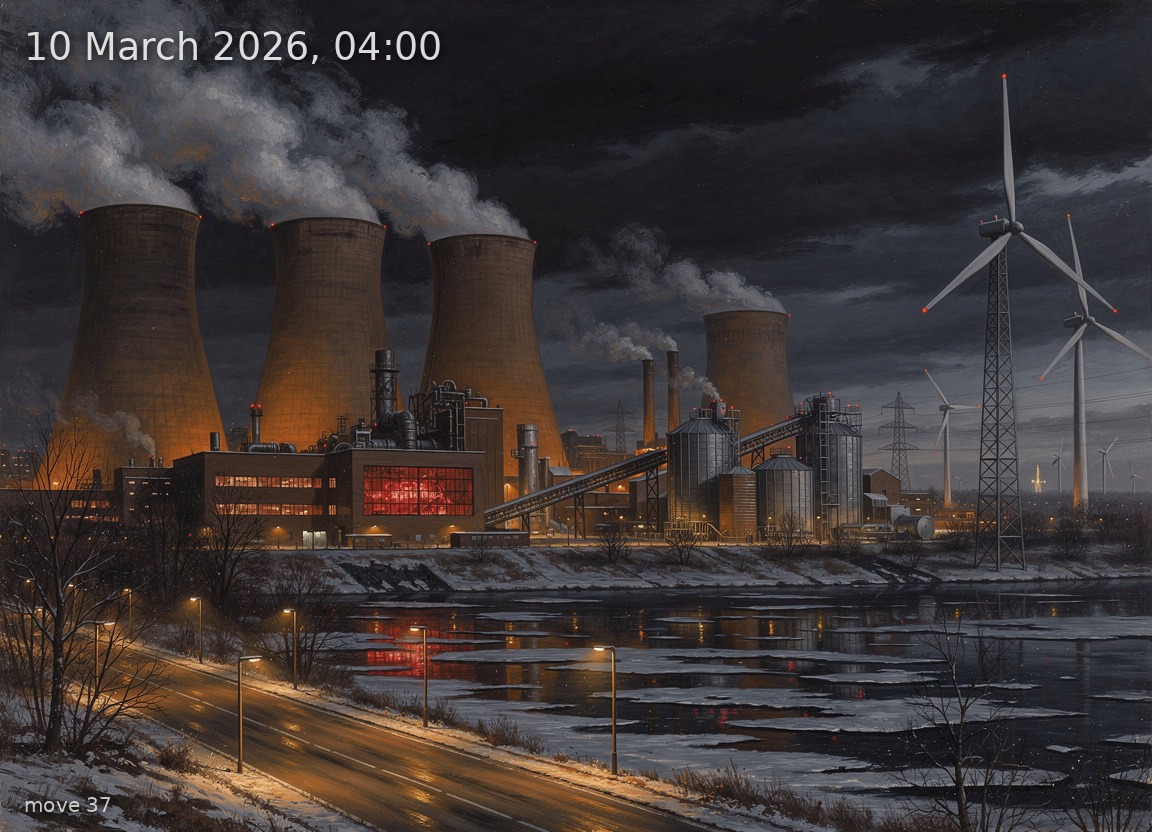
Brown coal dominates at 12.2 GW as near-zero wind and nighttime conditions force 27.7 GW of net imports at high prices.
Back
Generation mix
Wind onshore 14%
Wind offshore 2%
Biomass 21%
Brown coal 64%
36%
Renewable share
3.0 GW
Wind (on + offshore)
0.0 GW
Solar
19.1 GW
Total generation
-27.7 GW
Net import
128.5 €/MWh
Day-ahead price
3.0°C / 0 km/h
Temp / Wind speed
Open-Meteo, Kassel (51.3°N 9.5°E)
100% / 0.0 W/m²
Cloud cover / Radiation
523
gCO₂/kWh
Records
#3
Import Peak
Image prompt
Brown coal 12.2 GW dominates the left two-thirds of the scene as a vast lignite power station complex with four massive hyperbolic cooling towers emitting thick white-grey steam plumes into the black night sky, glowing red furnace light visible through boiler house windows; biomass 3.9 GW appears in the centre-right as a cluster of smaller industrial plants with ribbed metal silos, wood-chip conveyors, and short stacks emitting faint amber-lit exhaust; wind onshore 2.7 GW occupies the far right as a sparse row of tall three-blade turbines with lattice towers and nacelles, their rotors nearly motionless in the dead-calm air, lit faintly by red aviation warning lights; wind offshore 0.3 GW is suggested by a single distant turbine silhouette on the far horizon. The time is 4 AM — completely dark, deep black sky with no twilight glow whatsoever, total overcast at 100% cloud cover obliterating all stars. Temperature is 3°C: bare dormant trees, frost-rimmed ground, patches of lingering snow. Sodium-orange streetlights line an access road in the foreground, casting pools of warm light on wet asphalt. The atmosphere is heavy and oppressive, reflecting the extreme 128.5 EUR/MWh price — low grey clouds press down close, trapping the steam and industrial haze in a suffocating blanket. Transmission line pylons recede into the murky distance, symbolizing massive import flows. A frozen river or canal reflects the amber industrial glow. Highly detailed oil painting in the tradition of 19th-century German Romantic landscape painters such as Caspar David Friedrich and Carl Blechen — rich dark palette of blacks, deep navies, burnt umbers and furnace oranges, visible expressive brushwork, dramatic chiaroscuro, atmospheric depth with industrial haze layering into the distance. Meticulous engineering detail on cooling tower parabolic curves, turbine nacelle housings, three-blade rotor geometry, aluminium conveyor structures, and high-voltage lattice towers. No text, no labels.