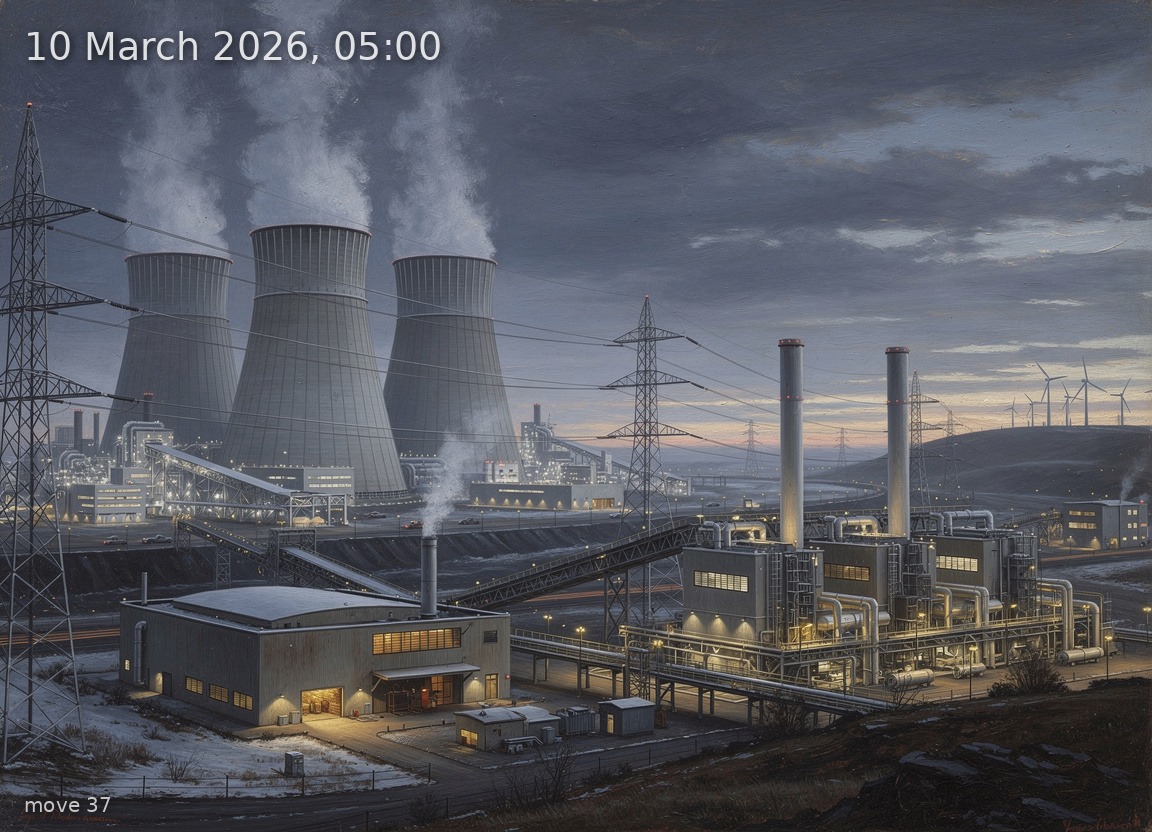
Brown coal and gas dominate as near-zero wind and no solar force 20.9 GW net imports at 140.7 EUR/MWh.
Back
Generation mix
Wind onshore 10%
Wind offshore 1%
Biomass 13%
Hydro 4%
Natural gas 30%
Brown coal 41%
28%
Renewable share
3.1 GW
Wind (on + offshore)
0.0 GW
Solar
29.5 GW
Total generation
-20.9 GW
Net import
140.7 €/MWh
Day-ahead price
2.5°C / 1 km/h
Temp / Wind speed
Open-Meteo, Kassel (51.3°N 9.5°E)
100% / 0.0 W/m²
Cloud cover / Radiation
489
gCO₂/kWh
Image prompt
Brown coal 12.2 GW dominates the left third of the scene as a massive lignite power plant complex with four hyperbolic cooling towers billowing thick white steam into the black sky; natural gas 9.0 GW fills the centre-right as three large CCGT combined-cycle units with tall slender exhaust stacks emitting faint heat shimmer, lit by banks of sodium-yellow industrial floodlights; biomass 4.0 GW appears as a mid-sized wood-chip-fired power station with a rectangular boiler building and single smokestack near centre-left, warm amber light spilling from its grated windows; onshore wind 2.9 GW is represented by a small cluster of three-blade turbines on a low ridge in the far right background, their rotors barely turning, almost motionless; hydro 1.2 GW is a small run-of-river station glimpsed in the lower right foreground beside a dark river reflecting industrial lights. Pre-dawn hour, 05:00 in early March: the sky is deep blue-grey with the faintest pale luminescence on the eastern horizon — no direct sunlight, no sunshine, no solar panels anywhere. Temperature 2.5°C: frost rims the bare winter branches and dormant brown fields; patches of old snow cling to furrows. Complete overcast: a heavy, oppressive blanket of low stratus clouds presses down on the scene, enhancing claustrophobic atmosphere suggesting extreme electricity prices. Overhead high-voltage transmission lines with lattice pylons stretch from left to right, cables sagging under load, symbolizing massive cross-border power imports. The river in the foreground reflects the orange sodium glow of the industrial facilities. Bare deciduous trees frame the composition. Style: highly detailed oil painting in the tradition of 19th-century German Romantic landscape painters — Caspar David Friedrich meets industrial sublime — rich impasto brushwork, dramatic chiaroscuro, atmospheric depth and haze from cooling tower steam mixing with cold air, meticulous engineering detail on every turbine nacelle, cooling tower ribbing, and exhaust stack. Mood: brooding, heavy, tense. No text, no labels.