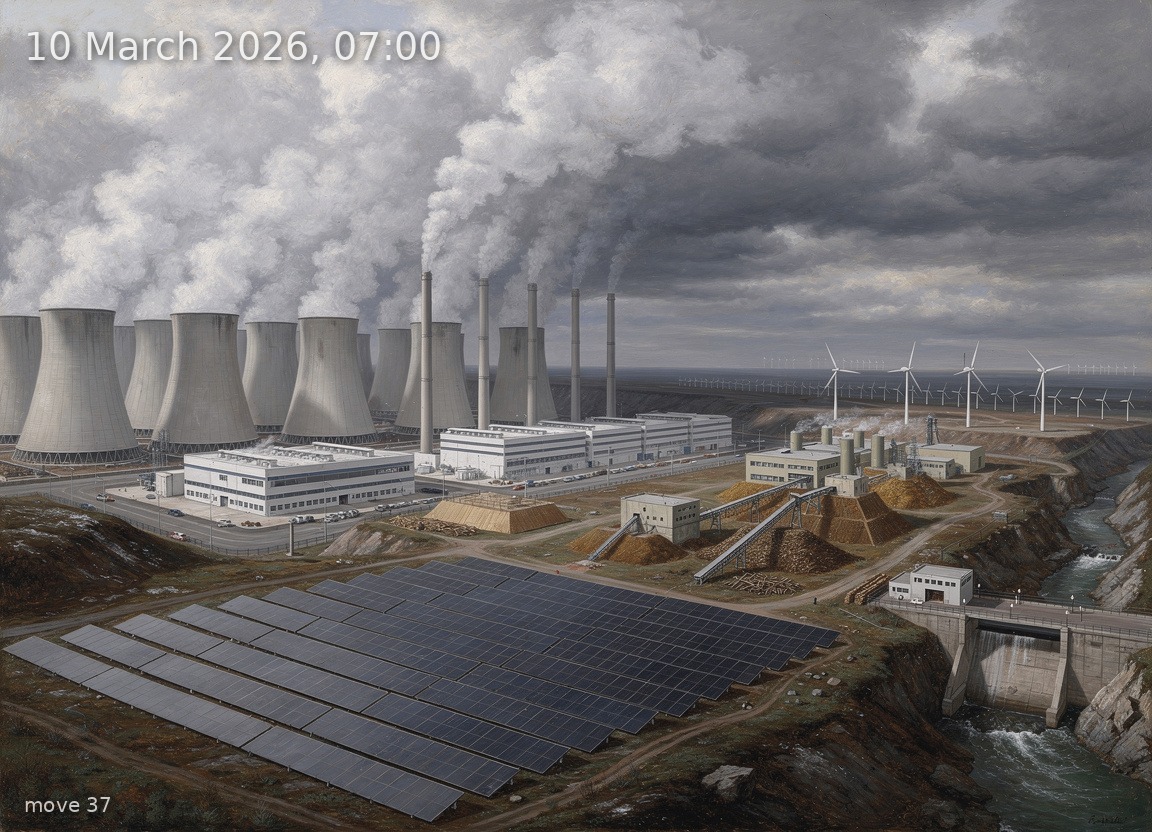
Brown coal and gas dominate as near-zero wind, full overcast, and cold temperatures force 27.2 GW of net imports.
Back
Generation mix
Wind onshore 8%
Wind offshore 1%
Solar 11%
Biomass 12%
Hydro 4%
Natural gas 29%
Brown coal 35%
36%
Renewable share
3.2 GW
Wind (on + offshore)
3.8 GW
Solar
34.6 GW
Total generation
-27.3 GW
Net import
180.2 €/MWh
Day-ahead price
1.2°C / 2 km/h
Temp / Wind speed
Open-Meteo, Kassel (51.3°N 9.5°E)
100% / 0.0 W/m²
Cloud cover / Radiation
430
gCO₂/kWh
Image prompt
Brown coal 12.1 GW dominates the left third of the scene as a vast complex of hyperbolic cooling towers belching thick white steam plumes into the heavy sky; natural gas 10.0 GW fills the centre-left as a row of modern CCGT plants with tall single exhaust stacks trailing thin grey vapour; biomass 4.1 GW appears centre-right as a cluster of industrial wood-chip power stations with squat chimneys and conveyor belts feeding fuel; solar 3.8 GW is shown as extensive fields of aluminium-framed crystalline silicon panels in the right-centre foreground, their surfaces dull and lifeless under the overcast, reflecting no light; wind onshore 2.9 GW appears as a scattered line of three-blade turbines on a distant ridge, their rotors barely turning in the still air; hydro 1.4 GW is a small dam and powerhouse nestled in a valley at the far right; wind offshore 0.3 GW is a faint suggestion of turbines on the extreme horizon. The sky is entirely covered in dense, oppressive, low-hanging grey clouds with no break or brightness — a suffocating 100% overcast ceiling pressing down. The time is 7:00 AM in early March: the light is the faintest pre-dawn grey-blue, barely distinguishing land from sky, with no direct sunlight and no warm tones — everything rendered in cold blue-greys, slate, and charcoal. Frost covers bare winter fields and leafless trees in the foreground; patches of old snow cling to plowed furrows. The temperature reads near freezing — breath-like mist rises from the ground. Massive high-voltage transmission lines sweep across the middle ground carrying imported power, their steel lattice pylons marching into the murky distance. The atmosphere is heavy, tense, and industrial. Highly detailed oil painting in the tradition of 19th-century German Romantic landscape painters — Caspar David Friedrich meets industrial sublime — rich tonal depth, visible impasto brushwork, dramatic atmospheric perspective, meticulous engineering accuracy on every turbine nacelle, cooling tower, and transformer yard. No text, no labels.