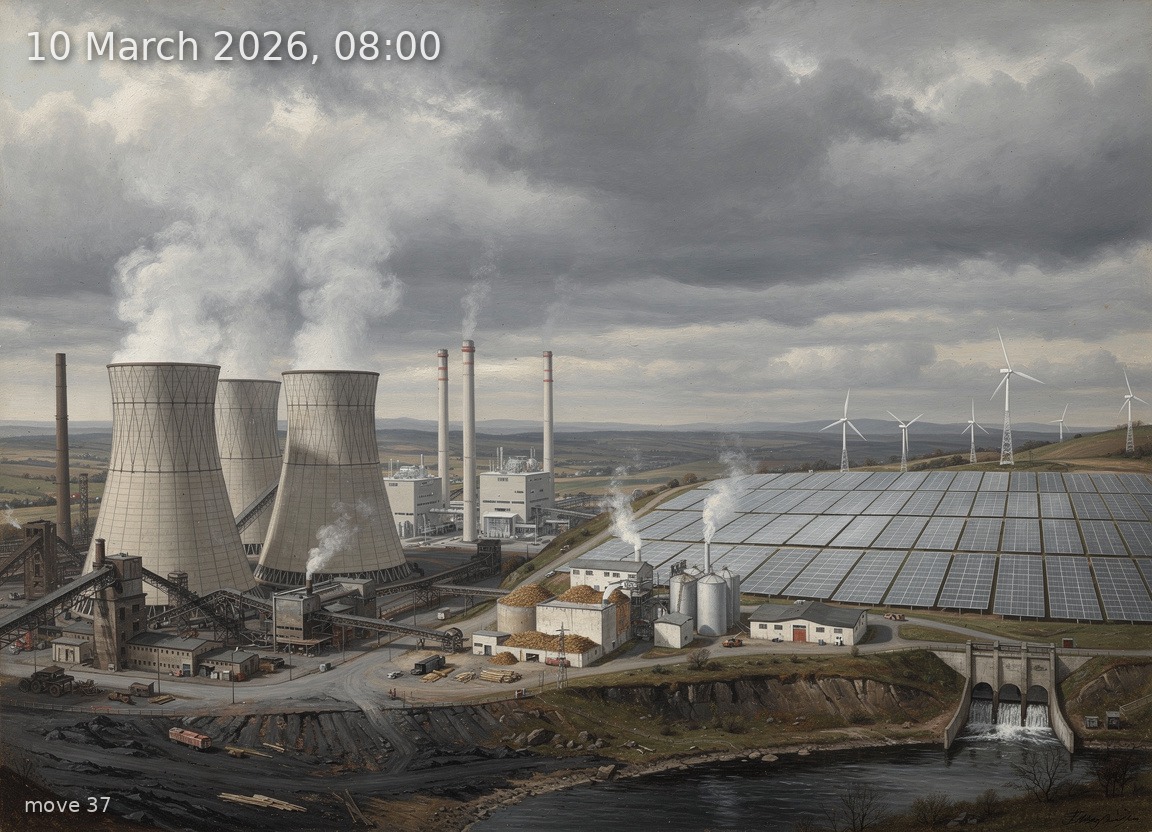
Brown coal and gas dominate as wind collapses near zero; 20 GW net imports needed under cold overcast skies.
Back
Generation mix
Wind onshore 7%
Wind offshore 1%
Solar 31%
Biomass 10%
Hydro 3%
Natural gas 21%
Brown coal 27%
52%
Renewable share
3.4 GW
Wind (on + offshore)
13.6 GW
Solar
43.7 GW
Total generation
-20.1 GW
Net import
173.3 €/MWh
Day-ahead price
2.0°C / 0 km/h
Temp / Wind speed
Open-Meteo, Kassel (51.3°N 9.5°E)
100% / 0.2 W/m²
Cloud cover / Radiation
325
gCO₂/kWh
Image prompt
Brown coal 11.9 GW dominates the left third of the scene as a massive lignite power complex with four hyperbolic cooling towers belching thick white-grey steam plumes that merge with the overcast sky; natural gas 9.1 GW fills the centre-left as three compact CCGT plants with tall single exhaust stacks emitting shimmering heat haze; solar 13.6 GW spreads across the centre-right as vast rolling fields of aluminium-framed crystalline silicon PV panels stretching to the horizon, their surfaces reflecting only flat grey light under the dense cloud deck, no sunshine visible; biomass 4.2 GW appears as a cluster of modest wood-chip-fed generation buildings with small smokestacks and steam wisps in the right-centre; wind onshore 3.0 GW shows as a handful of three-blade turbines with white lattice towers on a distant ridge, their rotors completely still in the dead-calm air; hydro 1.5 GW is a small concrete run-of-river dam visible in a valley at far right with dark water flowing through; wind offshore 0.4 GW is barely suggested as tiny turbine silhouettes on a misty far horizon line. TIME AND ATMOSPHERE: 8:00 AM March morning in central Germany, full daylight but completely overcast with a heavy, oppressive, uniformly grey sky pressing down—no blue, no sun, no shadows. Temperature is 2°C: bare deciduous trees with no leaves, frost on brown grass, patches of old grey snow on field edges, breath-mist visible near any human figures. The atmosphere feels heavy and expensive—a dense, claustrophobic ceiling of cloud weighing on the industrial landscape. High-voltage transmission pylons march prominently through the midground, their cables suggesting the massive power imports flowing into Germany. Bare winter fields of dark soil between the installations. Highly detailed oil painting in the tradition of 19th-century German Romantic landscape painters—rich muted earth tones and slate greys, visible confident brushwork, profound atmospheric depth and chiaroscuro despite the flat light, meticulous engineering detail on every turbine nacelle, cooling tower reinforcement pattern, PV panel racking, and smokestack. The scene evokes Caspar David Friedrich's sublime melancholy merged with industrial realism. No text, no labels.