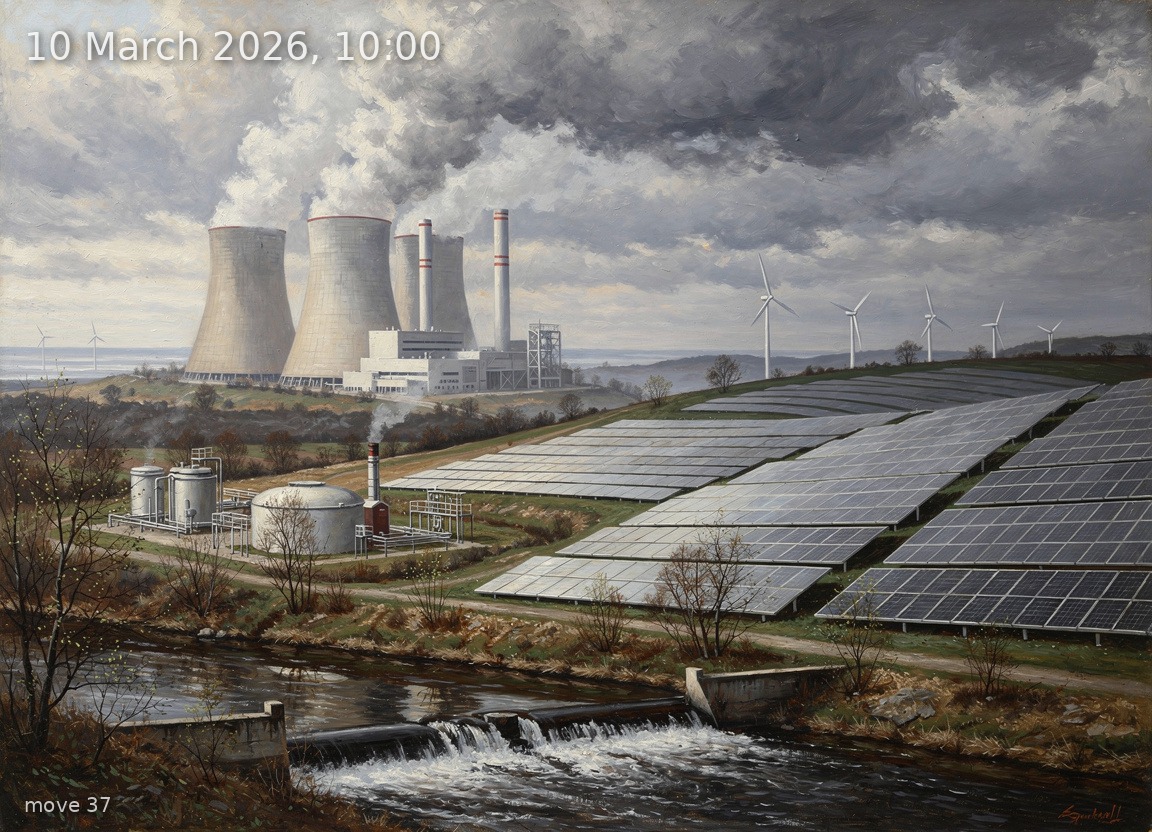
Solar leads at 33.4 GW under overcast skies; weak wind and 5.8 GW net imports drive prices to 118 EUR/MWh.
Back
Generation mix
Wind onshore 3%
Wind offshore 1%
Solar 58%
Biomass 7%
Hydro 3%
Natural gas 10%
Brown coal 18%
72%
Renewable share
1.9 GW
Wind (on + offshore)
33.4 GW
Solar
57.0 GW
Total generation
-5.8 GW
Net import
118.2 €/MWh
Day-ahead price
6.5°C / 3 km/h
Temp / Wind speed
Open-Meteo, Kassel (51.3°N 9.5°E)
86% / 105.8 W/m²
Cloud cover / Radiation
198
gCO₂/kWh
Image prompt
Solar 33.4 GW dominates the right two-thirds of the scene as endless rolling fields of aluminium-framed crystalline silicon PV panels stretching to the horizon, reflecting dim grey-white light; brown coal 10.2 GW occupies the left background as a cluster of massive hyperbolic cooling towers with thick white-grey steam plumes merging into the overcast sky; natural gas 6.0 GW appears centre-left as two modern CCGT plants with tall slender exhaust stacks emitting thin heat shimmer; biomass 4.0 GW is represented as a mid-ground industrial biogas facility with cylindrical digesters and a modest smokestack; wind onshore 1.6 GW appears as a small group of three-blade turbines on a distant ridge, blades completely still in the dead-calm air; wind offshore 0.3 GW is a barely visible pair of turbines on the far-left horizon line; hydro 1.5 GW appears as a concrete run-of-river weir with modest white water in the foreground stream. The sky is a heavy, oppressive 86% overcast — layered stratocumulus in leaden grey and slate tones suggesting an expensive, strained grid — with pale diffuse daylight at 10:00 AM filtering through without direct sun, casting flat shadowless illumination across a cool early-spring German landscape with bare deciduous trees just beginning to bud, patches of brown and pale green grass, temperature near 6.5°C suggested by frost remnants in shadowed hollows. Atmosphere feels tense and heavy. Rendered as a highly detailed oil painting in the tradition of 19th-century German Romantic landscape painters — Caspar David Friedrich meets industrial sublime — with rich impasto brushwork, atmospheric aerial perspective, meticulous engineering detail on every turbine nacelle, PV module frame, cooling tower hyperbolic curve, and CCGT stack. Deep tonal range from the dark foreground water to the pale milky sky. No text, no labels.