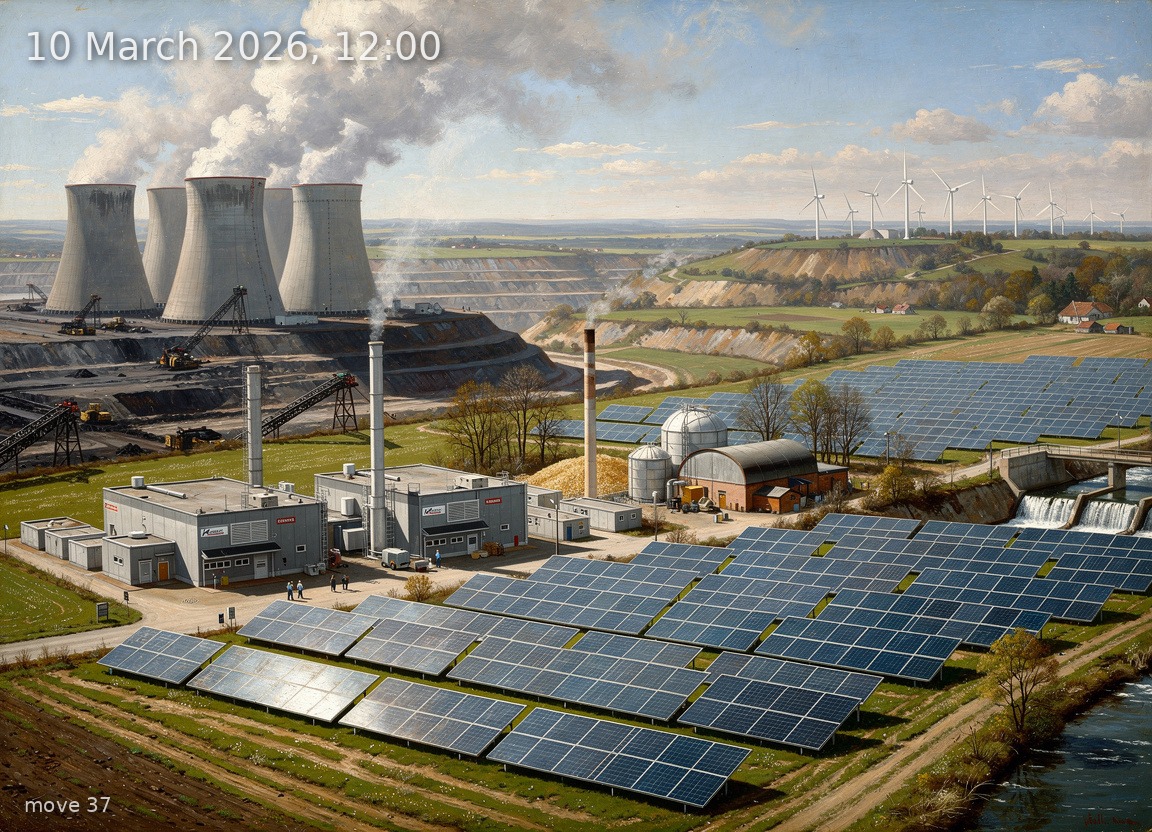
Solar at 38.6 GW dominates midday generation; brown coal and gas provide baseload as wind stays weak.
Back
Generation mix
Wind onshore 4%
Wind offshore 1%
Solar 63%
Biomass 6%
Hydro 2%
Natural gas 8%
Brown coal 16%
76%
Renewable share
2.6 GW
Wind (on + offshore)
38.6 GW
Solar
60.9 GW
Total generation
+0.6 GW
Net export
91.4 €/MWh
Day-ahead price
13.1°C / 10 km/h
Temp / Wind speed
Open-Meteo, Kassel (51.3°N 9.5°E)
29% / 376.0 W/m²
Cloud cover / Radiation
169
gCO₂/kWh
Image prompt
Solar 38.6 GW occupies the dominant right two-thirds of the scene as vast fields of aluminium-framed crystalline silicon PV panels stretching across gently rolling early-spring farmland, angled south, glinting brilliantly under strong midday sun. Brown coal 9.7 GW fills the left background as a cluster of massive hyperbolic cooling towers with thick white-grey steam plumes rising into the sky, flanked by lignite conveyor belts and open-pit mine terraces. Natural gas 4.7 GW appears in the centre-left as two compact CCGT power plants with slender exhaust stacks emitting thin heat shimmer. Biomass 3.9 GW is represented as a medium-sized wood-chip-fed CHP plant with a domed storage silo and a short smokestack, nestled among bare-branched trees at mid-ground. Wind onshore 2.2 GW shows as a small cluster of three-blade turbines on a distant ridge, rotors barely turning in the light breeze. Hydro 1.4 GW appears as a small concrete run-of-river dam with spillway in the far right middle ground along a modest river. Wind offshore 0.4 GW is faintly suggested as tiny turbines on a hazy horizon line. The sky is mostly clear with 29% cloud cover: a bright cobalt-blue dome with scattered white cumulus clouds, strong direct sunshine casting crisp shadows, the atmosphere carrying a faintly heavy, warm haze suggesting elevated electricity prices and industrial tension. Early spring vegetation: fields showing first green shoots, deciduous trees still mostly bare with swelling buds, temperature around 13°C conveyed through light jackets on tiny figures near the biomass plant. Full bright midday daylight consistent with noon in central Germany. Highly detailed oil painting in the tradition of 19th-century German Romantic landscape painters—rich saturated colour palette, visible confident brushwork, atmospheric aerial perspective with depth receding to distant horizons—but with meticulous technical accuracy in every turbine nacelle, PV cell pattern, cooling tower curvature, and CCGT stack geometry. The scene feels like a monumental masterwork painting of Germany's energy transition, epic in scale, luminous and layered. No text, no labels.