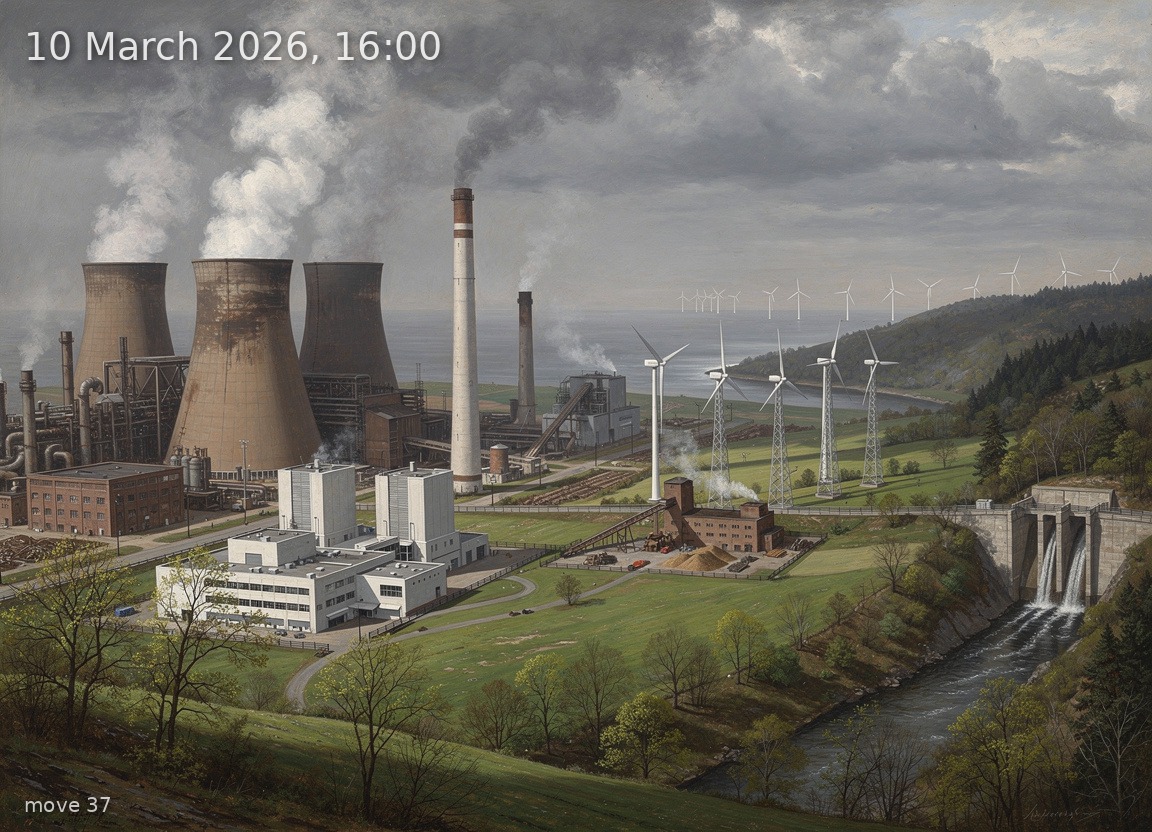
Brown coal and gas lead domestic generation while Germany imports ~26 GW under heavy overcast with zero solar output.
Back
Generation mix
Wind onshore 15%
Wind offshore 6%
Biomass 13%
Hydro 5%
Natural gas 24%
Brown coal 37%
38%
Renewable share
6.5 GW
Wind (on + offshore)
0.0 GW
Solar
31.4 GW
Total generation
-26.2 GW
Net import
144.4 €/MWh
Day-ahead price
17.6°C / 10 km/h
Temp / Wind speed
Open-Meteo, Kassel (51.3°N 9.5°E)
93% / 179.8 W/m²
Cloud cover / Radiation
424
gCO₂/kWh
Image prompt
Brown coal 11.7 GW dominates the left third of the scene as a massive lignite power station complex with four hyperbolic cooling towers belching thick white-grey steam plumes into the overcast sky; natural gas 7.6 GW fills the centre-left as two compact CCGT plants with tall single exhaust stacks emitting thin heat shimmer; wind onshore 4.7 GW appears in the centre-right as a cluster of moderate three-blade turbines on lattice towers turning slowly in light breeze across rolling green fields; wind offshore 1.7 GW is visible as a small row of distant turbines on the far horizon above a grey sea inlet; biomass 4.1 GW occupies the right-centre as a wood-chip-fired industrial plant with a squat stack and conveyor belts feeding fuel; hydro 1.5 GW appears as a small dam spillway nestled in a wooded hillside on the far right. The time is 4 PM in March — full daytime but under 93% heavy, oppressive grey cloud cover casting flat diffuse light with no shadows, the sky a uniform steel-grey wall pressing down on the landscape. No sunshine, no solar panels visible anywhere. The atmosphere feels heavy and stifling, reflecting the extreme 144 EUR/MWh price — the clouds seem to weigh on the earth. The temperature is warm for March at 17.6°C, so early spring green buds appear on deciduous trees and the grass is lush, with a faintly humid haze. High-voltage transmission lines with lattice pylons stretch prominently across the middle ground, cables running toward the horizon suggesting massive power imports. Highly detailed oil painting in the tradition of 19th-century German Romantic landscape painters — rich muted earth tones, visible textured brushwork, atmospheric depth and chiaroscuro despite the overcast — rendered with meticulous engineering accuracy on every turbine nacelle, cooling tower curvature, CCGT stack detail, and pylon insulator. The mood is brooding and industrial-sublime, a masterwork painting of a stressed energy landscape. No text, no labels.