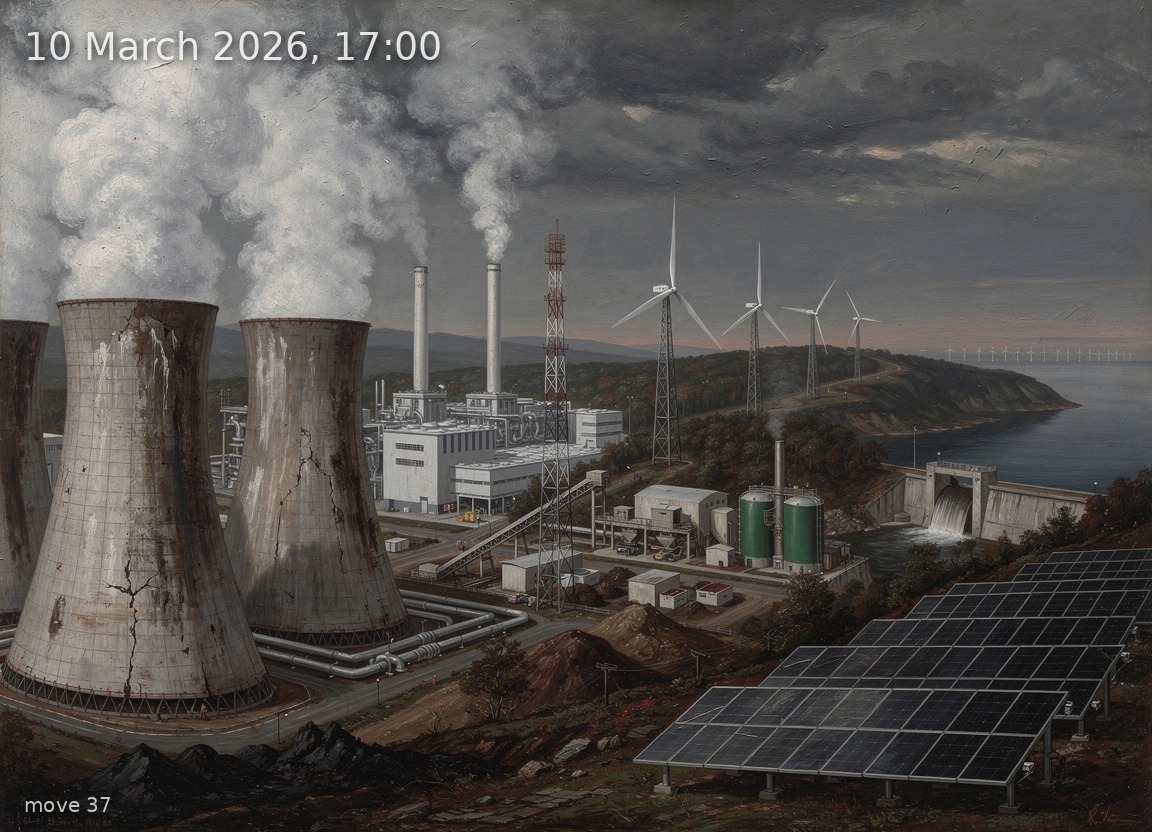
Brown coal and gas dominate domestic supply while 23 GW net imports bridge a massive generation shortfall under overcast skies.
Back
Generation mix
Wind onshore 15%
Wind offshore 3%
Solar 7%
Biomass 12%
Hydro 4%
Natural gas 26%
Brown coal 33%
41%
Renewable share
6.7 GW
Wind (on + offshore)
2.5 GW
Solar
37.2 GW
Total generation
-23.0 GW
Net import
179.0 €/MWh
Day-ahead price
15.4°C / 13 km/h
Temp / Wind speed
Open-Meteo, Kassel (51.3°N 9.5°E)
100% / 18.2 W/m²
Cloud cover / Radiation
398
gCO₂/kWh
Image prompt
Brown coal 12.2 GW dominates the left third of the scene as a cluster of massive hyperbolic cooling towers with thick white-grey steam plumes rising into the overcast sky, their concrete shells rendered in precise engineering detail with condensation streaks; natural gas 9.8 GW fills the center-left as a row of modern CCGT power stations with tall slender exhaust stacks emitting thin heat shimmer; wind onshore 5.5 GW appears as a mid-ground line of three-blade turbines on lattice and tubular towers, blades turning slowly in moderate wind; biomass 4.3 GW is depicted center-right as a wood-chip-fed industrial plant with green-tinged storage silos and a single stack with pale exhaust; solar 2.5 GW appears as a modest field of aluminium-framed crystalline silicon panels in the right foreground, their surfaces dull and reflectionless under the total overcast; wind offshore 1.3 GW is glimpsed as tiny distant turbines on a grey horizon sea line at far right; hydro 1.7 GW shows as a concrete dam with spillway in the right middle distance nestled against wooded hills. The sky is entirely overcast at 100% cloud cover, heavy and oppressive, with a narrow band of deep orange-red dusk glow along the very lowest horizon line as the sun sets behind thick clouds at 17:00 Berlin time — the upper sky transitions rapidly to dark slate grey. The atmosphere feels heavy and foreboding, reflecting the extreme 179 EUR/MWh price. Vegetation shows early spring — bare branches with the first pale green buds, brown grass turning green, temperature around 15°C. Transmission pylons with high-voltage lines stretch across the entire scene symbolizing the enormous import flows. Highly detailed oil painting in the tradition of 19th-century German Romantic landscape painters — rich, moody colour palette of ochres, slate greys, burnt sienna, and deep orange — visible impasto brushwork, atmospheric depth with industrial haze, meticulous technical accuracy on all energy infrastructure. The mood is Caspar David Friedrich meets industrial sublime. No text, no labels.