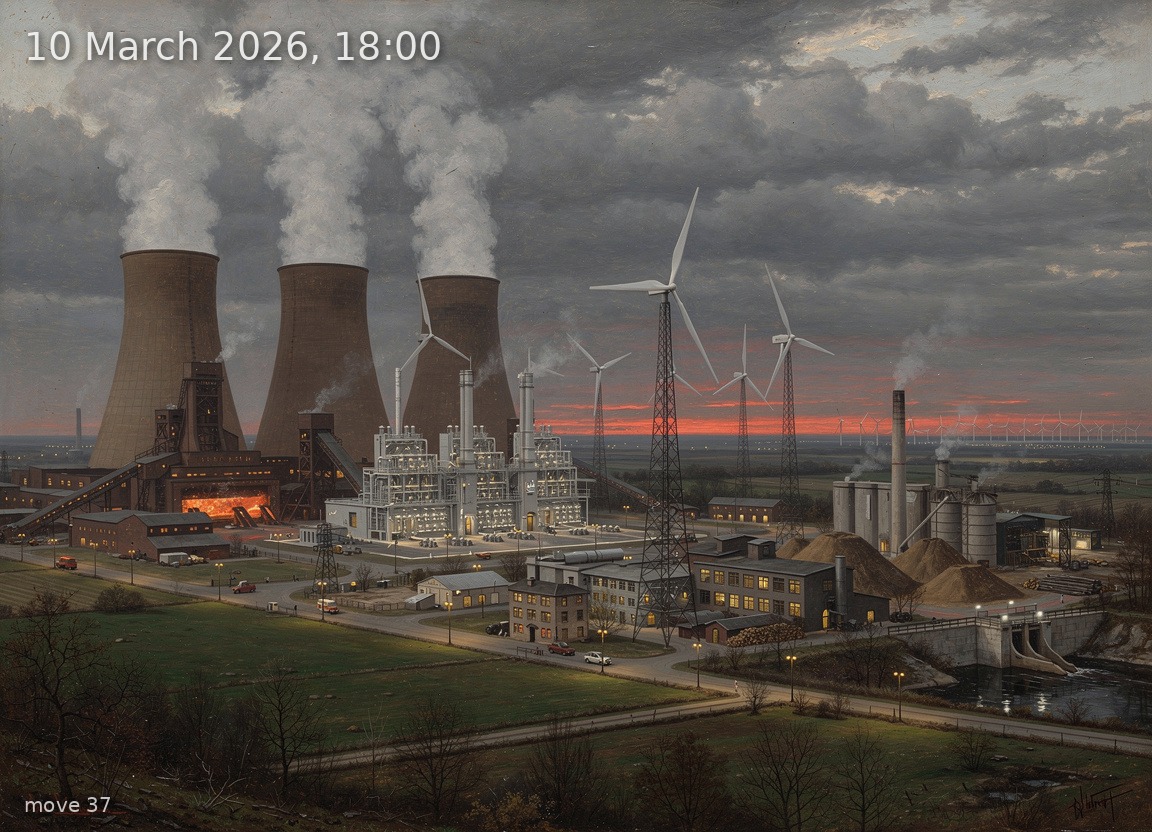
Brown coal and gas dominate a 36.2 GW supply facing 62.5 GW demand, requiring 26.3 GW net imports at extreme prices.
Back
Generation mix
Wind onshore 19%
Wind offshore 3%
Solar 0%
Biomass 12%
Hydro 4%
Natural gas 28%
Brown coal 34%
38%
Renewable share
7.9 GW
Wind (on + offshore)
0.0 GW
Solar
36.2 GW
Total generation
-26.3 GW
Net import
218.2 €/MWh
Day-ahead price
13.9°C / 3 km/h
Temp / Wind speed
Open-Meteo, Kassel (51.3°N 9.5°E)
100% / 0.0 W/m²
Cloud cover / Radiation
413
gCO₂/kWh
Image prompt
Brown coal 12.2 GW dominates the left third of the scene as a massive lignite complex with four hyperbolic cooling towers belching thick white steam into the overcast sky; natural gas 10.1 GW fills the center-left as a row of combined-cycle gas turbine plants with tall single exhaust stacks trailing heat shimmer and thin grey plumes; wind onshore 6.8 GW occupies the center-right as a scattered line of three-blade turbines on lattice towers, blades barely turning in the still air; biomass 4.4 GW appears as a cluster of smaller industrial buildings with wood-chip silos and modest chimneys emitting faint vapour; hydro 1.6 GW is represented by a small concrete dam and penstock visible in the far right background near a river; wind offshore 1.1 GW is suggested as tiny turbine silhouettes on the distant horizon. The time is 18:00 in early March—dusk with the last orange-red glow clinging to the very lowest horizon line, the rest of the sky a heavy uniform blanket of dark grey stratus clouds pressing down oppressively. No solar panels anywhere—no sun, no light from above. The landscape is flat German lowland with early spring grass just beginning to green, bare-branched trees. Sodium streetlights are flickering on along an access road. High-voltage transmission pylons march across the middle ground carrying thick bundled cables, visually emphasizing the massive import flows. The atmosphere is heavy, industrial, almost suffocating—conveying the extreme 218 EUR/MWh price through a brooding, oppressive weight in the air. Painted in the style of a highly detailed 19th-century German Romantic oil painting—rich impasto brushwork, dramatic chiaroscuro lighting from the furnace glows and the fading horizon, deep atmospheric perspective with industrial haze. Meticulous engineering accuracy on every turbine nacelle, cooling tower profile, and CCGT stack. No text, no labels.