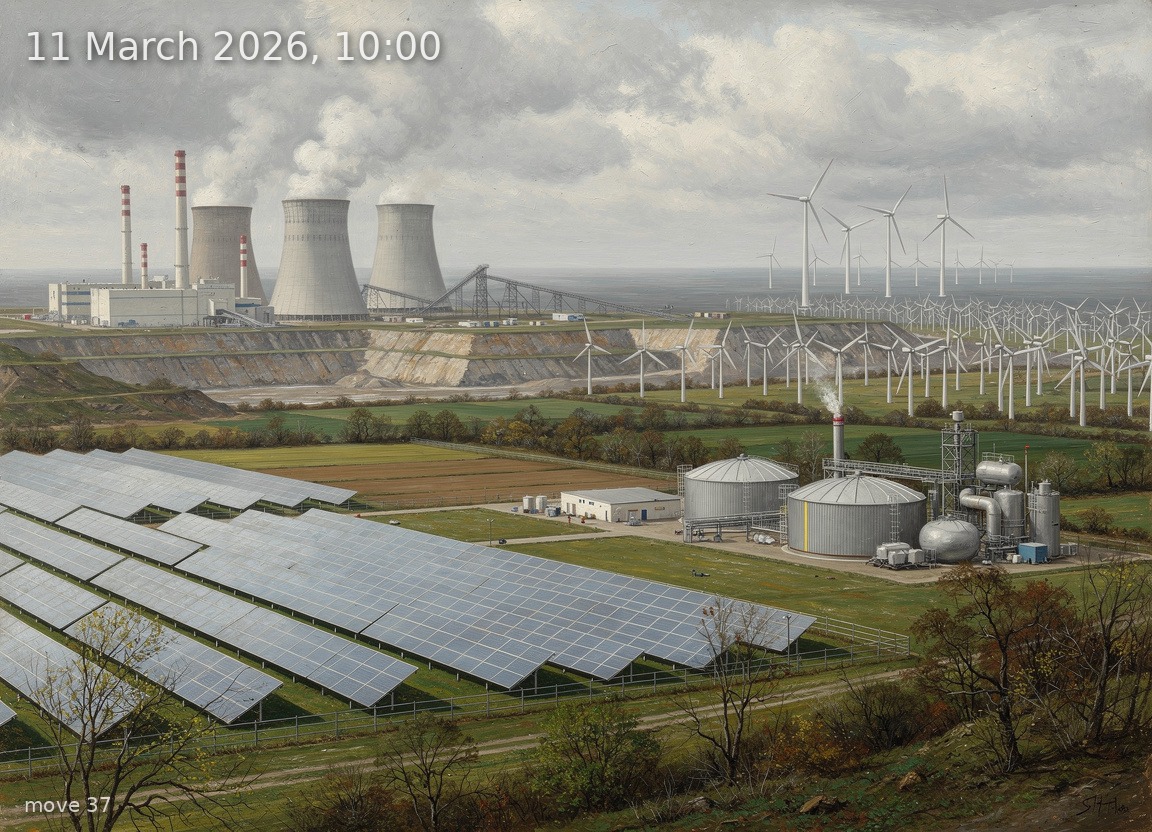
Wind (31.8 GW) and solar (23.8 GW) dominate under full overcast, enabling 6 GW net export at low prices.
Back
Generation mix
Wind onshore 34%
Wind offshore 10%
Solar 33%
Biomass 6%
Hydro 2%
Natural gas 4%
Hard coal 3%
Brown coal 9%
84%
Renewable share
31.8 GW
Wind (on + offshore)
23.8 GW
Solar
72.3 GW
Total generation
+6.0 GW
Net export
26.2 €/MWh
Day-ahead price
10.2°C / 14 km/h
Temp / Wind speed
Open-Meteo, Kassel (51.3°N 9.5°E)
100% / 19.0 W/m²
Cloud cover / Radiation
114
gCO₂/kWh
Image prompt
Wind onshore 24.8 GW dominates the right half and deep background as vast rolling fields crowded with hundreds of three-blade wind turbines on lattice and tubular towers, rotors spinning visibly in moderate wind; wind offshore 7.0 GW appears as a distant cluster of tall offshore turbines rising from a grey North Sea horizon at upper right; solar 23.8 GW fills the centre-left foreground as enormous arrays of aluminium-framed crystalline silicon PV panels stretching across flat agricultural fields, their glass surfaces reflecting the pale diffuse light of a completely overcast sky; brown coal 6.2 GW occupies the left background as a massive lignite power station with three hyperbolic cooling towers emitting thick white steam plumes into the grey air, alongside conveyor belts and open-pit mine terraces; biomass 4.1 GW appears as a mid-ground industrial biogas facility with cylindrical digesters and a modest smokestack; natural gas 2.9 GW is rendered as a compact CCGT plant with a single tall exhaust stack and sleek turbine hall near centre-left; hard coal 2.3 GW sits as a smaller coal plant with a rectangular boiler house and single cooling tower beside a coal stockpile at far left; hydro 1.2 GW is a modest run-of-river weir with a small powerhouse visible along a river cutting through the centre foreground. Time is 10:00 AM in March — full daylight but entirely diffuse, no shadows, no sun disc visible, the sky a uniform blanket of pale grey stratocumulus from horizon to zenith, temperature mild at 10°C with early spring green beginning to emerge on bare deciduous trees and grass. The atmosphere is calm and unhurried, reflecting a low electricity price. Style: highly detailed oil painting in the tradition of 19th-century German Romantic landscape painters — Caspar David Friedrich meets industrial modernity — rich muted earth tones, visible impasto brushwork, atmospheric depth with hazy distances, meticulous engineering detail on every turbine nacelle, PV module frame, cooling tower shell, and smokestack. No text, no labels, no human figures dominant.