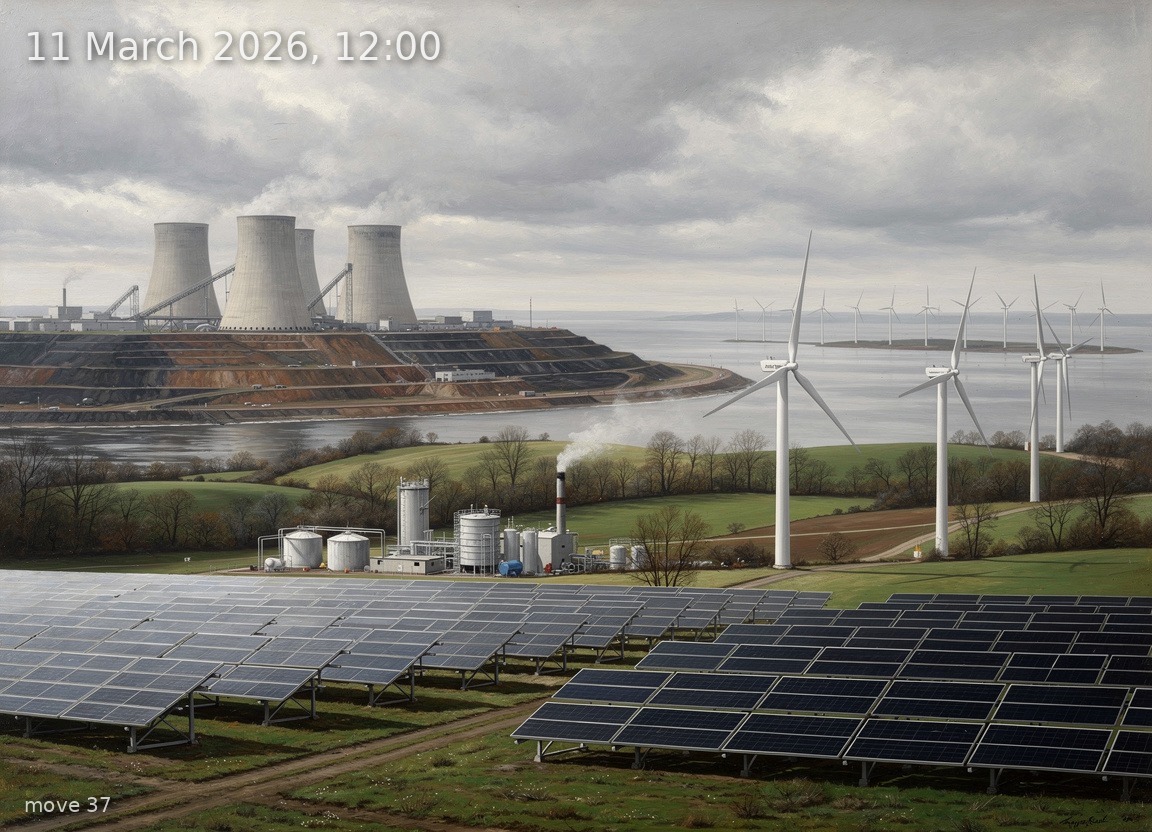
Wind (34.3 GW) and diffuse solar (24.6 GW) dominate under full overcast, driving 9 GW net exports and near-zero prices.
Back
Generation mix
Wind onshore 37%
Wind offshore 8%
Solar 33%
Biomass 5%
Hydro 2%
Natural gas 4%
Hard coal 3%
Brown coal 8%
85%
Renewable share
34.3 GW
Wind (on + offshore)
24.6 GW
Solar
75.8 GW
Total generation
+9.0 GW
Net export
9.9 €/MWh
Day-ahead price
12.1°C / 16 km/h
Temp / Wind speed
Open-Meteo, Kassel (51.3°N 9.5°E)
100% / 13.0 W/m²
Cloud cover / Radiation
110
gCO₂/kWh
Image prompt
Wind onshore 28.4 GW dominates the right two-thirds of the scene as vast ranks of three-blade turbines with white tubular towers and nacelles stretching across rolling green March farmland, their rotors spinning vigorously in moderate wind; wind offshore 5.9 GW appears as a distant line of larger turbines on the far-right horizon above a grey sea inlet; solar 24.6 GW fills the centre-left foreground as enormous fields of aluminium-framed crystalline silicon PV panels angled on metal racks across flat agricultural land, their surfaces reflecting the pale grey-white diffuse light of a completely overcast sky; brown coal 6.0 GW occupies the left background as a cluster of massive hyperbolic cooling towers with thin steam plumes drifting in the wind, adjacent to a lignite open-pit mine with terraced earth; biomass 4.0 GW appears as a mid-ground industrial facility with cylindrical digesters and a modest smokestack with faint exhaust; natural gas 3.0 GW is rendered as a compact CCGT power plant with a single tall exhaust stack and small vapour plume, positioned between the coal complex and biomass plant; hard coal 2.6 GW shows as a smaller conventional power station with a rectangular boiler house and chimney near the coal complex; hydro 1.3 GW is a small run-of-river weir and powerhouse visible along a river cutting through the mid-ground. The sky is a uniform blanket of heavy stratiform cloud from horizon to horizon — no blue sky, no direct sun, but full bright midday diffuse daylight typical of noon in March — the light is flat, cool, and shadowless. The landscape is early spring: fresh pale-green grass beginning to emerge, bare deciduous trees with first tiny buds, patches of brown earth. The atmosphere is calm and open despite the clouds, evoking a low-price tranquil energy abundance. Highly detailed oil painting in the tradition of 19th-century German Romantic landscape painters — Caspar David Friedrich meets industrial modernity — rich colour palette of greys, sage greens, and muted earth tones, visible confident brushwork, atmospheric depth with misty horizons, meticulous engineering detail on every turbine nacelle, PV panel frame, and cooling tower. No text, no labels.