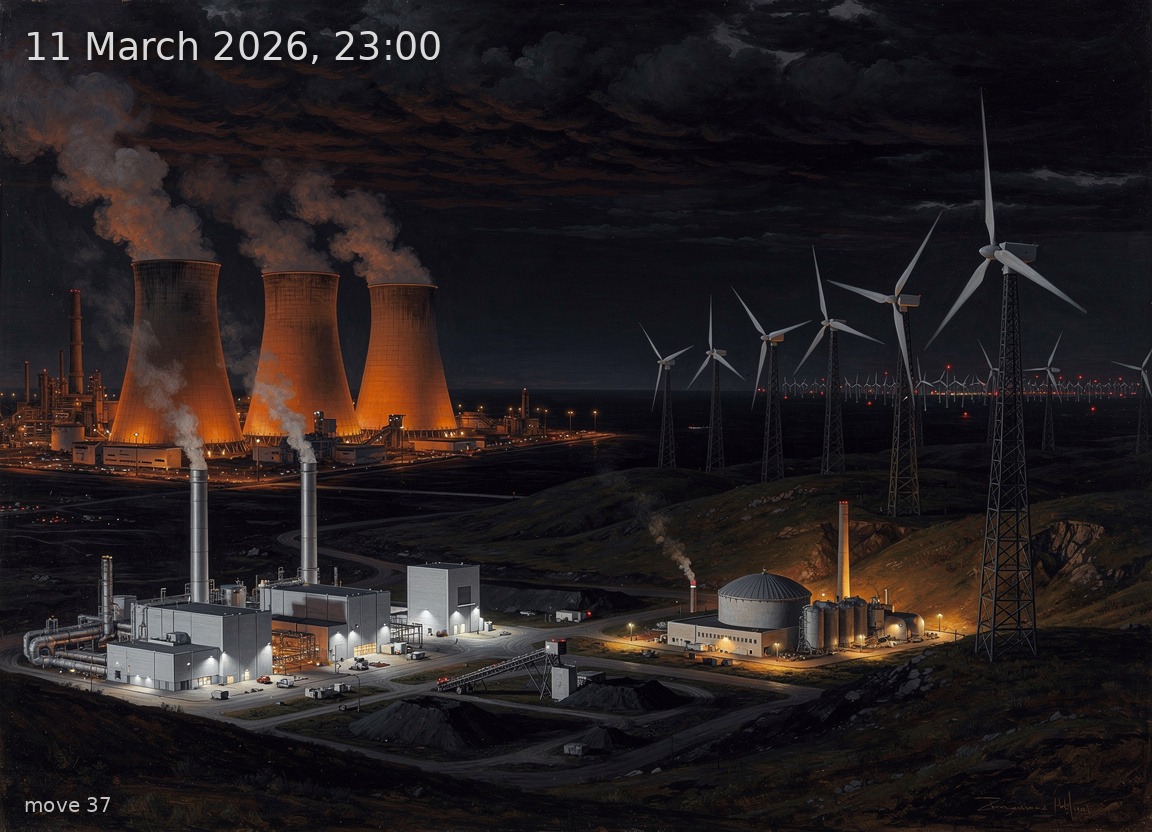
Strong wind and brown coal anchor late-night generation, but 3.8 GW net imports are needed to meet 49.8 GW demand.
Back
Generation mix
Wind onshore 39%
Wind offshore 12%
Biomass 9%
Hydro 2%
Natural gas 11%
Hard coal 5%
Brown coal 21%
62%
Renewable share
23.6 GW
Wind (on + offshore)
0.0 GW
Solar
46.0 GW
Total generation
-3.8 GW
Net import
104.0 €/MWh
Day-ahead price
6.5°C / 11 km/h
Temp / Wind speed
Open-Meteo, Kassel (51.3°N 9.5°E)
100% / 0.0 W/m²
Cloud cover / Radiation
268
gCO₂/kWh
Image prompt
Wind onshore 17.9 GW dominates the right half of the scene as dozens of towering three-blade turbines with white nacelles and lattice towers stretching across dark rolling hills, rotors spinning visibly in moderate wind; wind offshore 5.6 GW appears in the far right background as a cluster of turbines standing in a barely visible dark sea on the horizon with red aviation warning lights blinking; brown coal 9.8 GW occupies the left third as a massive lignite power station with four hyperbolic cooling towers emitting thick steam plumes lit from below by sodium-orange industrial lighting; natural gas 5.1 GW fills the centre-left as two compact CCGT units with tall single exhaust stacks releasing thin white plumes, illuminated by harsh white floodlights; hard coal 2.4 GW appears as a smaller coal plant with a single square cooling tower and coal conveyor belt behind the gas units; biomass 4.1 GW is rendered as a mid-sized industrial facility with a wood-chip storage dome and modest chimney with a warm amber glow, positioned centre-right between the gas plant and the wind farm; hydro 1.1 GW is a small concrete dam with a penstock visible in the lower foreground, water faintly reflecting industrial lights. The sky is completely black and starless, thick 100% cloud cover rendering it an oppressive dark ceiling with no moon, no twilight, no sky glow whatsoever — only artificial light sources illuminate the scene. The atmosphere feels heavy and costly, an almost suffocating industrial weight pressing down. Early spring vegetation is sparse, bare branches on scattered trees, dormant brown-green grass at 6.5°C. Sodium-orange and cool-white industrial floodlights create dramatic contrasts across the landscape. Transmission lines with high-voltage pylons cross the middle ground, symbolizing interconnector imports. Highly detailed oil painting in the tradition of 19th-century German Romantic landscape painters — rich colour palette of deep navy-blacks, warm industrial oranges, and cold steel greys — visible confident brushwork, atmospheric depth and chiaroscuro, meticulous engineering accuracy on every turbine nacelle, cooling tower, and exhaust stack. The scene feels like a monumental nocturnal industrial masterwork. No text, no labels.