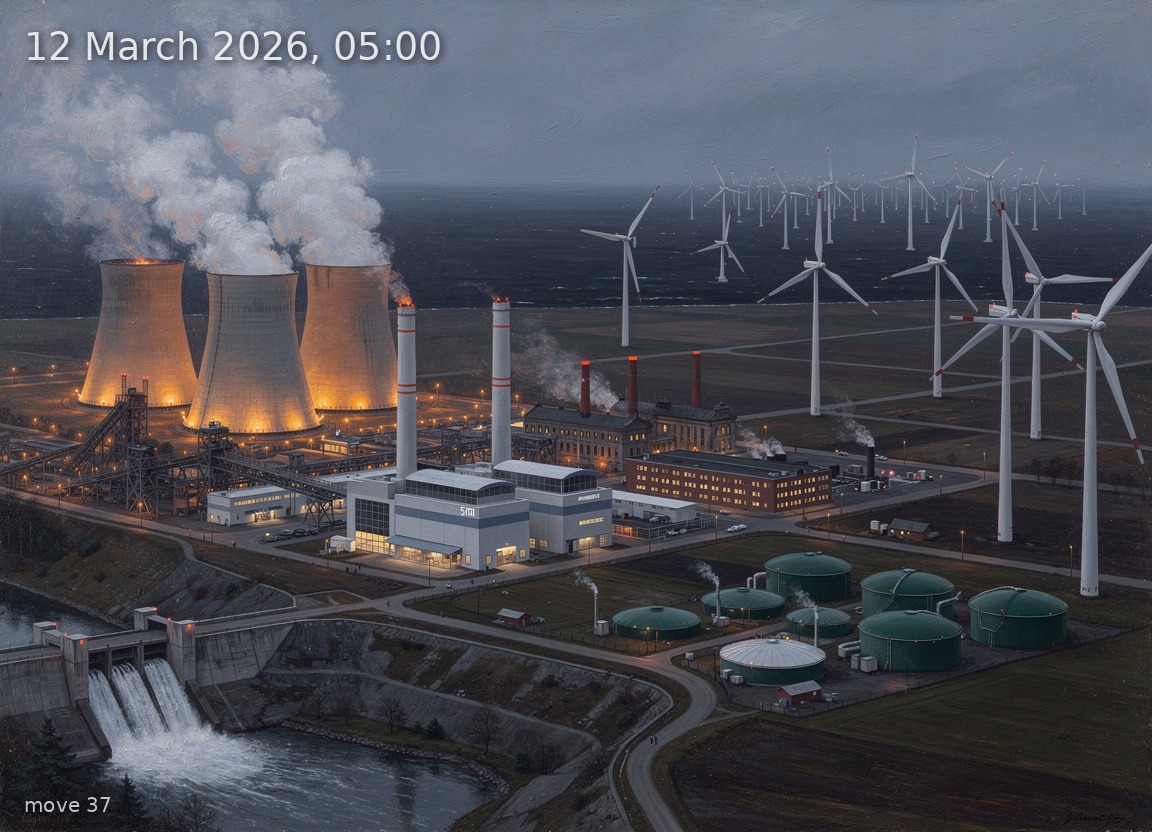
Wind (22.4 GW) and brown coal (7.4 GW) lead pre-dawn generation; 5.6 GW net imports cover high heating demand at near-€100/MWh.
Back
Generation mix
Wind onshore 36%
Wind offshore 16%
Biomass 9%
Hydro 3%
Natural gas 13%
Hard coal 6%
Brown coal 17%
64%
Renewable share
22.4 GW
Wind (on + offshore)
0.0 GW
Solar
43.2 GW
Total generation
-5.6 GW
Net import
99.8 €/MWh
Day-ahead price
3.0°C / 2 km/h
Temp / Wind speed
Open-Meteo, Kassel (51.3°N 9.5°E)
0% / 0.0 W/m²
Cloud cover / Radiation
250
gCO₂/kWh
Image prompt
Wind onshore 15.4 GW dominates the right half of the composition as dozens of towering three-blade turbines with white tubular towers and nacelles stretching across a dark northern German plain, their red aviation warning lights blinking; wind offshore 7.0 GW appears as a distant cluster of larger offshore turbines visible on a far horizon line over a black North Sea; brown coal 7.4 GW occupies the left quarter as massive hyperbolic cooling towers emitting thick white steam plumes lit from below by amber industrial sodium lamps, with conveyor belts feeding lignite into a sprawling Lausitz-style power station; natural gas 5.5 GW sits centre-left as two compact CCGT plants with tall single exhaust stacks trailing thin heat shimmer; hard coal 2.7 GW appears as a smaller classical power station with rectangular chimney stacks glowing faintly; biomass 4.0 GW is rendered as a mid-ground cluster of squat agricultural biogas facilities with round green digesters and small flue pipes; hydro 1.2 GW is a modest dam structure with water spilling, nestled in a valley on the far left. TIME AND ATMOSPHERE: 05:00 pre-dawn in early March — the sky is deep blue-grey with the faintest pale band on the eastern horizon hinting at coming dawn, but no direct sunlight; stars still faintly visible overhead. The air is bitterly cold at 3°C, with frost on bare branches and dormant brown grass; no leaves on trees. The overall atmosphere is heavy and oppressive — low haze, industrial steam mingling with cold air, a sense of expensive, strained power generation. No solar panels anywhere. Sodium-orange artificial lighting illuminates the industrial facilities and a small nearby village with lit windows. Overhead high-voltage transmission lines with lattice pylons cross the scene, suggesting the imports flowing in. STYLE: highly detailed oil painting in the tradition of Caspar David Friedrich and Carl Blechen — rich chiaroscuro, deep atmospheric depth, visible impasto brushwork, dramatic Romantic sensibility applied to an industrial energy landscape. Meticulous engineering detail on every turbine nacelle, cooling tower, and exhaust stack. No text, no labels.