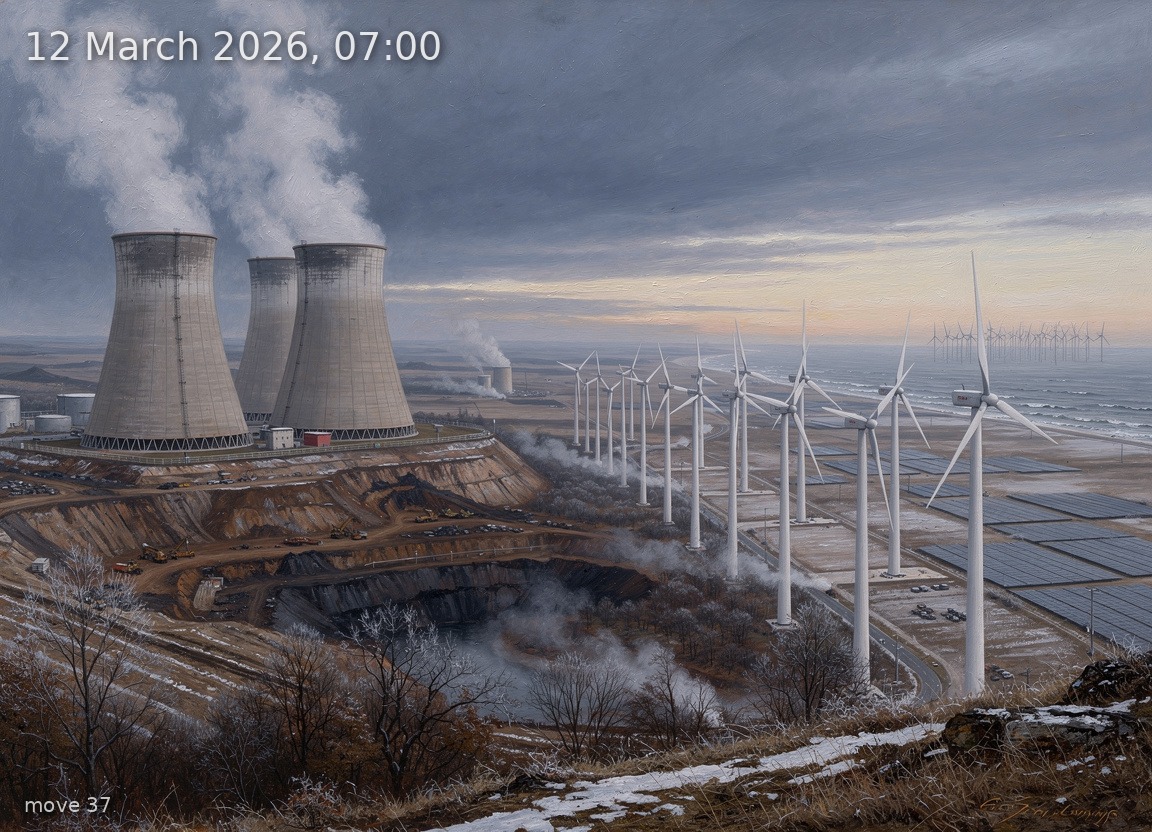
Wind leads at 22.2 GW but 13.3 GW net imports needed as cold morning demand hits 62.7 GW.
Back
Generation mix
Wind onshore 31%
Wind offshore 14%
Solar 7%
Biomass 9%
Hydro 3%
Natural gas 14%
Hard coal 7%
Brown coal 16%
63%
Renewable share
22.2 GW
Wind (on + offshore)
3.6 GW
Solar
49.4 GW
Total generation
-13.2 GW
Net import
137.1 €/MWh
Day-ahead price
2.3°C / 3 km/h
Temp / Wind speed
Open-Meteo, Kassel (51.3°N 9.5°E)
33% / 0.2 W/m²
Cloud cover / Radiation
250
gCO₂/kWh
Image prompt
Wind onshore 15.4 GW dominates the right half of the canvas as dozens of tall three-blade turbines with white tubular towers receding across a flat northern plain; wind offshore 6.8 GW appears as a distant cluster of turbines on the far-right horizon above a grey sea; brown coal 7.9 GW occupies the left quarter as three massive hyperbolic cooling towers with thick white-grey steam plumes rising into the sky, adjacent open-pit mine visible; natural gas 6.9 GW fills the centre-left as two compact CCGT power stations with tall slender exhaust stacks emitting thin heat shimmer; hard coal 3.3 GW sits behind the gas plants as a single smaller stack with darker smoke; biomass 4.3 GW appears as a medium-sized industrial plant with a wood-chip storage dome and moderate steam; solar 3.6 GW is shown as a small array of aluminium-framed crystalline silicon panels in the centre foreground, catching no direct light, panels dull and dark; hydro 1.3 GW is a modest dam structure with flowing water in the far centre-right valley. Time of day is 07:00 dawn in early March: the sky is deep blue-grey with the faintest pale pre-dawn glow low on the eastern horizon, no direct sunlight, no warm tones — only cold steel-blue light. Temperature 2.3 °C: frost coats the brown dormant grass and bare deciduous trees, patches of old snow in furrows, breath-like mist near the ground. Cloud cover 33%: scattered clouds in the upper sky allow glimpses of fading stars. The atmosphere feels heavy and oppressive reflecting the 137 EUR/MWh price — a brooding, tense quality to the air, industrial haze mixing with steam plumes. Transmission lines with lattice pylons stretch across the scene carrying imported power. Highly detailed oil painting in the tradition of 19th-century German Romantic landscape painters — Caspar David Friedrich's sense of sublime scale and melancholy, rich layered colour, visible impasto brushwork, atmospheric depth and aerial perspective — combined with meticulous engineering accuracy in every turbine nacelle, cooling tower curvature, and panel frame. No text, no labels.