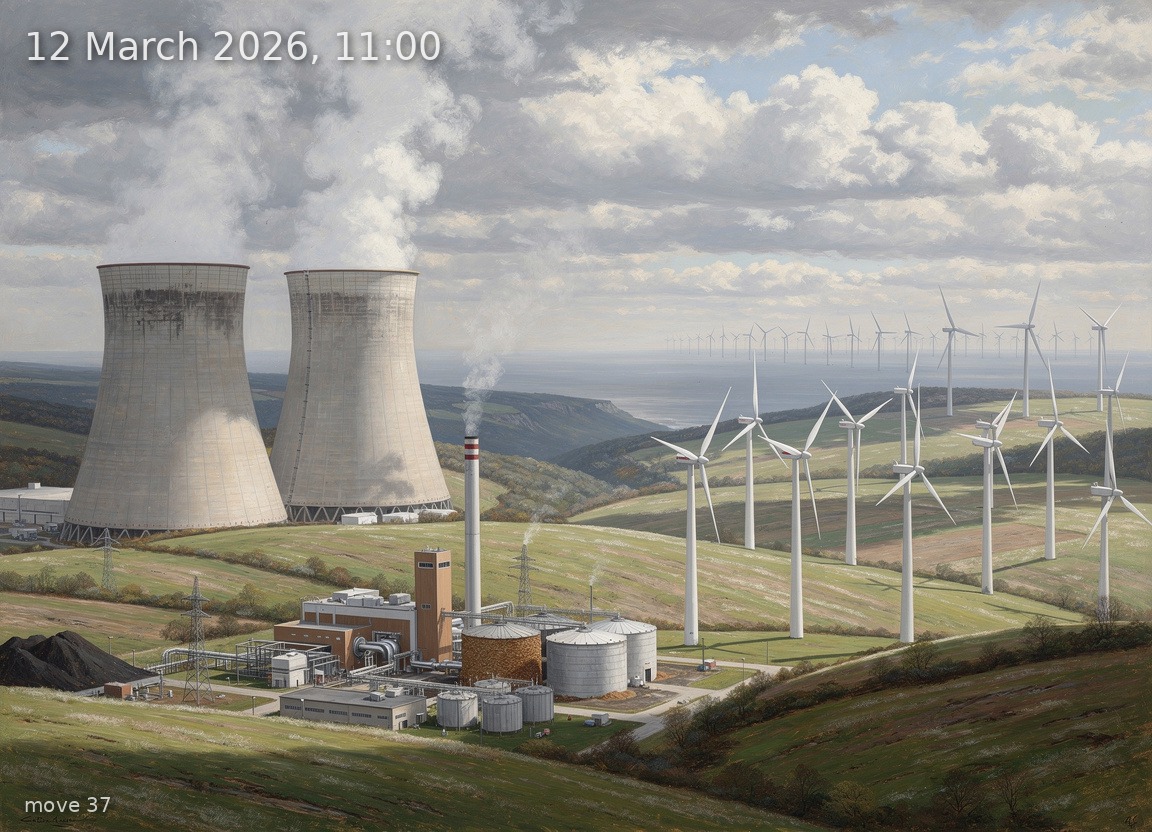
Wind dominates at 21.1 GW while Germany net imports 30.5 GW at near-zero prices on a breezy March morning.
Back
Generation mix
Wind onshore 43%
Wind offshore 17%
Biomass 11%
Hydro 3%
Natural gas 9%
Hard coal 5%
Brown coal 11%
75%
Renewable share
21.2 GW
Wind (on + offshore)
0.0 GW
Solar
35.1 GW
Total generation
-30.5 GW
Net import
0.3 €/MWh
Day-ahead price
8.8°C / 12 km/h
Temp / Wind speed
Open-Meteo, Kassel (51.3°N 9.5°E)
52% / 289.5 W/m²
Cloud cover / Radiation
169
gCO₂/kWh
Records
#2
Import Peak
Image prompt
Wind onshore 15.2 GW dominates the right two-thirds of the scene as vast ranks of three-blade turbines with white tubular towers and nacelles stretching across rolling early-spring hills with pale green budding grass; wind offshore 5.9 GW appears as a distant horizon line of turbines standing in a grey North Sea visible through a valley gap at far right; brown coal 3.8 GW occupies the left foreground as two massive hyperbolic concrete cooling towers with heavy white steam plumes rising vertically; biomass 4.0 GW appears as a mid-sized industrial plant with a tall rectangular stack and woodchip storage silos just behind the cooling towers; natural gas 3.3 GW is rendered as a compact CCGT facility with a single slender exhaust stack and modest heat shimmer, placed left of centre; hard coal 1.6 GW is a smaller coal plant with a single squat cooling tower and coal conveyor visible at far left edge; hydro 1.2 GW appears as a small dam and powerhouse nestled in a wooded ravine at left. The time is 11:00 AM in early March: full diffuse daylight under a sky that is roughly half covered with broken cumulus clouds, allowing patches of pale spring sunlight to fall across the landscape in shifting pools of brightness. No solar panels anywhere — zero solar generation. The atmosphere feels calm and open, almost weightless, reflecting the near-zero electricity price. Bare-branched oaks and birches with the faintest haze of green buds line field edges; temperature around 9°C gives a cool crispness with faint ground mist in valleys. Overhead, high-voltage transmission lines on lattice pylons run prominently through the centre of the composition, emphasising the massive 30.5 GW of cross-border imports flowing into Germany. Style: highly detailed oil painting in the tradition of 19th-century German Romantic landscape painters such as Caspar David Friedrich and Carl Blechen — rich layered colour, visible confident brushwork, atmospheric aerial perspective with depth receding to misty blue horizons — but with meticulous engineering accuracy on every turbine nacelle, cooling tower concrete texture, and power line insulator. The painting feels monumental, luminous, and quietly awe-inspiring. No text, no labels.