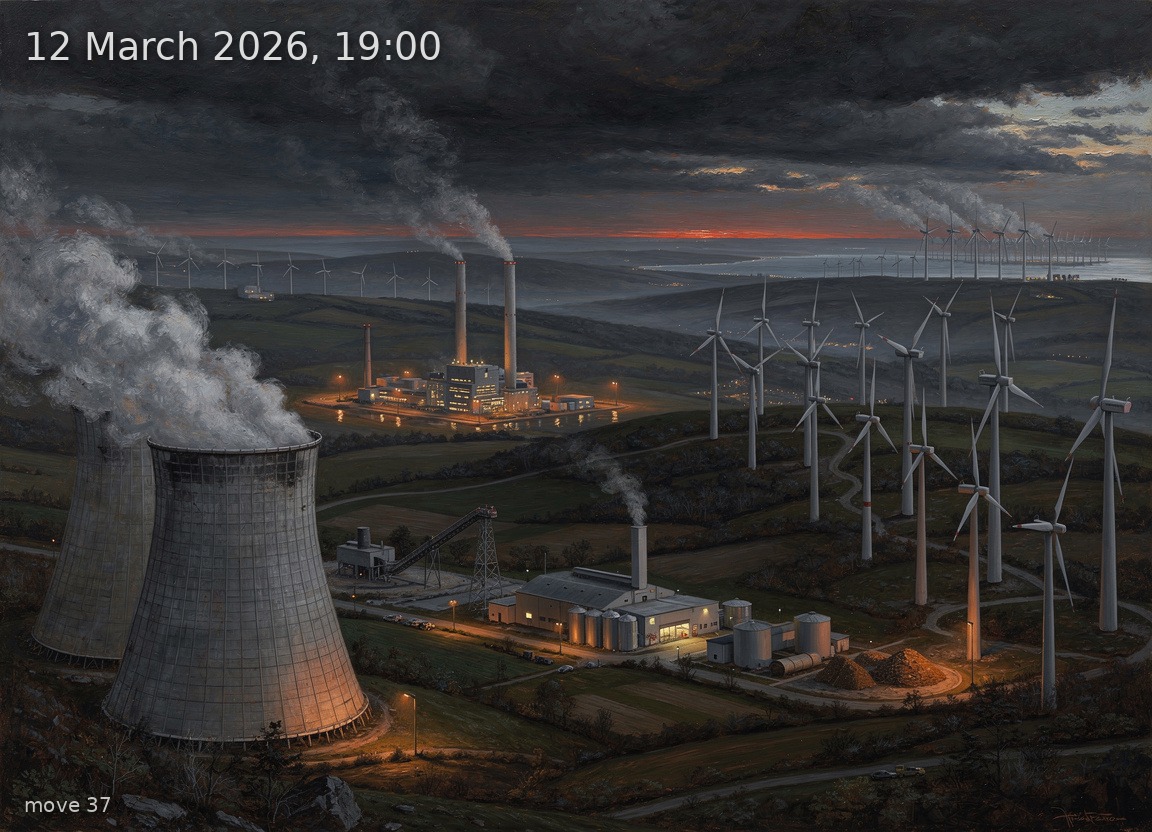
Strong wind (34.4 GW) leads generation but 9.9 GW net imports needed as evening demand peaks under overcast skies.
Back
Generation mix
Wind onshore 55%
Wind offshore 9%
Biomass 8%
Hydro 2%
Natural gas 12%
Hard coal 4%
Brown coal 9%
74%
Renewable share
34.4 GW
Wind (on + offshore)
0.0 GW
Solar
54.0 GW
Total generation
-9.9 GW
Net import
106.0 €/MWh
Day-ahead price
9.3°C / 15 km/h
Temp / Wind speed
Open-Meteo, Kassel (51.3°N 9.5°E)
100% / 0.0 W/m²
Cloud cover / Radiation
167
gCO₂/kWh
Image prompt
Wind onshore 29.4 GW dominates the right two-thirds of the scene as vast rows of three-blade turbines on rolling central German hills, their rotors spinning briskly in moderate wind; wind offshore 5.0 GW appears as a distant cluster of larger turbines on the far-right horizon above a faintly visible coastline. Natural gas 6.6 GW fills the centre-left as a compact CCGT power station with tall single exhaust stacks venting thin plumes, lit by sodium-orange industrial floodlights. Brown coal 4.9 GW occupies the left foreground as two massive hyperbolic cooling towers billowing thick white-grey steam that merges into the heavy overcast above. Hard coal 2.3 GW appears as a smaller coal plant with a single stack and conveyor belt just behind the brown coal towers. Biomass 4.4 GW is rendered as a mid-ground wood-chip-fed CHP facility with a modest rectangular stack emitting gentle vapour. Hydro 1.3 GW is a small run-of-river weir with illuminated sluice gates visible at the lower-left edge near a dark river. TIME: 19:00 dusk in March — the sky is nearly dark, with only the faintest dying orange-red glow clinging to the very lowest sliver of the western horizon; the rest of the sky is deep charcoal-grey to black, completely overcast with heavy low clouds pressing down oppressively, reflecting an amber-sodium tint from industrial lights below. No stars visible. Temperature around 9°C: early spring landscape with sparse bare-branched trees and patches of new green grass, damp ground. The atmosphere is heavy and brooding, conveying expensive electricity — a thick, pressurized industrial mood. High-voltage transmission pylons recede into the murky distance, their cables disappearing into cloud, symbolizing cross-border power flows. Style: highly detailed oil painting in the tradition of 19th-century German Romantic landscape painters such as Caspar David Friedrich and Carl Blechen — rich impasto brushwork, dramatic chiaroscuro between the glowing industrial facilities and the encompassing darkness, atmospheric depth with mist and steam layering, meticulous engineering detail on every turbine nacelle, cooling tower ribbing, and CCGT stack. The scene feels monumental and sublime, an industrial nocturne rendered as a masterwork painting. No text, no labels.