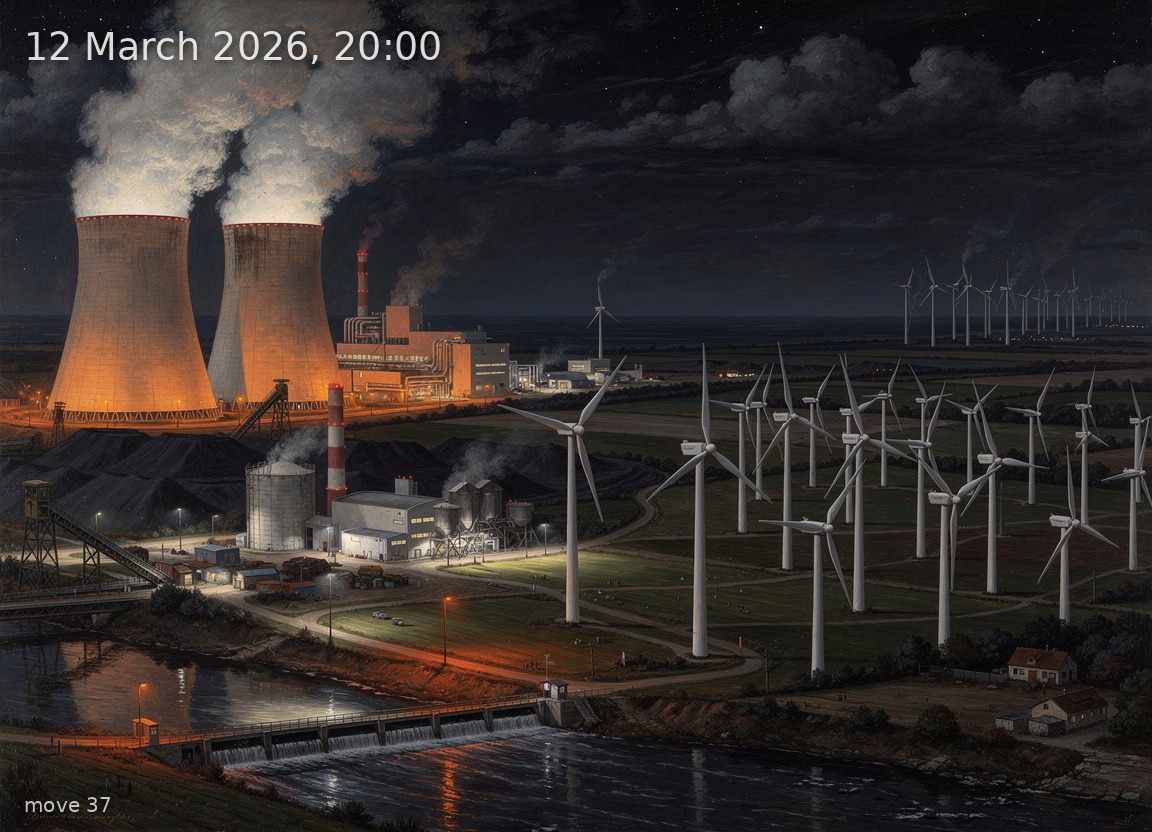
Strong onshore wind dominates evening generation, but 4.2 GW net imports cover the gap as solar is absent.
Back
Generation mix
Wind onshore 58%
Wind offshore 10%
Biomass 8%
Hydro 2%
Natural gas 11%
Hard coal 3%
Brown coal 8%
78%
Renewable share
38.7 GW
Wind (on + offshore)
0.0 GW
Solar
56.7 GW
Total generation
-4.2 GW
Net import
86.6 €/MWh
Day-ahead price
8.3°C / 12 km/h
Temp / Wind speed
Open-Meteo, Kassel (51.3°N 9.5°E)
59% / 0.0 W/m²
Cloud cover / Radiation
143
gCO₂/kWh
Image prompt
Wind onshore 33.1 GW dominates the scene, filling roughly 58% of the composition as vast ranks of three-blade turbines with white tubular towers and detailed nacelles stretching across rolling central German farmland from the centre to the far right, their rotors spinning visibly in moderate wind. Wind offshore 5.6 GW appears in the distant right background as a cluster of larger turbines rising from a dark horizon line suggesting the North Sea. Natural gas 6.0 GW occupies the centre-left as a compact combined-cycle gas turbine plant with twin exhaust stacks emitting thin heat shimmer, lit by sodium-orange industrial floodlights. Brown coal 4.6 GW fills the left foreground as two massive hyperbolic cooling towers with billowing white steam plumes glowing faintly from below, accompanied by conveyor belts and lignite stockpiles. Hard coal 1.9 GW appears as a smaller coal-fired station beside the brown coal plant, with a single tall chimney and red aviation warning lights. Biomass 4.3 GW is rendered as a wood-chip-fed power station with a cylindrical silo and modest smokestack in the mid-left, warmly lit. Hydro 1.2 GW is a small run-of-river weir in the lower foreground with water gleaming under artificial light. Time is 20:00 in March — fully dark, deep navy-black sky with no twilight or sky glow whatsoever, only stars partly obscured by 59% broken cloud cover. All illumination comes from sodium streetlights casting orange pools, industrial facility floodlights, glowing control-room windows, and red blinking tower lights. The atmosphere feels heavy and oppressive, reflecting the high electricity price — low brooding clouds press down, the air thick with moisture at 8.3°C, early spring bare-branched trees with just the faintest green buds visible in lamplight. Painted in the style of a highly detailed 19th-century German Romantic oil painting — rich impasto brushwork, deep chiaroscuro contrasts, atmospheric depth with haze and steam, meticulous engineering accuracy on every turbine blade, cooling tower curve, and exhaust stack, evoking Caspar David Friedrich meeting industrial sublime. No text, no labels.