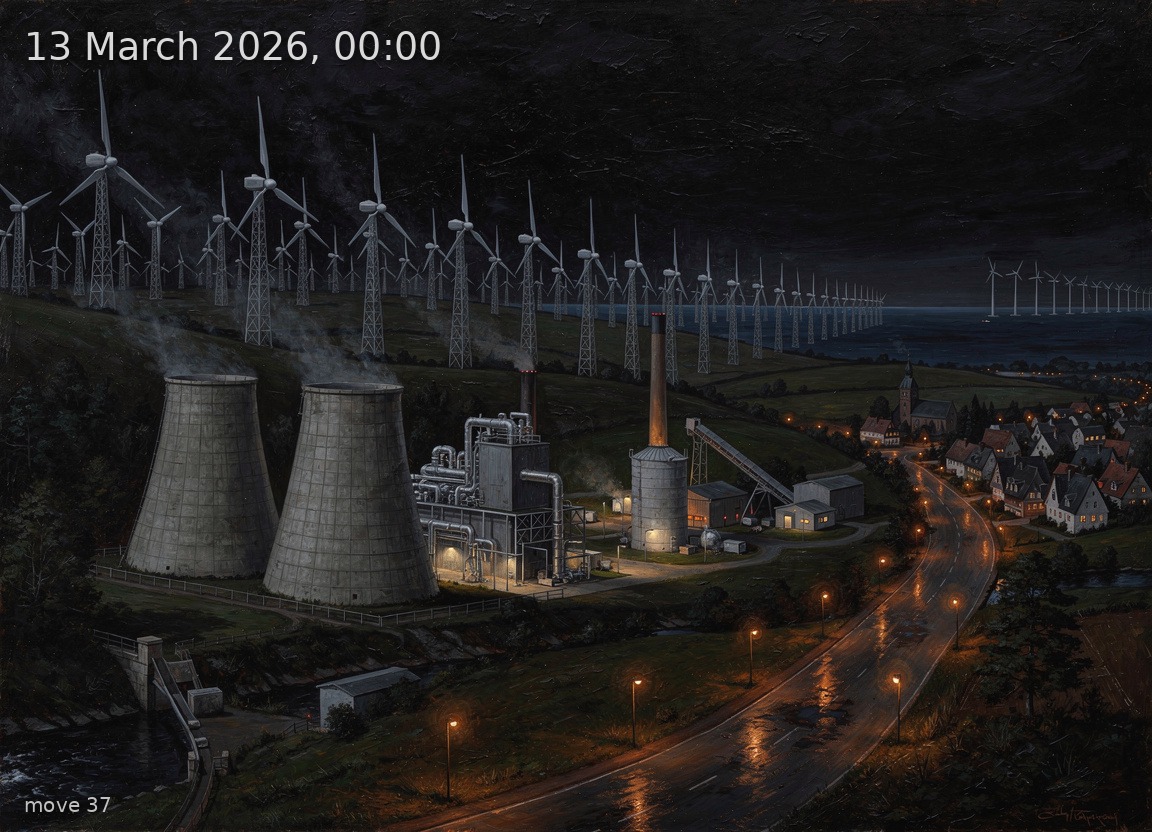
Massive onshore and offshore wind generation dominates midnight Germany, driving net exports and near-zero electricity prices.
Back
Generation mix
Wind onshore 62%
Wind offshore 12%
Biomass 7%
Hydro 2%
Natural gas 6%
Hard coal 3%
Brown coal 6%
84%
Renewable share
40.0 GW
Wind (on + offshore)
0.0 GW
Solar
53.5 GW
Total generation
+3.5 GW
Net export
6.3 €/MWh
Day-ahead price
6.1°C / 9 km/h
Temp / Wind speed
Open-Meteo, Kassel (51.3°N 9.5°E)
100% / 0.0 W/m²
Cloud cover / Radiation
107
gCO₂/kWh
Image prompt
Wind onshore 33.4 GW dominates the entire scene as vast ranks of three-blade turbines with lattice towers and white nacelles stretching across rolling hills from the centre to the far right and deep into the background, their rotors turning steadily; wind offshore 6.5 GW appears as a distant line of taller turbines on the far horizon above a dark North Sea sliver at the right edge; brown coal 3.2 GW occupies the lower left as a pair of hyperbolic cooling towers with thin wisps of pale steam rising into the blackness; natural gas 3.4 GW sits beside them as a compact CCGT plant with a single tall exhaust stack emitting a faint heat shimmer; hard coal 1.8 GW appears as a smaller power station with a single squat smokestack and conveyor gantry, positioned behind the gas plant; biomass 3.9 GW is rendered as a modest wood-chip-fed facility with a cylindrical silo and low exhaust, tucked between the coal plants and the nearest wind turbines; hydro 1.2 GW is suggested by a small dam and penstock at the far left valley edge. The sky is completely black — deep midnight with no moon, no twilight, no sky glow — a heavy 100% overcast blanket obliterating all stars. The only illumination comes from sodium-orange streetlights lining a country road in the foreground, warm glowing windows of a small Thuringian village nestled in the mid-ground, and red aviation warning lights blinking atop every turbine tower, creating a mesmerizing grid of crimson pinpoints receding into infinite darkness. Early spring vegetation: bare deciduous trees, pale dormant grass at 6°C. The atmosphere is calm and open despite the overcast, reflecting the ultra-low electricity price — no oppressive mood, just vast quiet nocturnal industry. Rendered as a highly detailed oil painting in the tradition of Caspar David Friedrich and Carl Blechen — rich impasto brushwork, deep ultramarine and lamp-black tones, luminous sodium-light reflections on wet ground, atmospheric depth with turbines fading into haze. Meticulous engineering detail on every nacelle, rotor blade pitch mechanism, cooling tower parabolic curvature, and CCGT exhaust stack. The scene feels monumental and Romantic, an industrial sublime of the German energy transition at night. No text, no labels.