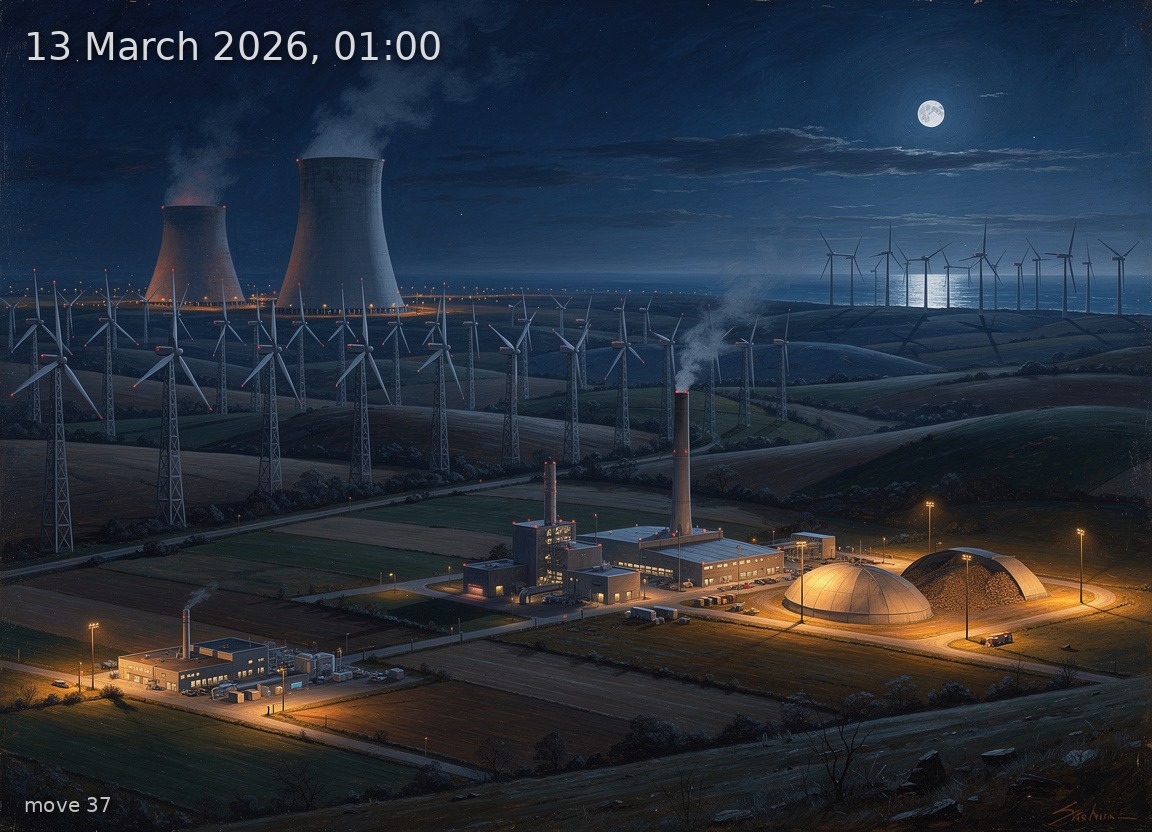
Massive onshore and offshore wind generation drives 84.6% renewable share and €4.1/MWh prices on a clear March night.
Back
Generation mix
Wind onshore 63%
Wind offshore 12%
Biomass 7%
Hydro 2%
Natural gas 6%
Hard coal 4%
Brown coal 6%
85%
Renewable share
39.3 GW
Wind (on + offshore)
0.0 GW
Solar
52.4 GW
Total generation
+4.3 GW
Net export
4.1 €/MWh
Day-ahead price
6.1°C / 10 km/h
Temp / Wind speed
Open-Meteo, Kassel (51.3°N 9.5°E)
5% / 0.0 W/m²
Cloud cover / Radiation
103
gCO₂/kWh
Image prompt
Wind onshore 33.0 GW dominates over two-thirds of the panoramic scene as vast ranks of three-blade turbines on lattice and tubular steel towers stretching deep into the distance across rolling central German farmland, their red aviation warning lights blinking in the darkness; wind offshore 6.3 GW appears at the far right horizon as a cluster of larger turbines rising from a faintly moonlit North Sea glimpsed through a gap in the terrain; biomass 3.9 GW is rendered as a mid-ground industrial plant with a tall stack emitting a thin pale plume and a wood-chip storage dome lit by sodium floodlights; natural gas 3.3 GW occupies the left-centre as a compact CCGT facility with a single exhaust stack and low warm-yellow lighting; brown coal 2.9 GW sits at the far left as a pair of hyperbolic cooling towers with gentle white steam plumes glowing faintly orange from the plant's ground-level lights; hard coal 1.8 GW appears as a smaller conventional power station with a single square cooling tower and conveyor infrastructure beside a coal pile; hydro 1.2 GW is suggested by a small dam structure in a forested valley at the lower left, spillway faintly illuminated. TIME: 1:00 AM — completely dark sky, deep navy-to-black, no twilight or sky glow whatsoever; a scattering of bright stars visible through 5% cloud cover; a thin crescent moon low on the horizon casts only the faintest silver-blue light on turbine blades. Early spring vegetation: bare deciduous trees, patches of dormant brown grass, some early green shoots barely visible. The atmosphere is calm, open, and serene — reflecting the rock-bottom electricity price. Highly detailed oil painting in the tradition of 19th-century German Romantic landscape painters such as Caspar David Friedrich, rich deep blues, warm sodium oranges and cool steel greys, visible expressive brushwork, dramatic atmospheric depth and chiaroscuro between artificial industrial light and vast surrounding darkness, meticulous engineering detail on every turbine nacelle, cooling tower, and exhaust stack. No text, no labels.