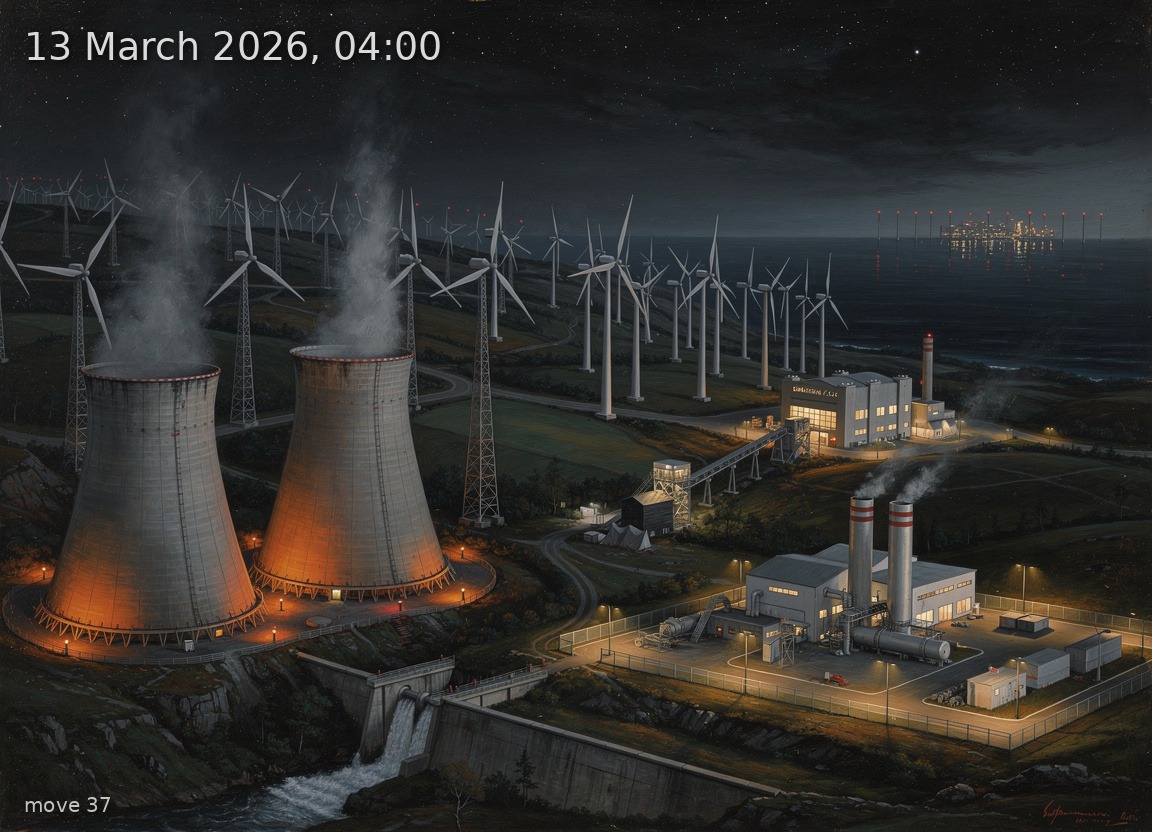
Massive onshore and offshore wind generation at 42 GW dominates a quiet pre-dawn grid, driving 4.9 GW net exports and near-zero prices.
Back
Generation mix
Wind onshore 64%
Wind offshore 12%
Biomass 7%
Hydro 2%
Natural gas 6%
Hard coal 3%
Brown coal 5%
86%
Renewable share
41.9 GW
Wind (on + offshore)
0.0 GW
Solar
54.9 GW
Total generation
+4.8 GW
Net export
1.5 €/MWh
Day-ahead price
6.2°C / 14 km/h
Temp / Wind speed
Open-Meteo, Kassel (51.3°N 9.5°E)
0% / 0.0 W/m²
Cloud cover / Radiation
96
gCO₂/kWh
Image prompt
Wind onshore 35.4 GW dominates the scene, filling roughly two-thirds of the composition as vast ranks of three-blade turbines on lattice and tubular towers stretching across rolling central German hills into deep darkness, rotors visibly spinning in strong wind; wind offshore 6.6 GW appears as a distant cluster of larger turbines on the far-right horizon, their red aviation warning lights blinking above an implied North Sea; biomass 3.9 GW is rendered as a mid-ground wood-chip-fired power station with a modest stack and warm amber glow from its furnace windows; natural gas 3.2 GW sits as a compact CCGT plant with twin exhaust stacks emitting thin white plumes, lit by sodium-vapor lamps; brown coal 2.8 GW occupies the left foreground as a pair of hyperbolic cooling towers with faint steam columns, lit from below by orange industrial floodlights; hard coal 1.9 GW appears as a smaller coal plant with a conveyor belt and single stack beside the lignite facility; hydro 1.1 GW is suggested by a small dam structure with spillway in the mid-left, subtle white water visible. TIME: 04:00 in March, completely dark sky—deep navy-black, absolutely no twilight or sky glow, a scattering of bright stars and a clear Milky Way visible through 0% cloud cover. The landscape is lit only by artificial light: sodium streetlights casting amber pools along a winding road, glowing windows of control buildings, red blinking lights atop every turbine nacelle creating a mesmerizing grid of crimson dots receding to the horizon. Early spring vegetation—bare-branched oaks and beeches, patches of dormant brown grass beginning to green, temperature around 6°C suggested by a thin mist hugging low ground. The atmosphere is calm and expansive, reflecting the rock-bottom electricity price: open, serene, unhurried. Style: highly detailed oil painting in the tradition of Caspar David Friedrich and Carl Blechen—rich layered color, visible confident brushwork, dramatic atmospheric depth, luminous treatment of artificial light against profound darkness—but with meticulous engineering accuracy on every turbine nacelle, cooling tower profile, and exhaust stack. No text, no labels, no human figures.