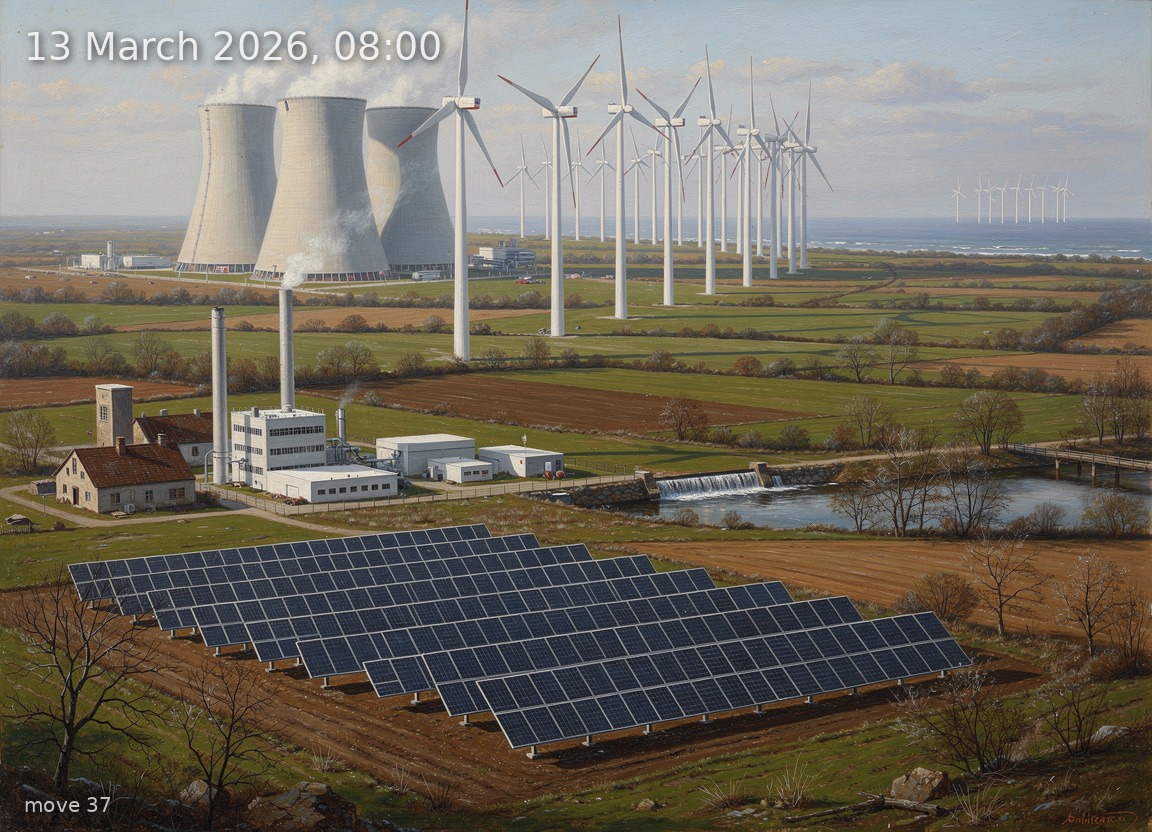
Massive 45.8 GW wind output dominates Germany's grid, crushing prices to 6.4 EUR/MWh and enabling 8.1 GW net exports.
Back
Generation mix
Wind onshore 52%
Wind offshore 8%
Solar 21%
Biomass 6%
Hydro 2%
Natural gas 5%
Hard coal 3%
Brown coal 4%
89%
Renewable share
45.8 GW
Wind (on + offshore)
15.8 GW
Solar
75.7 GW
Total generation
+8.0 GW
Net export
6.4 €/MWh
Day-ahead price
6.7°C / 17 km/h
Temp / Wind speed
Open-Meteo, Kassel (51.3°N 9.5°E)
0% / 26.0 W/m²
Cloud cover / Radiation
75
gCO₂/kWh
Image prompt
Wind onshore 39.6 GW dominates over half the canvas as vast ranks of three-blade turbines with white tubular towers and detailed nacelles stretching across rolling green-brown March farmland from centre to far right, their rotors spinning energetically in strong wind; wind offshore 6.2 GW appears at the far right horizon as a cluster of larger turbines rising from a sliver of grey-blue North Sea; solar 15.8 GW occupies the centre-left foreground as extensive ground-mounted arrays of aluminium-framed crystalline silicon panels angled south, catching the low morning sun with faint reflections; biomass 4.4 GW is a modest wood-chip-fed CHP plant with a tall rectangular stack and thin white exhaust plume at the left-centre; natural gas 3.5 GW appears as a compact CCGT facility with a single tall exhaust stack and low transparent heat shimmer to the left; brown coal 3.0 GW sits at the far left as two hyperbolic cooling towers with thin steam plumes rising lazily; hard coal 2.0 GW is a smaller gabled power station with a single square chimney and wisp of grey smoke beside the lignite plant; hydro 1.2 GW is suggested by a small river weir and low dam in the middle distance. Time of day: 08:00 March morning, full daylight, sun low in the east casting long golden shadows across the landscape, completely clear blue sky with zero clouds, bright and luminous atmosphere conveying calm and abundance. Temperature 6.7°C: early spring vegetation — bare deciduous trees, patches of green emerging on fields, frost lingering in shadows. Low electricity price atmosphere: vast open serene sky, expansive peaceful feeling. Style: highly detailed oil painting in the tradition of 19th-century German Romantic landscape painters such as Caspar David Friedrich and Carl Blechen — rich saturated colour, visible confident brushwork, atmospheric perspective with hazy blue distance, dramatic sense of scale where the industrial structures harmonise with the sweeping natural landscape. Meticulous engineering accuracy on every turbine nacelle, every PV cell grid pattern, every cooling tower's hyperbolic geometry. No text, no labels, no people in foreground.