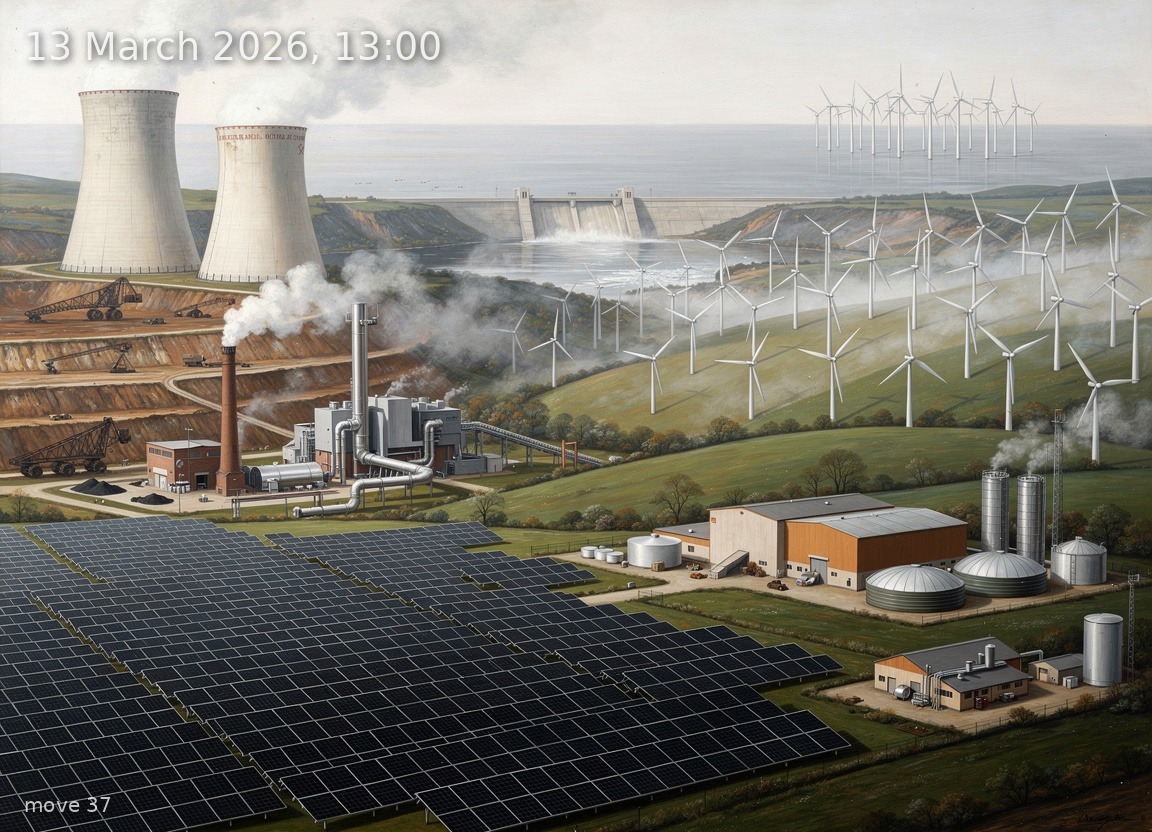
Wind and diffuse solar together produce 57.4 GW under overcast skies, driving prices negative and enabling 9.2 GW net export.
Back
Generation mix
Wind onshore 35%
Wind offshore 6%
Solar 39%
Biomass 6%
Hydro 2%
Natural gas 5%
Hard coal 2%
Brown coal 5%
88%
Renewable share
29.6 GW
Wind (on + offshore)
27.8 GW
Solar
71.3 GW
Total generation
+9.2 GW
Net export
-2.5 €/MWh
Day-ahead price
12.1°C / 19 km/h
Temp / Wind speed
Open-Meteo, Kassel (51.3°N 9.5°E)
100% / 52.5 W/m²
Cloud cover / Radiation
82
gCO₂/kWh
Image prompt
Wind onshore 25.3 GW dominates the right half of the composition as vast rolling hills densely packed with hundreds of three-blade wind turbines on lattice and tubular steel towers, rotors visibly spinning in moderate wind. Wind offshore 4.3 GW appears in the far-right background as a cluster of turbines rising from a grey sea horizon. Solar 27.8 GW fills the centre-left as enormous fields of aluminium-framed crystalline silicon PV panels stretching across flat farmland, their surfaces reflecting the flat white light of a fully overcast sky. Brown coal 3.5 GW occupies the far left as two massive hyperbolic cooling towers with heavy white steam plumes drifting eastward, beside a lignite strip mine. Hard coal 1.7 GW sits just right of the brown coal as a smaller coal plant with a tall brick chimney and conveyor belts. Natural gas 3.4 GW appears as a compact CCGT facility with a single sleek exhaust stack and heat recovery unit, positioned between the coal plants and the solar fields. Biomass 3.9 GW is rendered as a cluster of medium-sized industrial buildings with rounded digesters and short stacks emitting thin vapour, nestled among early-spring green fields. Hydro 1.3 GW appears as a small dam and reservoir in a valley in the distant centre background. The sky is entirely overcast — a uniform blanket of grey-white stratus clouds at 13:00 midday providing bright but completely diffuse daylight with no shadows, no blue sky, and no direct sun visible. The landscape is early spring: pale green grass beginning to emerge, bare deciduous trees just showing first buds, patches of dark soil. Temperature is mild. The atmosphere feels calm and open despite the overcast — not oppressive — reflecting the negative electricity price. Highly detailed oil painting in the tradition of 19th-century German Romantic landscape painters — Caspar David Friedrich meets industrial sublime — rich muted colour palette of greys, pale greens, warm browns, and cream whites, visible confident brushwork, deep atmospheric perspective with layers of mist between the turbines. Each technology rendered with meticulous engineering accuracy: nacelle housings, three-blade rotors, PV cell grid patterns, cooling tower parabolic curves with condensation plumes, CCGT stainless steel stacks. No text, no labels.