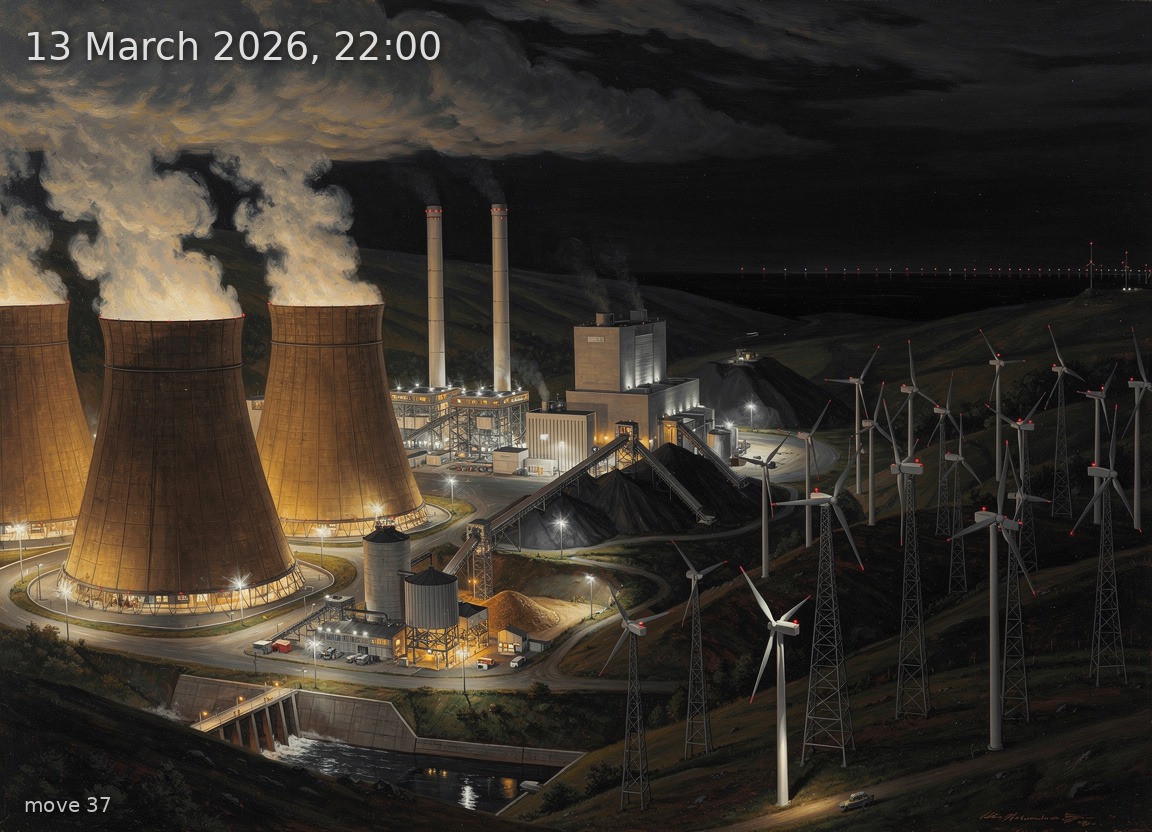
Wind leads at 17.6 GW but heavy coal and gas dispatch plus 6.7 GW net imports meet strong nighttime demand.
Back
Generation mix
Wind onshore 32%
Wind offshore 8%
Biomass 9%
Hydro 3%
Natural gas 16%
Hard coal 12%
Brown coal 20%
52%
Renewable share
17.7 GW
Wind (on + offshore)
0.0 GW
Solar
44.4 GW
Total generation
-6.8 GW
Net import
123.4 €/MWh
Day-ahead price
7.4°C / 10 km/h
Temp / Wind speed
Open-Meteo, Kassel (51.3°N 9.5°E)
100% / 0.0 W/m²
Cloud cover / Radiation
333
gCO₂/kWh
Image prompt
Brown coal 8.7 GW dominates the left quarter as a cluster of massive hyperbolic cooling towers with billowing white steam plumes lit from below by amber sodium lamps; natural gas 7.2 GW occupies the centre-left as several compact CCGT units with tall single exhaust stacks emitting thin heat shimmer against the black sky; hard coal 5.5 GW appears centre-right as a large conventional power station with twin square stacks and conveyor belts of dark coal illuminated by floodlights; wind onshore 14.2 GW spans the entire right third and recedes into the deep background as dozens of three-blade turbines on lattice and tubular towers, their red aviation warning lights blinking in rhythmic patterns across dark ridgelines; wind offshore 3.4 GW is suggested far in the background-right as a faint line of turbine lights hovering above a barely visible dark sea horizon; biomass 4.2 GW appears as a mid-sized industrial facility with a wood-chip silo and a single exhaust stack near the centre; hydro 1.2 GW is a small concrete dam with a spillway faintly visible in the lower foreground, water reflecting orange industrial glow. The sky is completely black, 100% overcast with no stars, no moon, no twilight — a heavy oppressive ceiling of invisible cloud pressing down, conveying the high electricity price. The season is early spring: bare deciduous trees with just the faintest swelling buds, dormant brown grass, patches of old snow in shadows, temperature around 7°C suggested by a damp mist hugging the ground. Wind at moderate speed animates the turbine blades and bends thin branches. All illumination comes from sodium streetlights casting orange pools, industrial floodlights, glowing furnace mouths, and the red blinking nacelle lights of turbines. Highly detailed oil painting in the tradition of 19th-century German Romantic landscape painters — rich, dark palette of deep navy, burnt umber, warm amber, and cold grey; visible confident brushwork; atmospheric depth with industrial haze softening distant elements; meticulous engineering accuracy on every turbine nacelle, cooling tower ribbing, and CCGT stack detail. The mood is brooding, industrially sublime, a nocturnal Rhenish landscape transformed by energy infrastructure. No text, no labels.