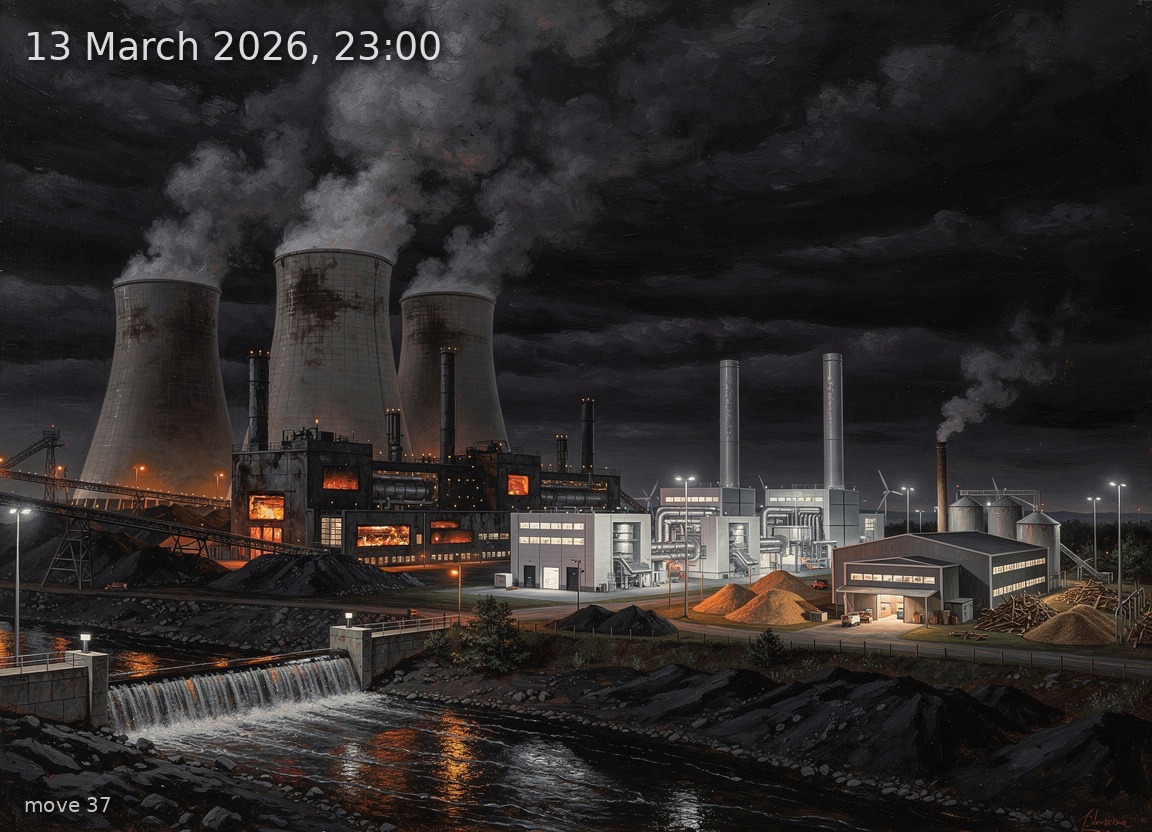
Wind leads at 16.7 GW but heavy coal and gas dispatch plus 6 GW net imports meet late-night demand.
Back
Generation mix
Wind onshore 32%
Wind offshore 7%
Biomass 10%
Hydro 3%
Natural gas 14%
Hard coal 13%
Brown coal 21%
52%
Renewable share
16.7 GW
Wind (on + offshore)
0.0 GW
Solar
42.5 GW
Total generation
-6.0 GW
Net import
115.8 €/MWh
Day-ahead price
7.2°C / 6 km/h
Temp / Wind speed
Open-Meteo, Kassel (51.3°N 9.5°E)
100% / 0.0 W/m²
Cloud cover / Radiation
339
gCO₂/kWh
Image prompt
Brown coal 8.8 GW dominates the left quarter as four massive hyperbolic cooling towers with thick white-grey steam plumes rising into blackness, surrounded by conveyor belts of wet lignite; hard coal 5.6 GW appears just left of centre as a cluster of dark industrial boiler houses with tall rectangular chimneys trailing thin grey smoke; natural gas 6.1 GW occupies the centre as three compact CCGT units with sleek cylindrical exhaust stacks emitting faint heat shimmer; wind onshore 13.6 GW fills the entire right third as dozens of tall three-blade turbines on lattice and tubular towers stretching across rolling hills, rotors turning slowly; wind offshore 3.1 GW appears in the far-right background as a line of turbines standing in a dark sea glimpsed at the horizon; biomass 4.1 GW is rendered as a modest wood-chip-fed plant with a single squat smokestack between the gas units and the wind field; hydro 1.2 GW appears as a small concrete dam with water cascading in the far left foreground. TIME: 23:00 — completely dark sky, no twilight, no stars visible through total 100% cloud cover, sky is an oppressive uniform deep charcoal-black canopy pressing down. All structures lit only by harsh sodium-orange and industrial white floodlights, molten amber glows from furnace openings, and small red aviation warning lights blinking atop every wind turbine nacelle. The atmosphere is heavy and claustrophobic, hinting at the high electricity price — low haze drifts across the scene, steam plumes diffuse into the dark overcast. Early spring vegetation is sparse, bare deciduous trees with just the faintest bud-swell, damp brown grass, puddles reflecting industrial light. Temperature 7 °C — a chill dampness pervades. A high-voltage transmission pylon in the mid-ground carries cables disappearing toward the border, symbolising imports. Style: highly detailed oil painting in the tradition of 19th-century German Romantic landscape masters — Caspar David Friedrich's sublime darkness combined with Adolph Menzel's meticulous industrial realism — rich impasto brushwork, dramatic chiaroscuro, atmospheric depth, luminous industrial light against the void. Every turbine nacelle, cooling tower contour, and gas-stack flange rendered with precise engineering accuracy. No text, no labels.