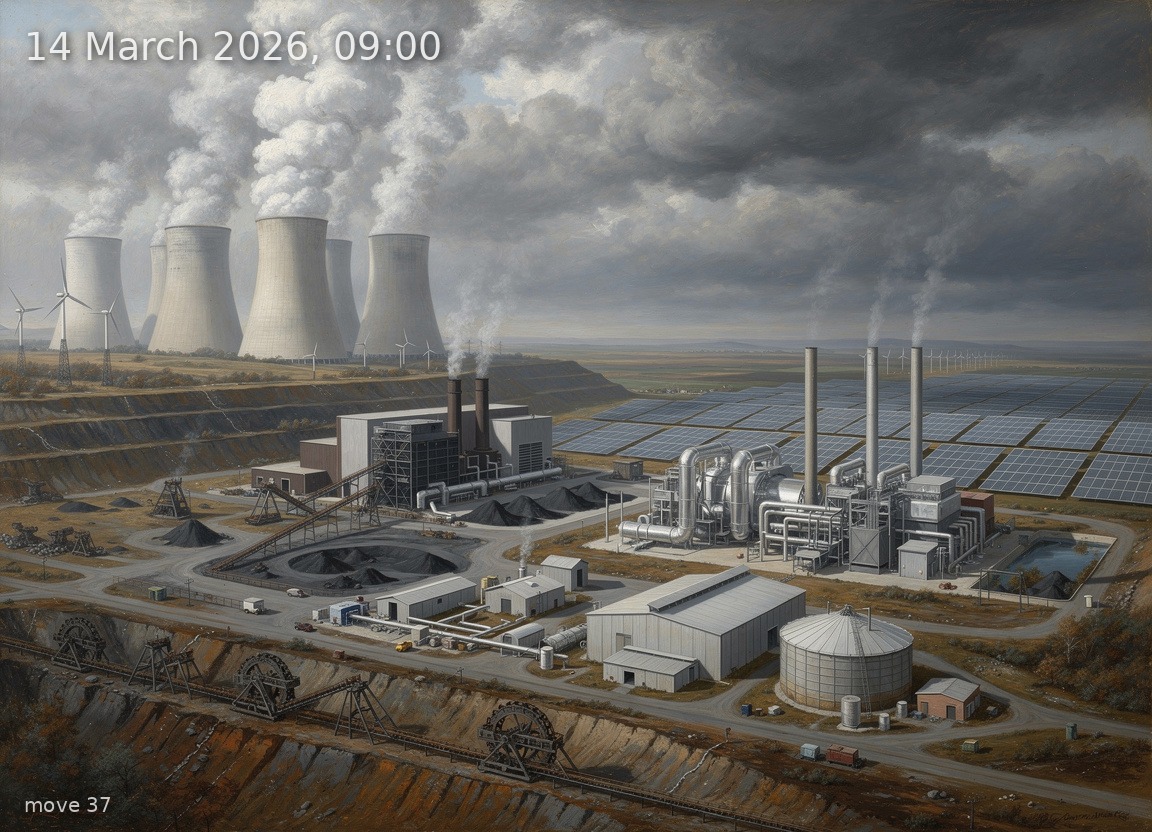
Cold, windless overcast morning forces heavy coal and gas dispatch alongside diffuse solar, requiring 7.8 GW net imports.
Back
Generation mix
Wind onshore 15%
Wind offshore 1%
Solar 24%
Biomass 9%
Hydro 3%
Natural gas 19%
Hard coal 11%
Brown coal 18%
52%
Renewable share
7.6 GW
Wind (on + offshore)
11.0 GW
Solar
46.6 GW
Total generation
-7.8 GW
Net import
116.1 €/MWh
Day-ahead price
2.3°C / 4 km/h
Temp / Wind speed
Open-Meteo, Kassel (51.3°N 9.5°E)
100% / 10.2 W/m²
Cloud cover / Radiation
324
gCO₂/kWh
Image prompt
Solar 11.0 GW occupies the upper-right quarter as vast fields of aluminium-framed crystalline silicon PV panels stretching across flat farmland, their surfaces reflecting only dull grey light under total overcast; natural gas 8.8 GW fills the centre-right as a cluster of modern CCGT plants with tall single exhaust stacks venting thin white plumes; brown coal 8.5 GW dominates the left third as massive hyperbolic cooling towers with thick billowing steam columns and a sprawling open-pit lignite mine in the foreground; wind onshore 7.2 GW appears as a line of three-blade turbines with lattice towers along a distant ridge, their rotors barely turning in the still air; hard coal 5.1 GW sits centre-left as a traditional coal-fired power station with rectangular stacks and conveyor belts feeding black coal; biomass 4.4 GW appears as a mid-sized industrial facility with a rounded wood-chip silo and modest chimney; hydro 1.2 GW is a small dam and powerhouse nestled in a valley at far right; wind offshore 0.4 GW is suggested by a few tiny turbines on the extreme horizon. The sky is entirely overcast with heavy, low, oppressive grey clouds pressing down — no blue, no sun visible — creating a suffocating atmosphere reflecting the 116 EUR/MWh price. The time is 9 AM in early March: full diffuse daylight but flat and shadowless. The temperature is just above freezing: patches of frost cling to bare brown fields and leafless trees, the landscape is dormant late-winter with no green. The air is nearly still — no motion in smoke plumes except gentle vertical drift. Transmission lines with heavy cables cross the scene symbolising the net imports flowing into Germany. Highly detailed oil painting in the tradition of 19th-century German Romantic landscape painters — rich, sombre colour palette of slate greys, umber browns, and muted ochres, visible impasto brushwork, atmospheric depth with industrial haze, meticulous engineering detail on every turbine nacelle, cooling tower, and panel frame. The mood is heavy, industrial, tense — a nation's grid straining under winter load. No text, no labels.