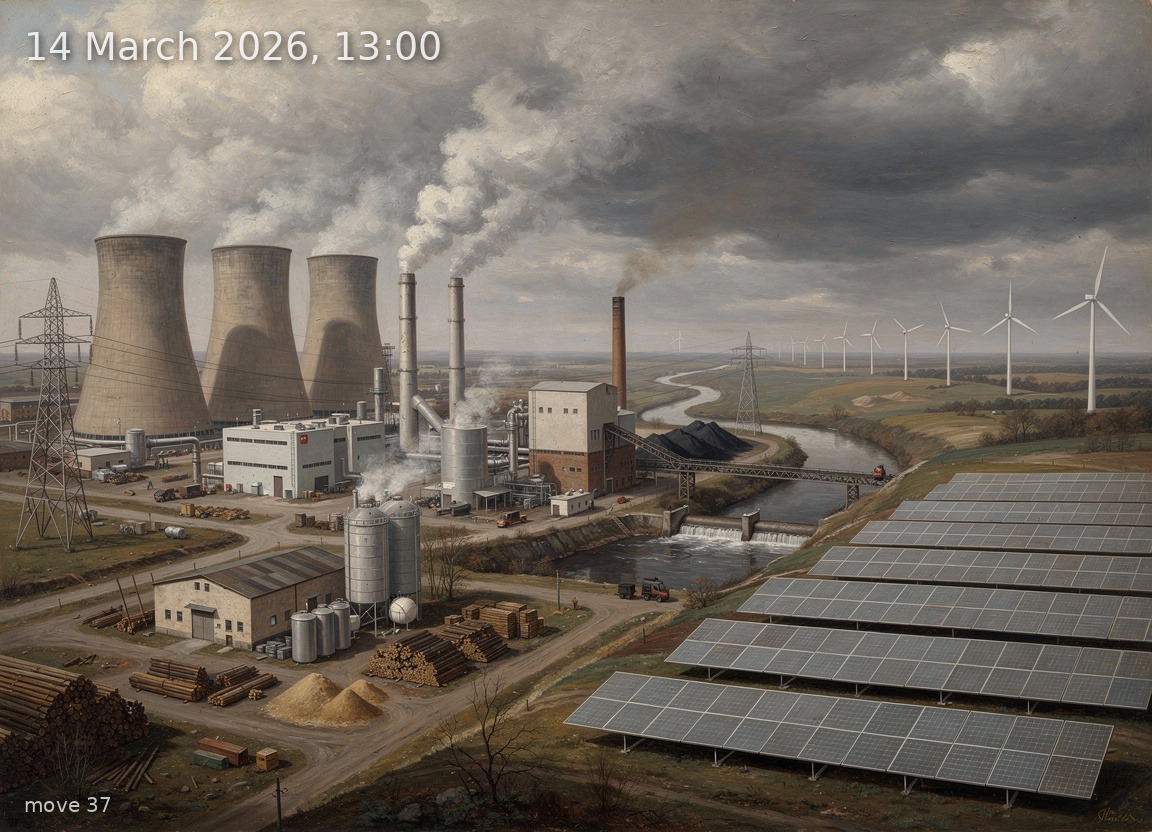
Overcast skies and calm winds force heavy coal and gas dispatch plus 10 GW net imports at high prices.
Back
Generation mix
Wind onshore 10%
Wind offshore 0%
Solar 29%
Biomass 9%
Hydro 3%
Natural gas 14%
Hard coal 11%
Brown coal 22%
52%
Renewable share
4.9 GW
Wind (on + offshore)
13.2 GW
Solar
45.3 GW
Total generation
-10.0 GW
Net import
103.4 €/MWh
Day-ahead price
5.3°C / 5 km/h
Temp / Wind speed
Open-Meteo, Kassel (51.3°N 9.5°E)
100% / 36.8 W/m²
Cloud cover / Radiation
340
gCO₂/kWh
Image prompt
Brown coal 10.2 GW dominates the left third of the scene as a massive lignite power station complex with four hyperbolic cooling towers trailing thick white-grey steam plumes into the overcast sky; natural gas 6.5 GW occupies the centre-left as two compact CCGT units with tall single exhaust stacks venting heat shimmer; hard coal 5.1 GW sits centre-right as a large coal plant with prominent boiler houses, conveyor belts of black coal, and a single rectangular chimney with brownish exhaust; solar 13.2 GW fills the right third as vast fields of aluminium-framed crystalline silicon PV panels stretching to the horizon, their surfaces dull and reflective-grey under the flat diffuse light of total overcast, producing power but without any direct sunbeam or glare; wind onshore 4.7 GW appears as a sparse row of modern three-blade turbines on a low ridge behind the solar field, their rotors barely turning in the near-calm air; wind offshore 0.2 GW is suggested by a single distant turbine silhouette on the far horizon; biomass 4.0 GW is rendered as a medium-sized wood-chip-fired plant with a modest stack and lumber yard near the coal complex; hydro 1.2 GW appears as a small run-of-river weir and powerhouse beside a grey river in the middle distance. The sky is entirely covered by a thick, oppressive, low-hanging stratus layer in tones of pewter and slate, consistent with 100% cloud cover at 1 PM in March — fully daylight but shadowless, diffuse, and gloomy. The atmosphere feels heavy and costly, pressing down on the landscape. Temperature is 5.3°C: bare deciduous trees with no leaves, brown dormant grass, patches of old snow in furrows. The terrain is flat central German lowland with a winding river. High-voltage transmission pylons stride across the scene carrying thick cable bundles, symbolising the massive import flows. Painted in the style of a highly detailed 19th-century German Romantic oil painting — rich, brooding palette of greys, ochres, and muted earth tones, visible impasto brushwork, atmospheric depth with haze softening distant structures, meticulous engineering detail on every turbine nacelle, cooling tower reinforcement, and panel frame. No text, no labels.