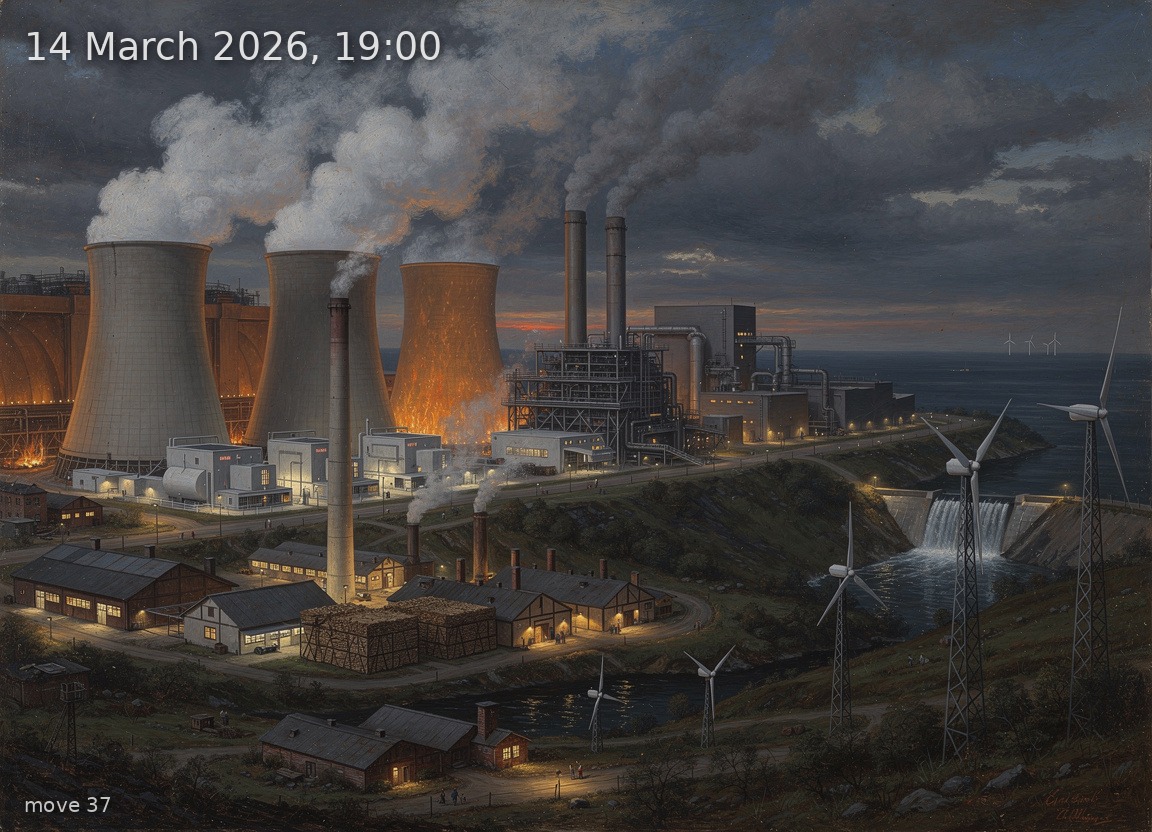
Brown coal, gas, and hard coal dominate as Dunkelflaute conditions and 15.6 GW net imports drive prices to 170 EUR/MWh.
Back
Generation mix
Wind onshore 11%
Wind offshore 0%
Biomass 12%
Hydro 4%
Natural gas 27%
Hard coal 15%
Brown coal 31%
28%
Renewable share
4.2 GW
Wind (on + offshore)
0.0 GW
Solar
37.5 GW
Total generation
-15.6 GW
Net import
169.8 €/MWh
Day-ahead price
5.5°C / 4 km/h
Temp / Wind speed
Open-Meteo, Kassel (51.3°N 9.5°E)
100% / 0.0 W/m²
Cloud cover / Radiation
494
gCO₂/kWh
Image prompt
Brown coal 11.6 GW dominates the left third of the scene as a massive lignite power station complex with four hyperbolic cooling towers billowing thick white steam plumes into the night; natural gas 10.0 GW fills the centre-left as three compact CCGT units with tall single exhaust stacks venting shimmering heat haze; hard coal 5.5 GW appears centre-right as a large coal-fired plant with rectangular boiler house and twin chimneys trailing grey smoke; biomass 4.5 GW is rendered as a cluster of industrial biomass CHP facilities with timber-framed fuel storage and modest stacks glowing warmly; wind onshore 4.1 GW occupies the far right as a sparse row of three-blade turbines on lattice towers standing nearly motionless in the still air; hydro 1.6 GW appears as a small dam spillway in the right background with faint floodlighting on concrete; wind offshore 0.2 GW is a barely visible pair of turbines on the distant dark horizon. The scene is set at dusk transitioning to night — 19:00 in mid-March — with only the last thin ribbon of deep orange-red light clinging to the very lowest horizon line, the sky above rapidly darkening to deep charcoal and navy, heavy 100% overcast clouds pressing down oppressively. Temperature is a cold 5.5°C: bare deciduous trees with no leaves, patches of frost on brown grass, breath-like mist near ground level. The air is nearly dead calm. Sodium-orange streetlights and harsh industrial floodlights illuminate the power stations, casting long amber reflections on wet roads. High-voltage transmission pylons march across the middle ground carrying thick cable bundles, symbolizing the massive import flows. The atmosphere is heavy, brooding, and expensive — an oppressive industrial weight presses on the landscape. Painted in the style of a highly detailed 19th-century German Romantic oil painting — rich impasto brushwork, dramatic chiaroscuro between the fiery industrial glow and the encroaching darkness, atmospheric depth with haze and steam layering the distance, meticulous engineering accuracy on every turbine nacelle, cooling tower hyperbolic curve, and CCGT exhaust detail. Palette of deep indigo, burnt sienna, sulfurous yellow, and coal-smoke grey. No text, no labels.