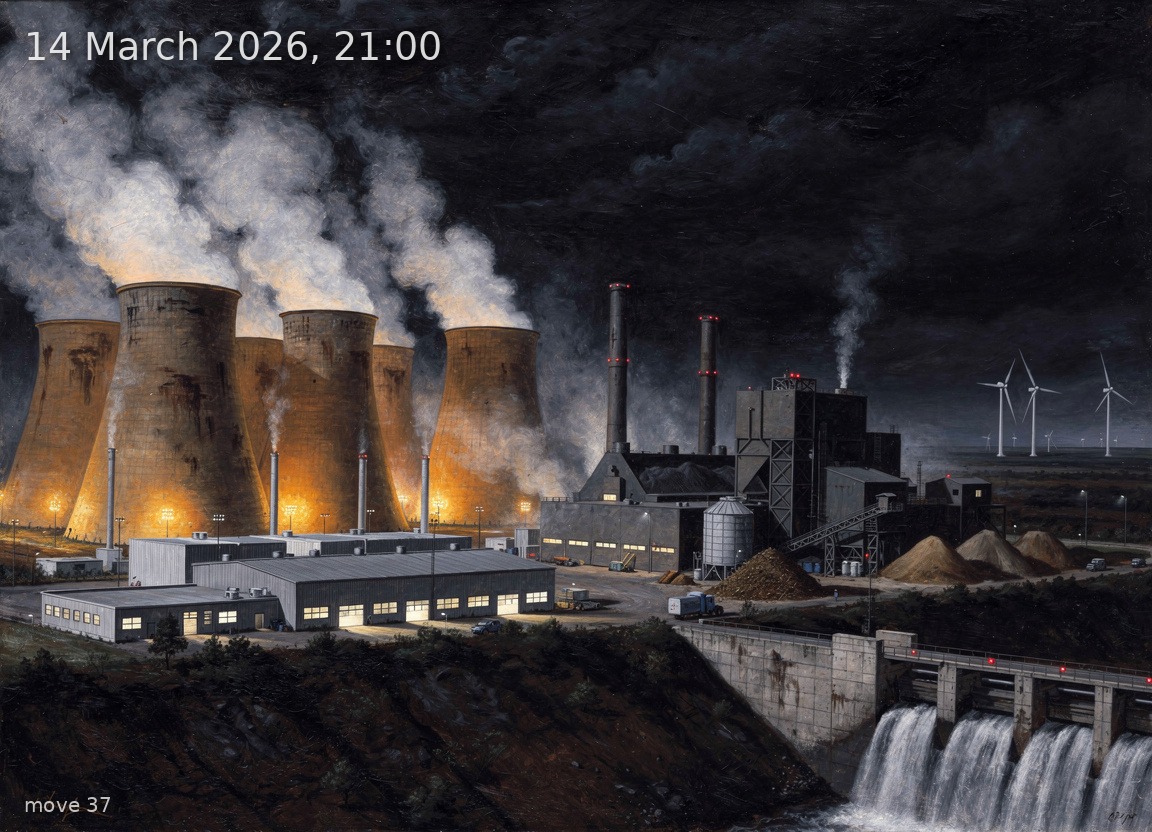
Brown coal, gas, and hard coal dominate as zero solar, weak wind, and cold evening demand drive 137 EUR/MWh prices.
Back
Generation mix
Wind onshore 10%
Wind offshore 2%
Biomass 12%
Hydro 4%
Natural gas 27%
Hard coal 15%
Brown coal 32%
27%
Renewable share
4.2 GW
Wind (on + offshore)
0.0 GW
Solar
36.8 GW
Total generation
-9.4 GW
Net import
137.4 €/MWh
Day-ahead price
4.8°C / 10 km/h
Temp / Wind speed
Open-Meteo, Kassel (51.3°N 9.5°E)
100% / 0.0 W/m²
Cloud cover / Radiation
500
gCO₂/kWh
Image prompt
Brown coal 11.7 GW dominates the left third of the scene as a massive complex of hyperbolic cooling towers belching thick white steam plumes into the black night sky, their concrete shells lit by harsh sodium-orange floodlights; natural gas 9.8 GW fills the centre-left as a row of compact CCGT power plants with tall single exhaust stacks emitting thin vapour trails, their turbine halls glowing with interior light behind metal-clad walls; hard coal 5.4 GW appears centre-right as a darker industrial block with conveyor belts, coal bunkers, and a pair of squat chimneys trailing grey smoke; biomass 4.3 GW is rendered as a mid-sized facility with a wood-chip silo and a single modest stack with faintly luminous exhaust, positioned in the right-centre; wind onshore 3.6 GW appears as a small cluster of three-blade turbines on a distant ridge in the right background, their red aviation warning lights blinking against the black sky, rotors turning slowly in light wind; wind offshore 0.6 GW is suggested by a barely visible pair of turbines on the far-right horizon over a dark plain; hydro 1.4 GW is depicted as a concrete dam spillway in the lower right foreground, water faintly catching industrial light as it cascades down. The sky is completely dark—no twilight, no moon, no stars—a heavy 100% overcast ceiling of invisible clouds pressing down oppressively. The atmosphere is thick and hazy with industrial emissions, giving the sodium streetlights and floodlights a diffused, suffocating orange halo. Bare early-spring trees with no leaves stand in silhouette. The ground is cold, with patches of frost on dormant brown grass. Transmission towers with high-voltage lines recede into the murky distance, carrying imported power. The overall mood is tense and industrial, reflecting extreme price pressure. Rendered as a highly detailed oil painting in the tradition of 19th-century German Romantic landscape painting—rich impasto brushwork, dramatic chiaroscuro between artificial light and deep shadow, atmospheric depth and haze, meticulous engineering detail on every turbine nacelle, cooling tower, and exhaust stack—evoking Caspar David Friedrich's sublime darkness fused with industrial modernity. No text, no labels.