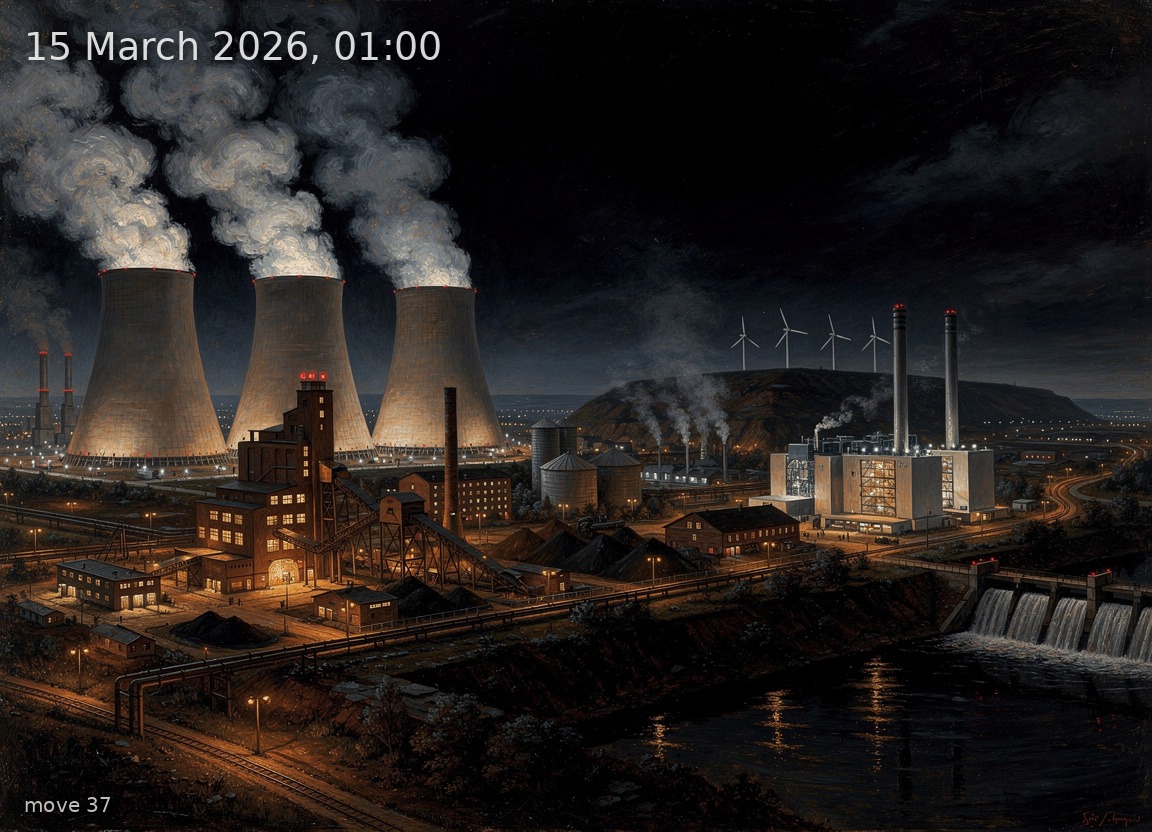
Brown coal, gas, and hard coal dominate a tight 1 AM grid requiring 8.8 GW net imports under cold, windless overcast.
Back
Generation mix
Wind onshore 9%
Wind offshore 1%
Biomass 12%
Hydro 4%
Natural gas 22%
Hard coal 16%
Brown coal 36%
26%
Renewable share
3.2 GW
Wind (on + offshore)
0.0 GW
Solar
33.3 GW
Total generation
-8.8 GW
Net import
133.7 €/MWh
Day-ahead price
3.4°C / 9 km/h
Temp / Wind speed
Open-Meteo, Kassel (51.3°N 9.5°E)
100% / 0.0 W/m²
Cloud cover / Radiation
525
gCO₂/kWh
Image prompt
Brown coal 11.9 GW occupies the left third of the scene as a massive lignite power station complex with five hyperbolic cooling towers belching thick white steam plumes into the black sky; hard coal 5.4 GW appears left-of-centre as a pair of large coal-fired plants with tall rectangular stacks and conveyor belt infrastructure; natural gas 7.4 GW fills the centre-right as three compact CCGT units with slender single exhaust stacks venting heat shimmer; biomass 4.0 GW appears as a mid-ground cluster of smaller industrial buildings with wood-chip silos and modest chimneys emitting thin grey smoke; wind onshore 3.0 GW is represented by a sparse row of five three-blade turbines on a distant ridge, their rotors barely turning in the weak breeze; hydro 1.3 GW is a small dam structure with illuminated spillway at the far right edge; wind offshore 0.3 GW is a faint pair of turbines on the extreme horizon. The scene is set at 1:00 AM in complete darkness — a pitch-black, starless sky with 100% cloud cover, absolutely no twilight or sky glow, only the orange sodium streetlights of an industrial district, the eerie glow from furnace windows, and scattered red aviation warning lights on the cooling towers and turbine nacelles. The atmosphere is heavy and oppressive, reflecting the extreme electricity price — low-hanging clouds trap the industrial steam, creating a thick, suffocating haze lit from below in amber and sulphurous yellow. Bare early-March trees with no leaves stand in the foreground, their branches glistening with frost at 3°C. A frozen puddle in the muddy foreground reflects the industrial glow. High-voltage transmission lines and lattice pylons stretch across the scene, symbolizing the heavy import flows. Highly detailed oil painting in the tradition of 19th-century German Romantic landscape painters — rich, dark colour palette dominated by deep navy, burnt umber, and amber; visible impasto brushwork; atmospheric depth with layers of industrial haze receding into blackness; meticulous engineering detail on every turbine nacelle, cooling tower, and exhaust stack. The mood is sublime and foreboding, a nocturnal industrial Ruhrgebiet vision worthy of Caspar David Friedrich reimagined for the fossil age. No text, no labels.