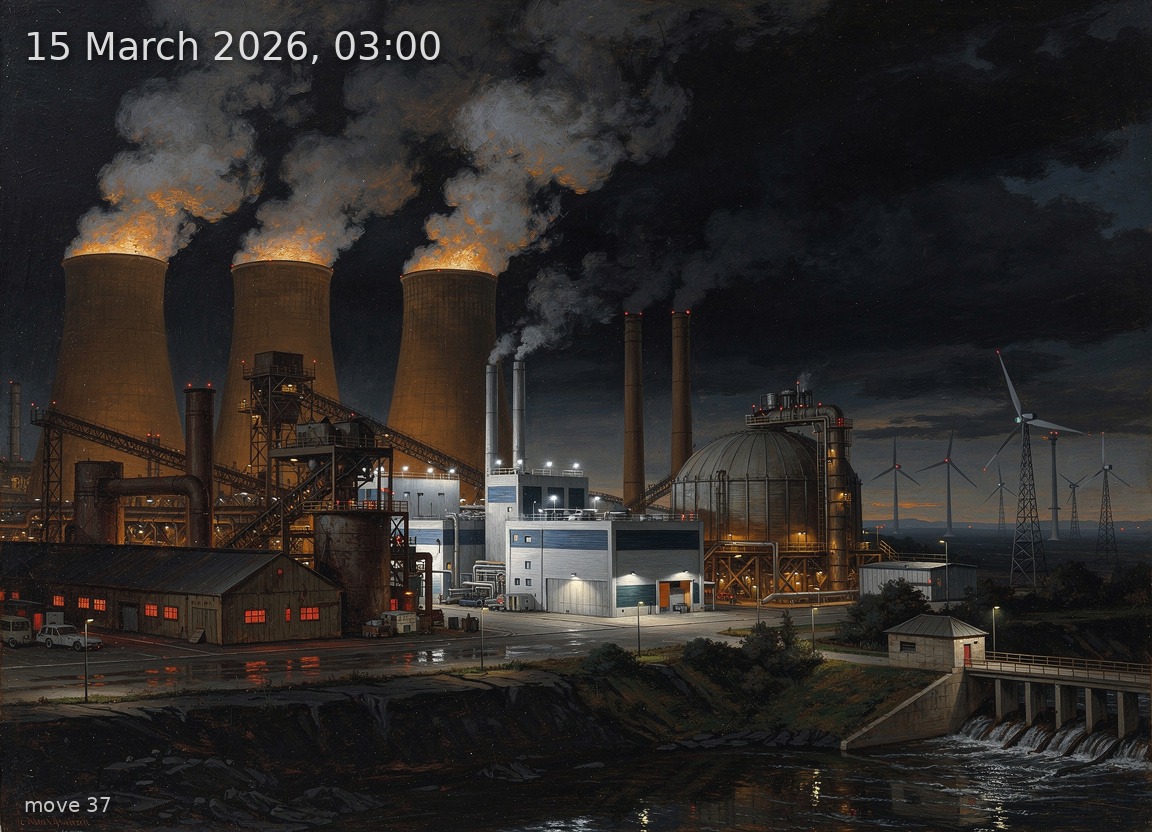
Brown coal, hard coal, and gas dominate a wind-still, sunless 3 AM grid requiring 8.5 GW net imports.
Back
Generation mix
Wind onshore 8%
Wind offshore 1%
Biomass 13%
Hydro 4%
Natural gas 20%
Hard coal 17%
Brown coal 37%
25%
Renewable share
2.9 GW
Wind (on + offshore)
0.0 GW
Solar
31.9 GW
Total generation
-8.5 GW
Net import
123.5 €/MWh
Day-ahead price
3.6°C / 6 km/h
Temp / Wind speed
Open-Meteo, Kassel (51.3°N 9.5°E)
99% / 0.0 W/m²
Cloud cover / Radiation
533
gCO₂/kWh
Image prompt
Brown coal 11.9 GW dominates the left third of the scene as a massive lignite power station complex with four hyperbolic cooling towers emitting thick white steam plumes lit from below by orange sodium lights; hard coal 5.4 GW appears center-left as a large coal plant with tall chimneys and conveyor belts feeding coal bunkers, glowing red at furnace windows; natural gas 6.5 GW fills the center as two compact CCGT units with slender exhaust stacks releasing thin vapour columns, their turbine halls illuminated by harsh industrial floodlights; biomass 4.0 GW occupies the center-right as a wood-chip-fueled generating station with a distinctive domed silo and short smokestack with faint grey exhaust; wind onshore 2.7 GW appears in the right background as a small cluster of three-blade turbines on lattice towers, their rotors barely turning, red aviation warning lights blinking; hydro 1.2 GW is suggested far right as a small dam with penstock and turbine house, water gleaming faintly; wind offshore 0.2 GW is a single distant turbine silhouette on the far horizon. TIME: 3 AM, completely dark — black sky with heavy 99% cloud cover obscuring all stars and moon, no twilight, no sky glow whatsoever. The only illumination comes from sodium-orange and mercury-white industrial lighting casting long reflections on wet cold ground. Temperature near freezing: patches of frost on railings and grass, bare deciduous trees with no leaves, early-spring dormant landscape. The atmosphere is heavy and oppressive, thick low clouds pressing down on the industrial skyline, conveying the economic weight of 123.5 EUR/MWh electricity. Transmission lines recede into darkness toward the east, suggesting cross-border imports. Style: highly detailed oil painting in the tradition of 19th-century German Romantic landscape painters such as Caspar David Friedrich, but depicting an industrial nocturne — rich dark palette of deep navy, charcoal, burnt umber, and sodium orange, visible impasto brushwork, atmospheric chiaroscuro depth, meticulous engineering detail on every turbine nacelle, cooling tower hyperbolic curvature, CCGT exhaust stack geometry, and coal conveyor structure. The scene evokes sublime industrial grandeur and melancholy. No text, no labels.