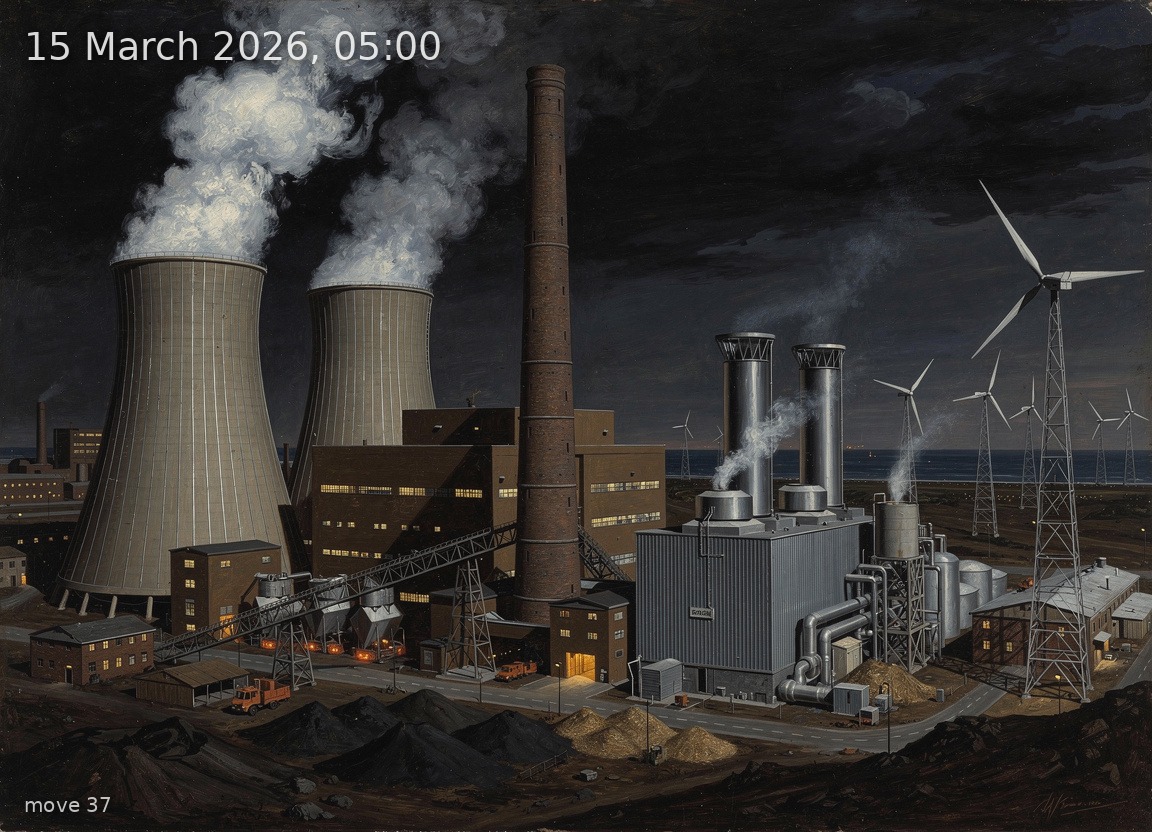
Brown coal, hard coal, and gas dominate a cold, windless pre-dawn grid requiring 9.7 GW net imports.
Back
Generation mix
Wind onshore 7%
Wind offshore 1%
Biomass 13%
Hydro 4%
Natural gas 20%
Hard coal 17%
Brown coal 38%
25%
Renewable share
2.5 GW
Wind (on + offshore)
0.0 GW
Solar
31.3 GW
Total generation
-9.6 GW
Net import
124.1 €/MWh
Day-ahead price
3.7°C / 5 km/h
Temp / Wind speed
Open-Meteo, Kassel (51.3°N 9.5°E)
100% / 0.0 W/m²
Cloud cover / Radiation
540
gCO₂/kWh
Image prompt
Brown coal 11.9 GW occupies the left third of the scene as a massive lignite power complex with four hyperbolic cooling towers belching thick white steam plumes into the black sky; hard coal 5.5 GW appears center-left as a coal-fired plant with a tall brick chimney stack and visible conveyor belts feeding fuel hoppers; natural gas 6.3 GW fills the center as two compact CCGT units with sleek cylindrical exhaust stacks emitting thin heat shimmer; biomass 4.1 GW is rendered center-right as a wood-chip-fueled industrial plant with a corrugated steel facade and a modest smokestack with faintly luminous exhaust; wind onshore 2.1 GW appears in the right background as a sparse cluster of three-blade turbines on lattice towers, their rotors nearly motionless in the still air; wind offshore 0.4 GW is a barely visible pair of turbines on the far-right horizon above a dark sea sliver; hydro 1.1 GW is suggested by a small dam structure with water cascading in the far right midground. The hour is 05:00 in mid-March: the sky is deep blue-black with the faintest pre-dawn grey beginning to seep along the eastern horizon, no direct sunlight, no solar panels anywhere. Temperature is near freezing—patches of frost glitter on dormant brown grass and bare deciduous trees with no leaves. Cloud cover is total: a heavy, oppressive, unbroken overcast ceiling presses down low, lit from below by the orange sodium glow of industrial floodlights and the ruddy furnace light spilling from plant windows. The atmosphere feels heavy and costly, haze and steam merging into the dark clouds. Rendered as a highly detailed oil painting in the tradition of 19th-century German Romantic landscape painters—rich, dark palette of indigo, umber, ochre, and furnace-orange, visible confident brushwork, dramatic chiaroscuro, atmospheric depth with receding layers of industrial silhouettes. Each technology is painted with meticulous engineering accuracy: turbine nacelles, three-blade rotors, aluminium cooling tower ribbing, CCGT exhaust cowls, coal conveyor gantries. The scene evokes a sublime industrial nocturne, monumental and brooding. No text, no labels.