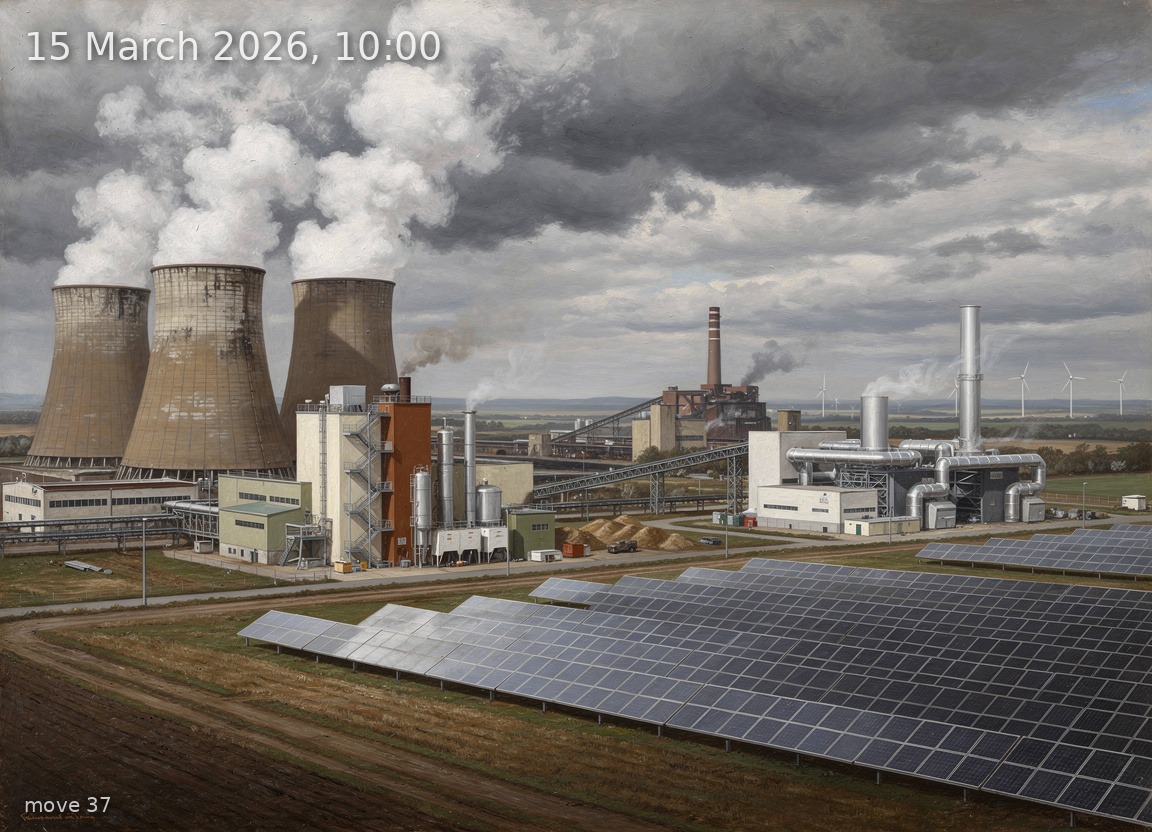
Overcast skies and near-zero wind force heavy lignite, gas, and 12.1 GW net imports to meet German demand.
Back
Generation mix
Wind onshore 2%
Wind offshore 5%
Solar 42%
Biomass 11%
Hydro 3%
Natural gas 9%
Hard coal 6%
Brown coal 22%
64%
Renewable share
2.7 GW
Wind (on + offshore)
16.3 GW
Solar
38.3 GW
Total generation
-12.0 GW
Net import
87.3 €/MWh
Day-ahead price
5.0°C / 5 km/h
Temp / Wind speed
Open-Meteo, Kassel (51.3°N 9.5°E)
96% / 26.2 W/m²
Cloud cover / Radiation
265
gCO₂/kWh
Image prompt
Solar 16.3 GW occupies the right third of the scene as vast fields of aluminium-framed crystalline silicon PV panels stretching across flat farmland, their surfaces dull and barely reflective under thick overcast; brown coal 8.3 GW dominates the left quarter as a massive lignite power station with three hyperbolic concrete cooling towers emitting thick white steam plumes that merge into the grey sky; biomass 4.2 GW appears in the centre-left as a cluster of wood-chip-fed CHP plants with tall rectangular boiler buildings and modest exhaust stacks trailing thin smoke; natural gas 3.6 GW sits centre-right as two compact CCGT units with sleek single exhaust stacks venting shimmering heat haze; hard coal 2.2 GW appears behind the gas plants as a smaller station with a single large smokestack and coal conveyor belt; wind offshore 1.8 GW is visible as a distant line of three-blade turbines on the far horizon, their rotors barely turning; wind onshore 0.9 GW is represented by two solitary lattice-towered turbines in the mid-ground, blades nearly still; hydro 1.2 GW appears as a small run-of-river weir with churning white water in the foreground. The time is 10:00 AM in mid-March—full daylight but deeply muted under 96% cloud cover, the sky a uniform oppressive blanket of heavy grey stratus with no blue patches, the light flat and cold. The landscape is early spring in central Germany: bare deciduous trees with the faintest suggestion of budding, brown-green dormant fields, patches of old snow in shadowed furrows. Temperature reads cold—5°C—so breath-like mist rises from the river. High electricity price atmosphere conveyed through a brooding, heavy, almost suffocating overcast pressing down on the industrial panorama. High-voltage transmission pylons march across the scene from left to right, symbolising the massive import flows. Highly detailed oil painting in the tradition of 19th-century German Romantic landscape masters—Caspar David Friedrich's atmospheric depth merged with Adolph Menzel's industrial precision—rich earth tones, visible impasto brushwork in the clouds and steam, meticulous engineering detail on every turbine nacelle, PV cell grid, cooling tower ribbing, and CCGT stack. No text, no labels.