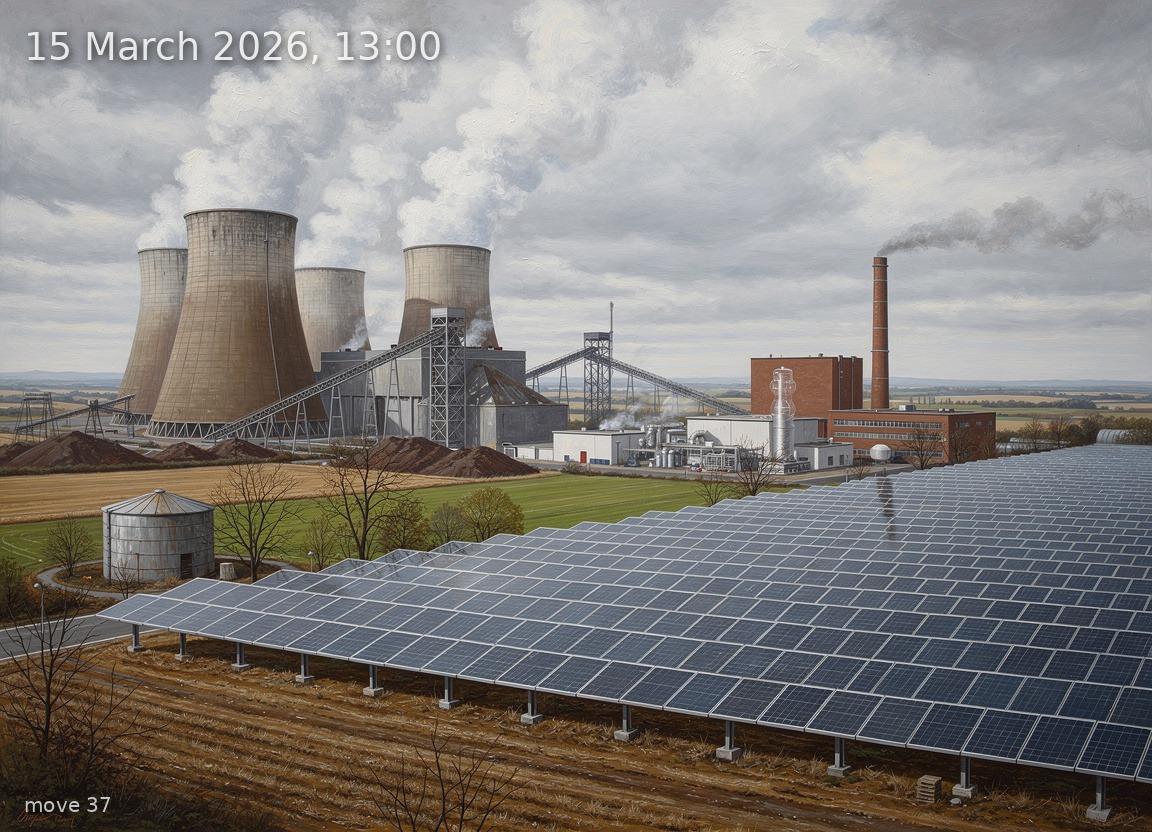
Solar leads at 17.7 GW under full overcast; brown coal and gas fill gaps as low wind forces 9.2 GW net imports.
Back
Generation mix
Wind onshore 6%
Wind offshore 10%
Solar 43%
Biomass 10%
Hydro 3%
Natural gas 8%
Hard coal 4%
Brown coal 17%
71%
Renewable share
6.7 GW
Wind (on + offshore)
17.7 GW
Solar
41.4 GW
Total generation
-9.1 GW
Net import
36.5 €/MWh
Day-ahead price
6.4°C / 4 km/h
Temp / Wind speed
Open-Meteo, Kassel (51.3°N 9.5°E)
100% / 64.0 W/m²
Cloud cover / Radiation
206
gCO₂/kWh
Image prompt
Solar 17.7 GW dominates the right half and centre of the scene as vast fields of aluminium-framed crystalline silicon photovoltaic panels stretching across flat agricultural land toward the horizon, their blue-grey surfaces reflecting the diffuse white light of a completely overcast sky. Brown coal 7.1 GW occupies the left quarter as a cluster of massive hyperbolic concrete cooling towers emitting thick white steam plumes that merge into the low grey cloud ceiling, flanked by conveyor belts feeding raw lignite into enormous boiler houses. Wind offshore 4.0 GW appears in the distant background as a row of tall three-blade turbines barely visible through haze on the far horizon, their rotors nearly motionless. Natural gas 3.2 GW is rendered as a compact combined-cycle gas turbine plant with a single tall exhaust stack and visible heat-shimmer, positioned between the coal complex and the solar fields. Wind onshore 2.7 GW shows as a small cluster of modern lattice-tower turbines on a low ridge behind the solar panels, blades turning sluggishly. Biomass 4.0 GW appears as a mid-sized industrial facility with a wood-chip storage dome and a modest smokestack with faint exhaust, nestled among bare early-spring trees to the left of the gas plant. Hydro 1.2 GW is suggested by a small concrete dam and reservoir visible in a valley in the far left background. Hard coal 1.5 GW is a single traditional power station with a rectangular brick chimney releasing thin grey smoke, adjacent to the brown coal complex. The sky is entirely blanketed in uniform pale-grey stratus clouds at 13:00 full daylight — bright but completely diffuse, no sun disc visible, no shadows on the ground. The landscape is early March in central Germany: brown stubble fields, bare deciduous trees with only the faintest hint of budding, patches of dull green winter wheat, temperature around 6°C suggesting a raw chill — figures in the distance wear coats. The atmosphere is neither oppressive nor serene, a moderate industrial hum under a calm pewter sky. Highly detailed oil painting in the tradition of 19th-century German Romantic landscape painters — Caspar David Friedrich's compositional grandeur merged with meticulous industrial realism — rich layered colour in muted greys, ochres, and steel-blues, visible confident brushwork, extraordinary atmospheric depth and aerial perspective. Every technology rendered with correct engineering detail: turbine nacelles, three-blade rotors, PV module grid patterns, cooling tower parabolic geometry, CCGT heat recovery units. No text, no labels, no human figures in the foreground.