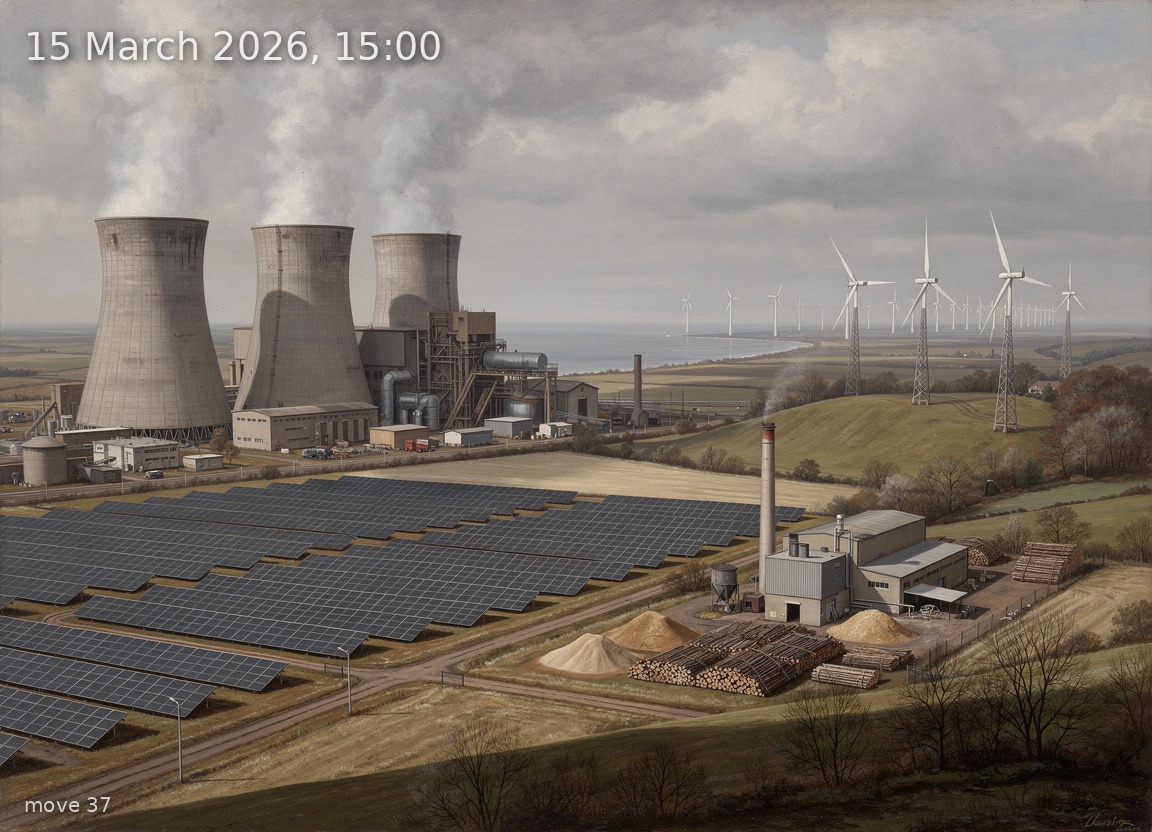
Overcast skies limit solar output; brown coal and net imports of 7.7 GW fill the gap alongside moderate wind.
Back
Generation mix
Wind onshore 9%
Wind offshore 13%
Solar 29%
Biomass 10%
Hydro 3%
Natural gas 9%
Hard coal 6%
Brown coal 22%
63%
Renewable share
8.6 GW
Wind (on + offshore)
11.5 GW
Solar
40.1 GW
Total generation
-7.7 GW
Net import
63.1 €/MWh
Day-ahead price
7.3°C / 4 km/h
Temp / Wind speed
Open-Meteo, Kassel (51.3°N 9.5°E)
100% / 16.2 W/m²
Cloud cover / Radiation
267
gCO₂/kWh
Image prompt
Brown coal 8.9 GW dominates the left third of the scene as a massive lignite power station with four hyperbolic cooling towers emitting dense white steam plumes; solar 11.5 GW occupies the centre-left as vast fields of aluminium-framed crystalline silicon PV panels stretching across flat farmland, their surfaces reflecting only dull grey sky; wind offshore 5.1 GW appears in the distant right background as rows of tall three-blade turbines rising from a hazy North Sea horizon; wind onshore 3.5 GW stands in the right midground as a cluster of modern lattice-tower turbines with slowly turning rotors on rolling hills; biomass 4.1 GW is rendered as a wood-chip-fed combined heat and power plant with a tall industrial chimney and timber storage yard in the centre-right; natural gas 3.5 GW appears as two compact CCGT units with slender exhaust stacks and modest heat shimmer near the brown coal complex; hard coal 2.3 GW is a smaller coal plant with a single stack and conveyor belt visible behind the gas units; hydro 1.2 GW is a modest run-of-river weir with foaming spillway along a river in the foreground. The time is 15:00 in mid-March: full daylight but completely overcast, a heavy uniform 100% cloud ceiling casts flat diffuse light with no shadows, no sun disk visible, the sky a monotone pewter-grey that presses down oppressively — matching a moderately high electricity price. Temperature is 7°C: early spring with bare deciduous trees just hinting at first buds, pale dormant grass, patches of mud, no snow. Wind is very light at 4 km/h: turbine blades barely creeping, no movement in vegetation, still air, smoke and steam rising straight upward. Transmission lines on steel lattice pylons cross the scene left to right, symbolizing cross-border power flow. Highly detailed oil painting in the tradition of 19th-century German Romantic landscape painters — rich muted earth tones, visible confident brushwork, atmospheric depth with hazy industrial distance, dramatic chiaroscuro despite overcast light — rendered with meticulous engineering accuracy for every technology. No text, no labels.