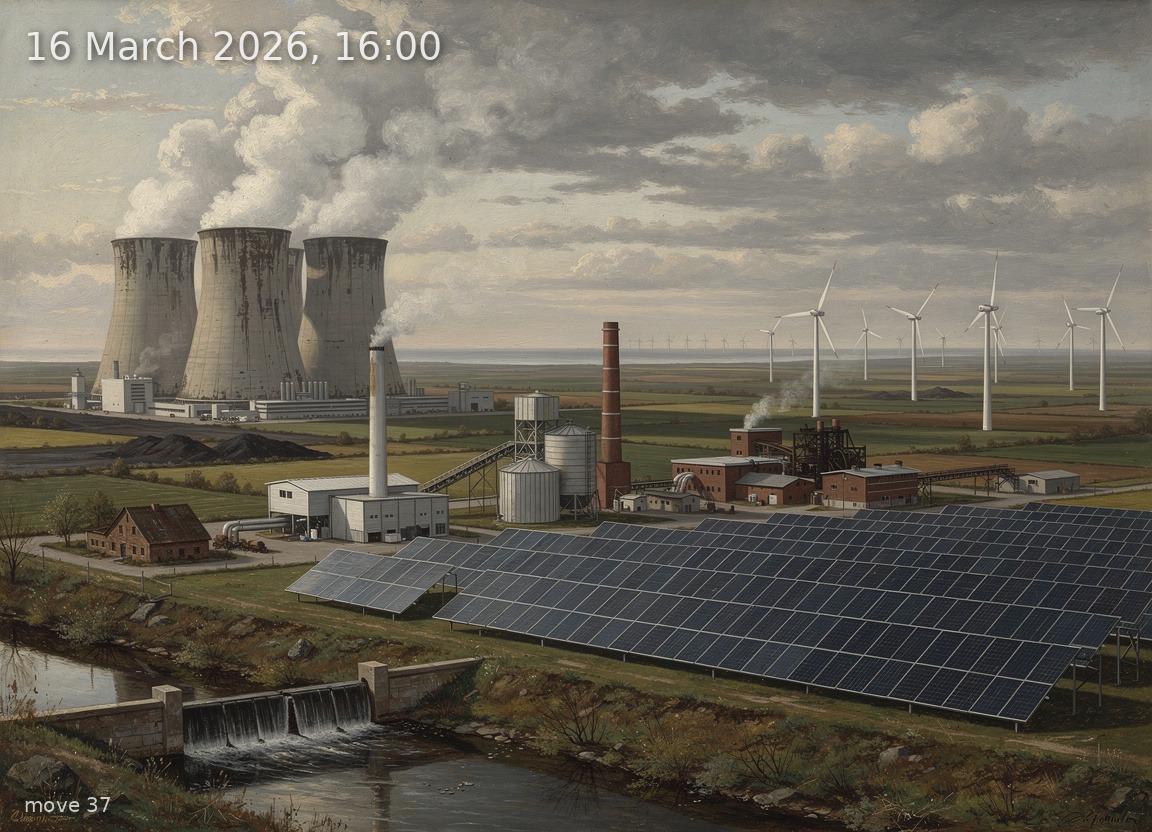
Wind onshore (20.9 GW) and brown coal (11.4 GW) anchor a 63% renewable grid under elevated afternoon prices.
Back
Generation mix
Wind onshore 34%
Wind offshore 5%
Solar 15%
Biomass 7%
Hydro 2%
Natural gas 11%
Hard coal 8%
Brown coal 19%
63%
Renewable share
23.9 GW
Wind (on + offshore)
9.5 GW
Solar
61.2 GW
Total generation
-0.3 GW
Net import
106.2 €/MWh
Day-ahead price
7.4°C / 9 km/h
Temp / Wind speed
Open-Meteo, Kassel (51.3°N 9.5°E)
54% / 49.5 W/m²
Cloud cover / Radiation
262
gCO₂/kWh
Image prompt
Wind onshore 20.9 GW dominates the right half of the scene as dozens of three-blade turbines with white tubular towers and nacelles stretching across rolling green-brown early-spring farmland; brown coal 11.4 GW occupies the left quarter as a massive lignite power station with four hyperbolic concrete cooling towers emitting thick white steam plumes; solar 9.5 GW appears as a broad field of aluminium-framed crystalline silicon panels in the centre-right foreground catching diffused afternoon light; natural gas 6.5 GW is rendered as two compact CCGT units with single tall exhaust stacks and thin heat shimmer, positioned left of centre; hard coal 4.7 GW sits behind the gas plant as a dark brick-and-steel station with conveyor belts and a single square chimney trailing grey smoke; biomass 4.2 GW appears as a modest wood-chip-fired plant with a rounded silo and low stack near the centre; wind offshore 3.0 GW is suggested by a distant row of larger turbines on a hazy horizon line; hydro 1.1 GW is a small concrete run-of-river weir in a stream in the lower-left foreground. The sky is 54% overcast—broken cumulus clouds in layers of grey and cream with patches of pale blue, the late-afternoon March sun at roughly 25° elevation filtering through gaps, casting soft warm light and muted shadows. Direct radiation is low, giving the landscape a slightly diffused, subdued golden quality. Bare deciduous trees with the first faint buds of spring dot the margins; dormant grass has a brownish-green tinge at 7.4 °C. The atmosphere feels heavy and pressured, conveying the 106 EUR/MWh price—a leaden weight in the air, an industrial tension. Painted in the style of a highly detailed 19th-century German Romantic oil painting with rich impasto brushwork, atmospheric aerial perspective, deep colour saturation in the earth tones and industrial greys, meticulous engineering accuracy on every turbine blade, cooling tower, and panel frame. No text, no labels.