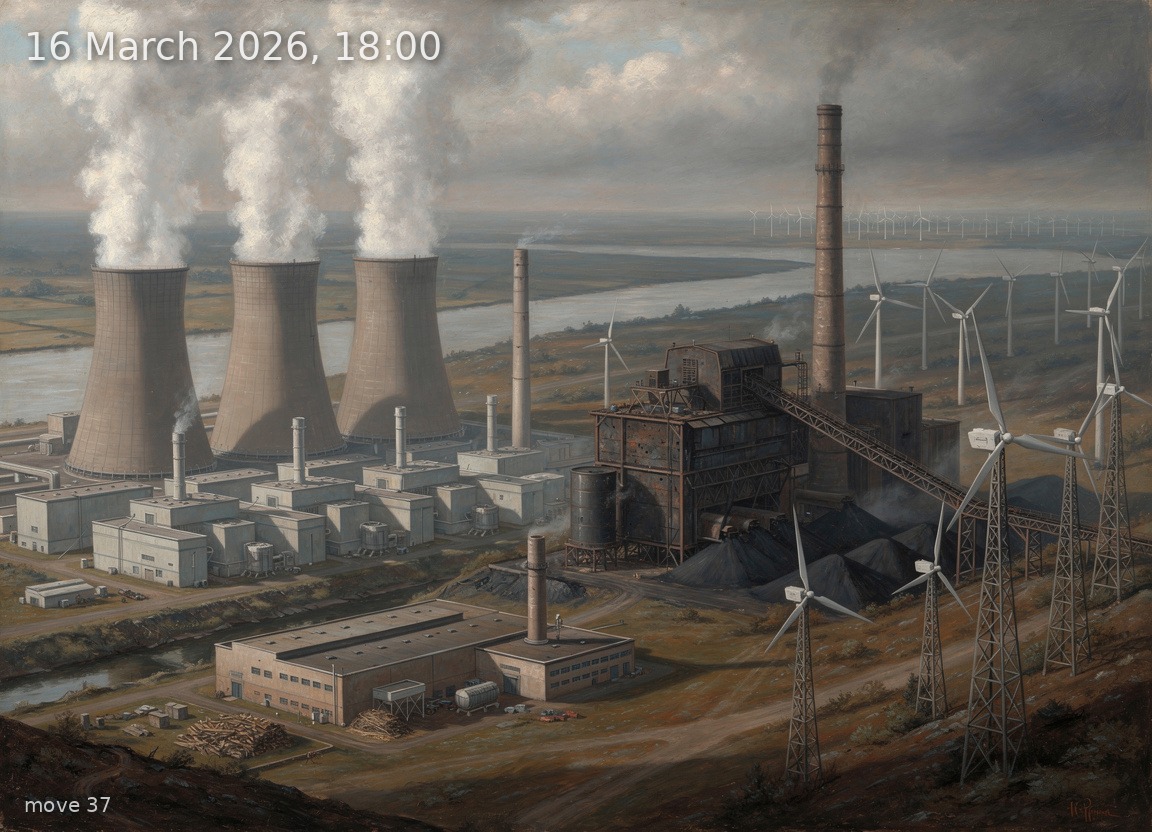
Brown coal, gas, and hard coal dominate evening dispatch as low wind and absent solar drive high prices and 17 GW net imports.
Back
Generation mix
Wind onshore 26%
Wind offshore 6%
Solar 0%
Biomass 9%
Hydro 3%
Natural gas 20%
Hard coal 12%
Brown coal 23%
45%
Renewable share
15.6 GW
Wind (on + offshore)
0.2 GW
Solar
48.6 GW
Total generation
-17.3 GW
Net import
165.0 €/MWh
Day-ahead price
6.9°C / 4 km/h
Temp / Wind speed
Open-Meteo, Kassel (51.3°N 9.5°E)
100% / 43.5 W/m²
Cloud cover / Radiation
379
gCO₂/kWh
Image prompt
Brown coal 11.4 GW dominates the left third of the scene as a massive lignite power station with four hyperbolic cooling towers emitting thick white steam plumes; natural gas 9.7 GW occupies the centre-left as a row of compact CCGT units with tall single exhaust stacks venting heat shimmer; hard coal 5.8 GW appears centre-right as a darker, older coal plant with a single large smokestack and coal conveyor belt; wind onshore 12.7 GW fills the right third and extends into the background as dozens of three-blade turbines on lattice and tubular towers, blades turning very slowly in near-calm air; wind offshore 2.8 GW is suggested by a distant cluster of turbines on a grey horizon line beyond a river; biomass 4.4 GW appears as a mid-ground wood-chip-fed CHP plant with a modest rectangular stack and steam wisp; hydro 1.6 GW is a small concrete run-of-river weir with churning white water in the foreground stream. The sky is dusk at 18:00 in March — the lower horizon glows a muted orange-red rapidly giving way to heavy slate-grey and deep indigo overcast above, 100 percent cloud cover pressing down oppressively with no stars visible. The atmosphere feels weighty and expensive, haze and industrial steam blurring the middle distance. Temperature is near 7°C: bare deciduous trees with no leaves, dormant brown grass, patches of mud. Light wind barely stirs the scene. Sodium streetlights along a road in the lower foreground are just flickering on, casting amber pools. No solar panels anywhere — no sunshine. Style: highly detailed oil painting in the tradition of 19th-century German Romantic landscape painters such as Caspar David Friedrich and Carl Blechen — rich, sombre colour palette of umber, ochre, slate blue, and warm industrial orange; visible confident brushwork; atmospheric depth with layers of haze; meticulous engineering detail on every turbine nacelle, cooling tower flute, and gas-stack geometry. The painting conveys the sublime weight of industrial civilisation at twilight. No text, no labels.