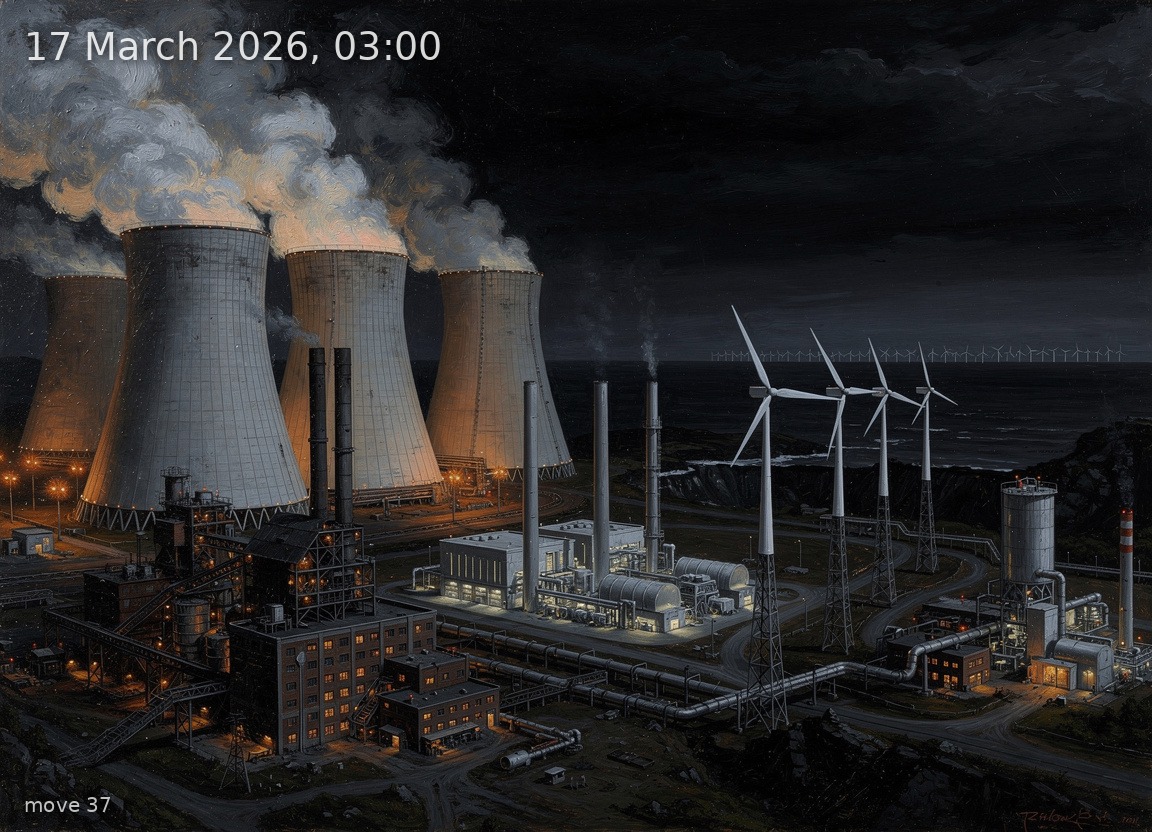
Brown coal and fossil thermal plants dominate a cold, wind-moderate night with 7.1 GW net imports needed.
Back
Generation mix
Wind onshore 19%
Wind offshore 10%
Biomass 10%
Hydro 3%
Natural gas 14%
Hard coal 14%
Brown coal 30%
42%
Renewable share
11.5 GW
Wind (on + offshore)
0.0 GW
Solar
39.0 GW
Total generation
-7.1 GW
Net import
106.5 €/MWh
Day-ahead price
1.2°C / 3 km/h
Temp / Wind speed
Open-Meteo, Kassel (51.3°N 9.5°E)
73% / 0.0 W/m²
Cloud cover / Radiation
417
gCO₂/kWh
Image prompt
Brown coal 11.6 GW dominates the left third as a vast complex of hyperbolic cooling towers with thick white steam plumes lit from below by sodium-orange industrial lights; hard coal 5.4 GW appears as a dark cluster of conventional power station buildings with tall chimneys and coal conveyors in the left-centre; natural gas 5.5 GW fills the centre as compact CCGT units with slender exhaust stacks emitting thin vapour; wind onshore 7.6 GW spans the right-centre as a row of tall three-blade turbines on lattice towers, rotors turning slowly; wind offshore 3.9 GW appears in the far right distance as a line of turbines standing in a dark sea barely visible on the horizon; biomass 3.9 GW is rendered as a modest industrial facility with a wood-chip silo and single stack near the wind turbines; hydro 1.2 GW appears as a small illuminated dam and powerhouse nestled in a valley in the far background. Time is 3 AM in mid-March — the sky is completely black with no twilight whatsoever, deep navy-to-black, overcast at 73% cloud cover so no stars are visible, only a featureless dark canopy. Temperature is 1.2°C: frost rims the bare branches of leafless winter trees in the foreground, patches of old snow on dormant brown grass. The atmosphere feels heavy and oppressive, reflecting the high electricity price — a thick industrial haze hangs low, tinted amber by rows of sodium streetlights lining a road in the lower foreground. Steam plumes from the lignite towers are massive and billow sideways slightly in the 3 km/h breeze, catching the orange glow from below. No solar panels anywhere — no sunshine, pure darkness. Highly detailed oil painting in the tradition of 19th-century German Romantic landscape painters such as Caspar David Friedrich and Carl Blechen — rich impasto brushwork, deep chiaroscuro, atmospheric depth with layers of industrial haze receding into blackness, warm sodium-light reflections on wet pavement contrasting with cold blue-grey steel structures. Meticulous engineering detail on every turbine nacelle, cooling tower fluting, CCGT exhaust stack, and coal conveyor. The scene conveys the sublime scale of industrial infrastructure against the vast dark night. No text, no labels.