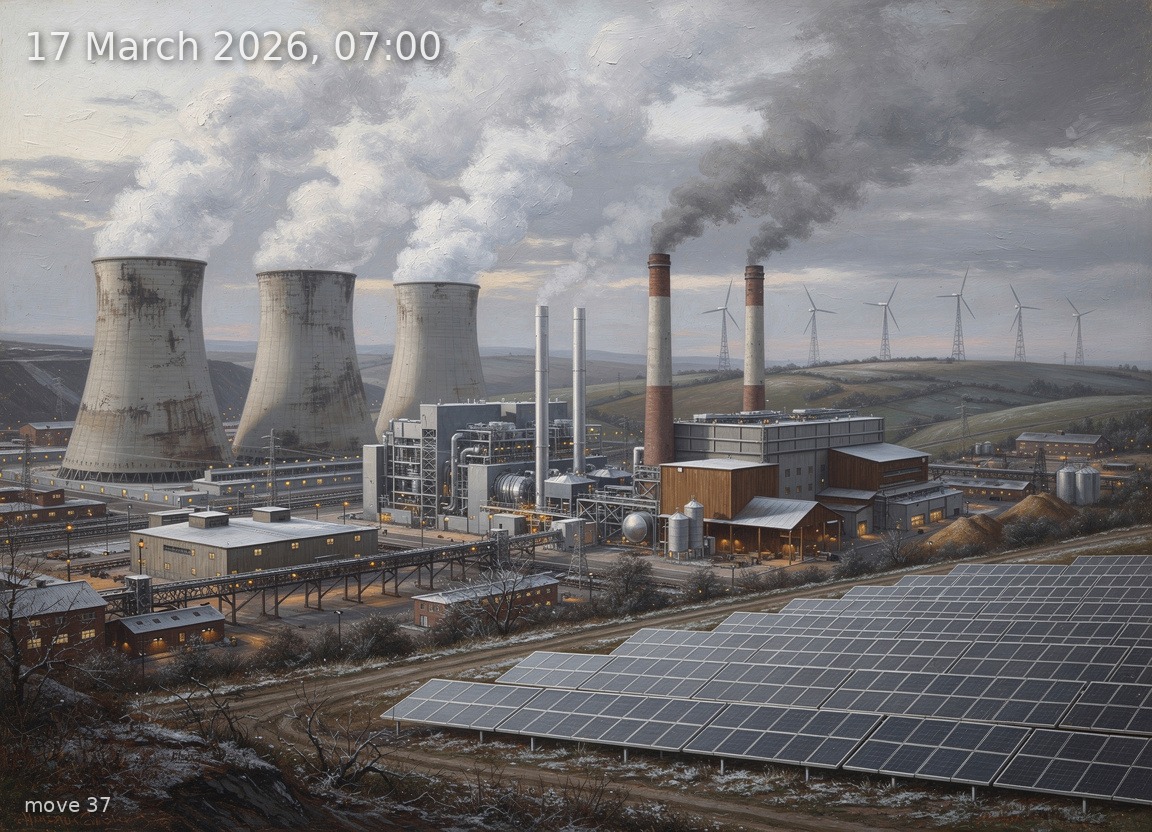
Brown coal and gas dominate as cold, still, overcast conditions suppress renewables and drive 18.9 GW of net imports.
Back
Generation mix
Wind onshore 12%
Wind offshore 9%
Solar 8%
Biomass 10%
Hydro 3%
Natural gas 19%
Hard coal 13%
Brown coal 26%
42%
Renewable share
9.2 GW
Wind (on + offshore)
3.5 GW
Solar
43.7 GW
Total generation
-18.9 GW
Net import
168.0 €/MWh
Day-ahead price
1.0°C / 2 km/h
Temp / Wind speed
Open-Meteo, Kassel (51.3°N 9.5°E)
97% / 0.0 W/m²
Cloud cover / Radiation
406
gCO₂/kWh
Image prompt
Brown coal 11.6 GW dominates the left third of the scene as a vast lignite power station with four massive hyperbolic cooling towers emitting thick white steam plumes; natural gas 8.3 GW fills the centre-left as a cluster of compact CCGT units with tall single exhaust stacks trailing thinner vapour; hard coal 5.6 GW appears centre-right as a classical coal plant with rectangular boiler houses and a pair of tall chimneys; wind onshore 5.2 GW is shown in the middle distance on low hills as a row of three-blade turbines on lattice towers, blades barely turning in the near-still air; wind offshore 4.0 GW is suggested on the far-right horizon as smaller silhouettes of turbines above a sliver of grey sea; biomass 4.2 GW appears as a timber-clad industrial facility with a modest smokestack near the coal plant; hydro 1.3 GW is a small concrete run-of-river dam in the foreground with dark water; solar 3.5 GW is rendered as a field of aluminium-framed crystalline silicon panels in the right foreground, their surfaces reflecting only dull grey sky, producing minimal output. Time is early dawn at 07:00 in March: the sky is a deep blue-grey pre-dawn wash, no direct sunlight, only a faint pale band of cold light along the eastern horizon. Clouds cover 97% of the sky in heavy, oppressive layers. Temperature is 1°C: frost rims the bare branches of dormant deciduous trees and patches of old snow cling to ploughed fields. Air is almost perfectly still. The atmosphere is dense, weighty, and brooding, reflecting the extreme price pressure. Rendered as a highly detailed oil painting in the tradition of 19th-century German Romantic landscape painters — rich, sombre colour palette of slate blues, ash greys, ochre industrial yellows, and warm furnace oranges; visible impasto brushwork on steam clouds and sky; meticulous engineering accuracy on every turbine nacelle, cooling tower profile, and panel frame; atmospheric depth created by layers of industrial haze receding toward the flat northern horizon. No text, no labels.