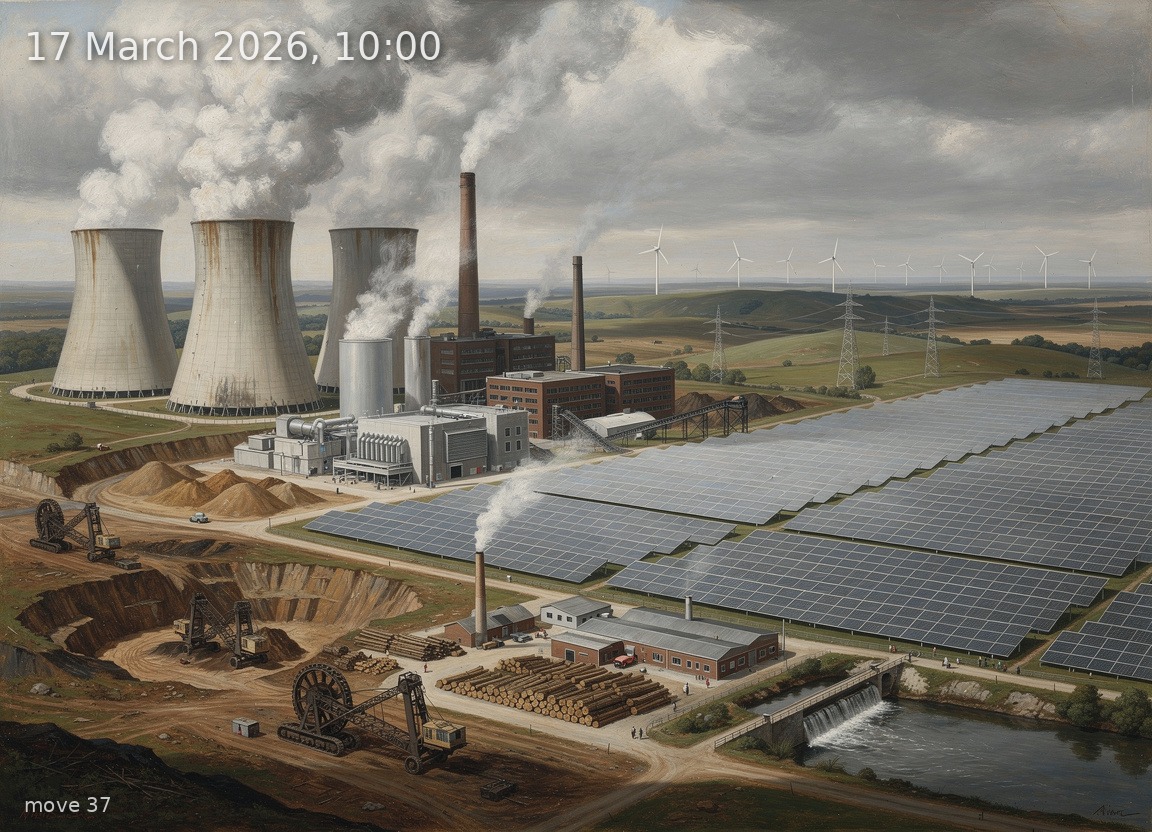
Solar leads at 21.6 GW under heavy overcast; brown coal and imports cover a 36.4 GW residual load.
Back
Generation mix
Wind onshore 5%
Wind offshore 8%
Solar 38%
Biomass 7%
Hydro 2%
Natural gas 12%
Hard coal 10%
Brown coal 19%
60%
Renewable share
7.3 GW
Wind (on + offshore)
21.6 GW
Solar
56.7 GW
Total generation
-8.6 GW
Net import
108.6 €/MWh
Day-ahead price
3.7°C / 4 km/h
Temp / Wind speed
Open-Meteo, Kassel (51.3°N 9.5°E)
98% / 25.5 W/m²
Cloud cover / Radiation
281
gCO₂/kWh
Image prompt
Solar 21.6 GW dominates the right half of the composition as vast fields of aluminium-framed crystalline silicon PV panels stretching across flat farmland, their surfaces reflecting only dull grey light; brown coal 10.5 GW occupies the left foreground as a cluster of massive hyperbolic cooling towers with thick white-grey steam plumes merging into the overcast sky, beside open-pit lignite excavations with bucket-wheel excavators; natural gas 6.6 GW appears centre-left as two compact CCGT power plants with slender exhaust stacks and thin heat shimmer; hard coal 5.5 GW sits behind them as a dark brick power station with twin chimneys and coal conveyors; wind offshore 4.5 GW is visible in the far background as a row of three-blade turbines on the horizon, their rotors barely turning; wind onshore 2.8 GW appears as a few scattered lattice-tower turbines on low hills, nearly still; biomass 4.0 GW is rendered as a mid-ground wood-chip plant with a modest smokestack and log piles; hydro 1.2 GW is a small run-of-river weir with a stone powerhouse at the painting's far right edge. The sky is a heavy, unbroken 98% cloud ceiling in tones of slate grey and dull pewter, oppressive and low-hanging, conveying high electricity prices. Full daytime at 10:00 but no direct sun — flat diffuse light illuminates the landscape evenly without shadows. The season is early spring: bare deciduous trees, patches of brown grass beginning to green, temperature near freezing visible as frost on metal structures and breath-like steam. The atmosphere feels dense and weighty. Rendered as a highly detailed oil painting in the tradition of 19th-century German Romantic landscape painters — rich layered colour, visible confident brushwork, atmospheric depth and haze — with meticulous engineering accuracy on every turbine nacelle, panel frame, cooling tower, and smokestack. No text, no labels.