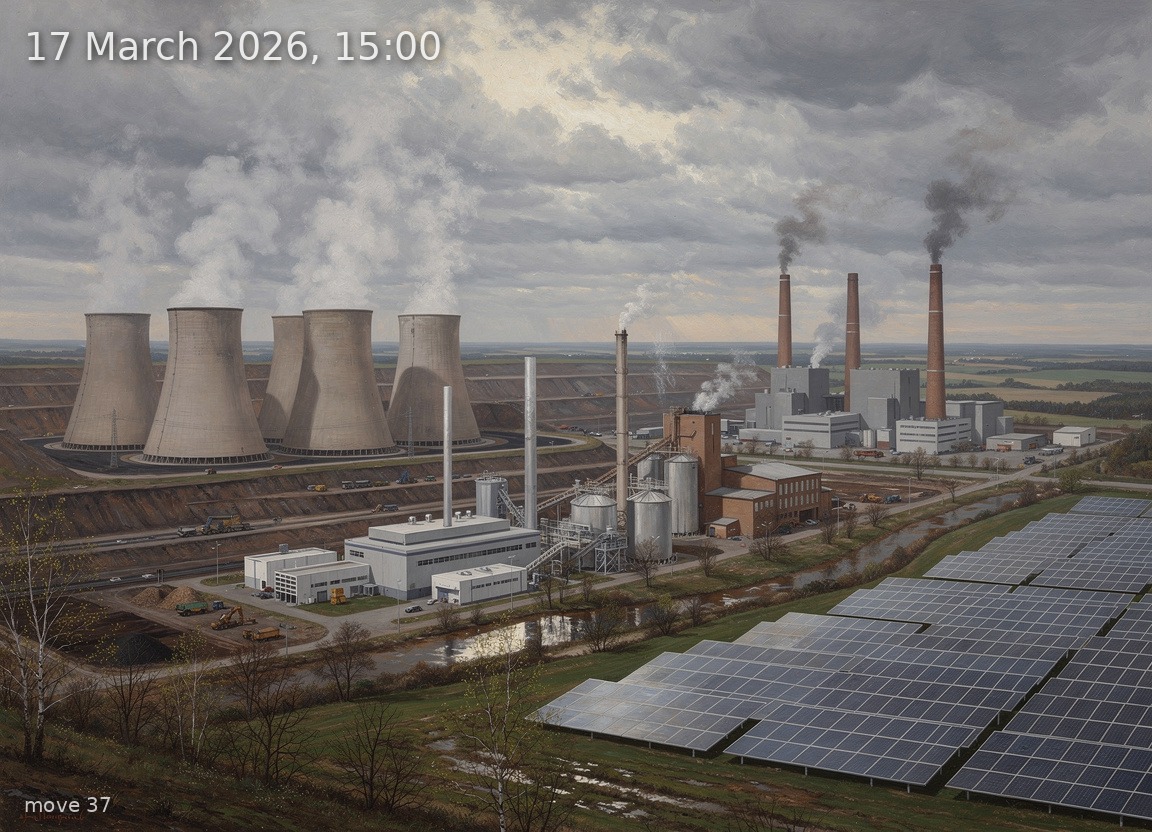
Solar leads at 17.9 GW under heavy overcast, but brown coal and gas fill a 36.7 GW residual load with 8.8 GW net imports.
Back
Generation mix
Wind onshore 6%
Wind offshore 5%
Solar 35%
Biomass 8%
Hydro 2%
Natural gas 12%
Hard coal 10%
Brown coal 22%
56%
Renewable share
5.3 GW
Wind (on + offshore)
17.9 GW
Solar
51.2 GW
Total generation
-8.8 GW
Net import
112.1 €/MWh
Day-ahead price
9.2°C / 7 km/h
Temp / Wind speed
Open-Meteo, Kassel (51.3°N 9.5°E)
95% / 61.5 W/m²
Cloud cover / Radiation
317
gCO₂/kWh
Image prompt
Brown coal 11.3 GW dominates the left third of the scene as a cluster of massive hyperbolic cooling towers with thick white-grey steam plumes rising into the overcast, surrounded by open-pit lignite mines with terraced brown earth; solar 17.9 GW fills the centre-right as vast fields of aluminium-framed crystalline silicon PV panels stretching across flat farmland, their surfaces reflecting only dim grey light; natural gas 6.3 GW appears as a group of modern CCGT plants with tall slender exhaust stacks and compact turbine halls positioned centre-left, thin heat shimmer above their outlets; hard coal 5.1 GW sits behind the lignite complex as a traditional coal plant with rectangular boiler houses and a pair of tall brick chimneys trailing dark plumes; wind onshore 2.9 GW shows as a small cluster of three-blade turbines on a low hill to the far right, rotors barely turning in light wind; wind offshore 2.4 GW is suggested by distant turbines on a hazy horizon line; biomass 4.0 GW appears as a mid-sized industrial facility with wood-chip silos and a squat smokestack near the centre; hydro 1.2 GW is a small run-of-river weir with a concrete powerhouse at the edge of a grey river in the foreground. The sky is 95% overcast — a heavy, oppressive blanket of uniform grey stratus pressing low, consistent with the high electricity price, with only the faintest bright patch where the sun tries to break through at mid-afternoon position; diffuse daylight illuminates the scene flatly without strong shadows. Temperature is a cool 9°C early spring: bare deciduous trees with the first tiny buds, brown-green dormant grass, patches of mud. The air feels dense and still. Highly detailed oil painting in the tradition of 19th-century German Romantic landscape painters — Caspar David Friedrich's atmospheric depth meets industrial realism — rich muted colour palette of greys, ochres, slate blues, and dull greens, visible confident brushwork, meticulous engineering detail on every turbine nacelle, cooling tower ribbing, PV cell grid pattern, and smokestack riveting. Panoramic wide composition. No text, no labels.