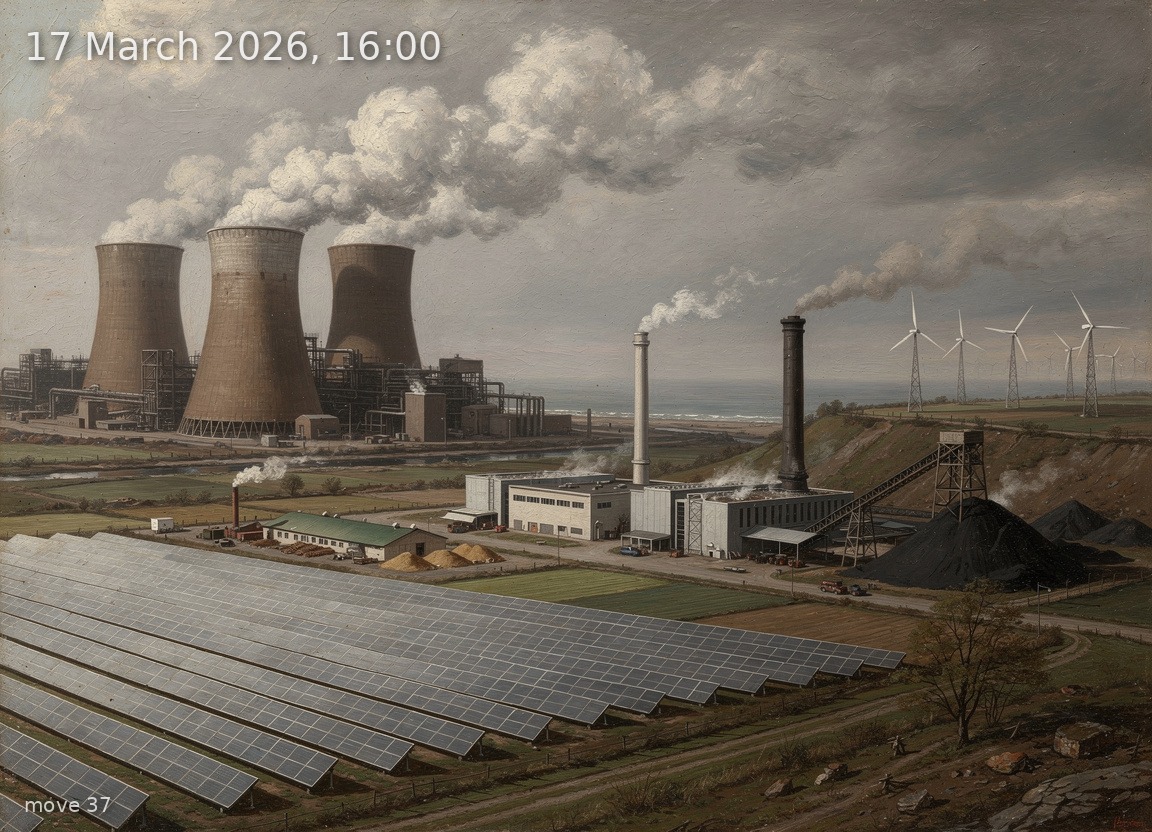
Brown coal and gas dominate as weak winds and overcast skies limit renewables, driving high prices and significant net imports.
Back
Generation mix
Wind onshore 7%
Wind offshore 5%
Solar 22%
Biomass 9%
Hydro 3%
Natural gas 19%
Hard coal 11%
Brown coal 25%
45%
Renewable share
5.5 GW
Wind (on + offshore)
10.5 GW
Solar
47.5 GW
Total generation
-11.9 GW
Net import
131.8 €/MWh
Day-ahead price
9.9°C / 7 km/h
Temp / Wind speed
Open-Meteo, Kassel (51.3°N 9.5°E)
91% / 58.5 W/m²
Cloud cover / Radiation
379
gCO₂/kWh
Image prompt
Brown coal 11.9 GW occupies the left third of the scene as a massive lignite power station complex with four hyperbolic cooling towers issuing thick white steam plumes; solar 10.5 GW fills the centre-left foreground as vast fields of aluminium-framed crystalline silicon PV panels stretching across flat farmland, their surfaces reflecting only dull grey sky; natural gas 8.8 GW appears centre-right as two modern CCGT plants with tall single exhaust stacks and low rectangular turbine halls, heat shimmer above their vents; hard coal 5.2 GW sits right of centre as a smaller coal plant with a single large smokestack and conveyor belt feeding a coal bunker; wind onshore 3.2 GW is rendered as a sparse cluster of three-blade turbines with lattice towers on a low ridge in the right background, rotors barely turning; wind offshore 2.3 GW appears as distant turbines on the far-right horizon line suggesting the North Sea coast; biomass 4.3 GW is a modest wood-chip fired plant with a green-roofed facility and small chimney in the middle distance; hydro 1.4 GW is a small dam and powerhouse nestled in a gentle valley in the far background. The sky is 91% overcast — a heavy, low, uniform blanket of grey stratus clouds pressing down oppressively, consistent with a day-ahead price of 131.8 EUR/MWh. Late-afternoon daylight at 16:00 in March: the sun is low in the west but completely hidden, casting flat, shadowless illumination with a cold bluish-grey tone. Temperature is near 10°C: early spring vegetation — bare deciduous trees with the faintest green buds, pale brown grass, patches of mud. The atmosphere is heavy, humid, almost suffocating in its greyness. Painted in the style of a highly detailed 19th-century German Romantic oil painting — rich impasto brushwork, atmospheric perspective with haze thickening toward the horizon, meticulous engineering detail on every turbine nacelle, cooling tower fluting, and PV panel frame. The palette is dominated by slate grey, industrial white, muted earth tones, and the dull silver of solar panels. No text, no labels.