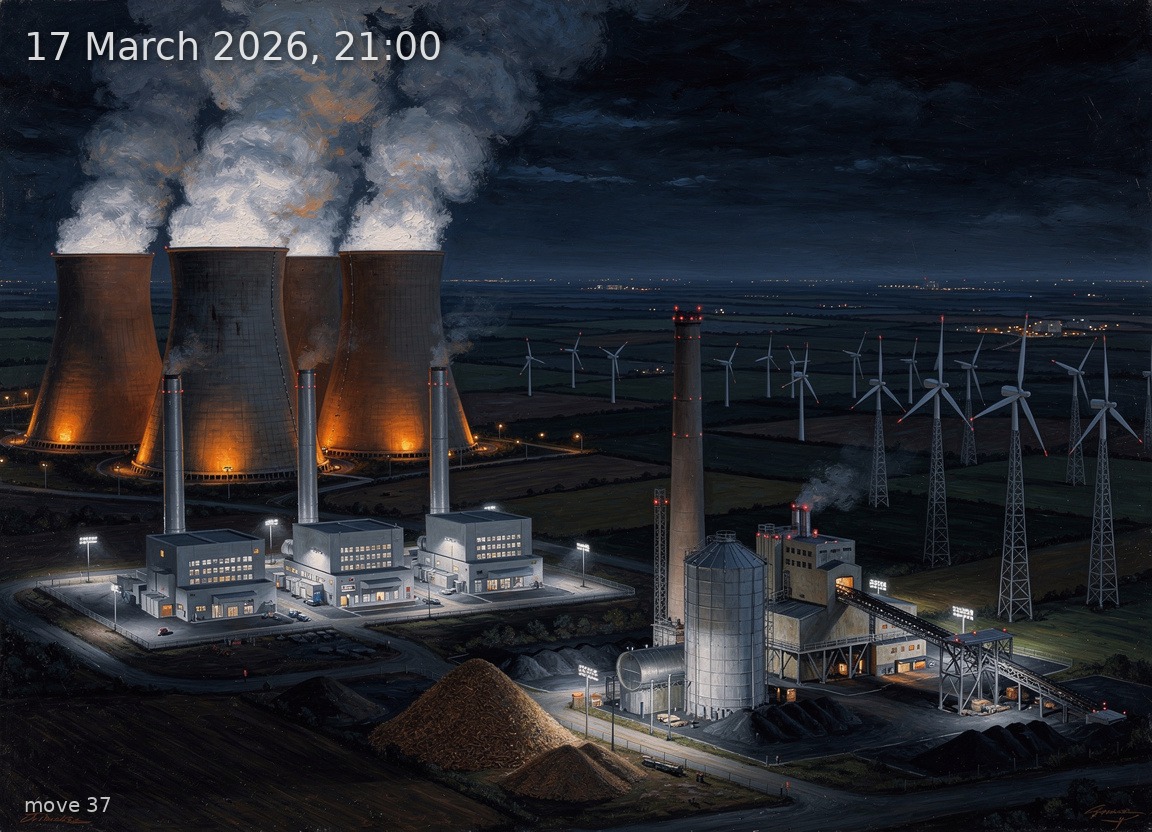
Wind and lignite anchor a 50.9 GW evening grid as solar is absent and 6.9 GW of net imports cover remaining demand.
Back
Generation mix
Wind onshore 28%
Wind offshore 11%
Solar 0%
Biomass 8%
Hydro 2%
Natural gas 18%
Hard coal 10%
Brown coal 23%
49%
Renewable share
19.6 GW
Wind (on + offshore)
0.0 GW
Solar
50.9 GW
Total generation
-7.0 GW
Net import
129.8 €/MWh
Day-ahead price
6.7°C / 2 km/h
Temp / Wind speed
Open-Meteo, Kassel (51.3°N 9.5°E)
73% / 0.0 W/m²
Cloud cover / Radiation
352
gCO₂/kWh
Image prompt
Brown coal 11.9 GW dominates the left third of the scene as a cluster of massive hyperbolic cooling towers emitting thick white steam plumes, lit from below by orange sodium lamps; natural gas 9.0 GW occupies the centre-left as three compact CCGT plants with tall single exhaust stacks venting thin heat shimmer; hard coal 5.1 GW appears centre-right as a smaller coal-fired station with a wide chimney and conveyor belts; wind onshore 14.1 GW spans the entire right half and background as dozens of three-blade turbines on lattice and tubular towers stretching across dark rolling farmland, their red aviation warning lights blinking; wind offshore 5.4 GW is suggested by a distant line of turbines on the far horizon where land meets a faint strip of sea; biomass 4.3 GW appears as a medium-sized industrial plant with a wood-chip silo and single stack near the coal station; hydro 1.1 GW is a small dam structure with illuminated spillway at the far left edge. TIME AND ATMOSPHERE: fully dark night sky, deep navy-black, no twilight glow whatsoever, 73% cloud cover renders the sky a heavy formless ceiling barely distinguishable from black, a few dim stars visible through gaps. Ground-level lighting is entirely artificial: sodium-orange streetlights line a road in the foreground, industrial floodlights cast pools of harsh white on the power stations, the cooling tower steam glows orange-white from below. The air feels heavy and oppressive, reflecting the high 129.8 EUR/MWh price — low clouds press down on the scene. Temperature 6.7°C in early spring: bare deciduous trees with no leaves, damp brown fields, patches of old frost on grass, the landscape sparse and wintry. Wind at ground level is calm at 2.5 km/h — no visible movement in grass, but turbine blades turn steadily at hub height. STYLE: highly detailed oil painting in the tradition of 19th-century German Romantic landscape painters such as Caspar David Friedrich, with rich dark palette of Prussian blue, lamp black, raw umber, and warm cadmium orange from artificial lights, visible thick brushwork, deep atmospheric perspective, meticulous engineering detail on every turbine nacelle, every cooling tower's parabolic curve, every CCGT exhaust stack. The composition evokes sublime industrial grandeur against the vast dark night. No text, no labels.