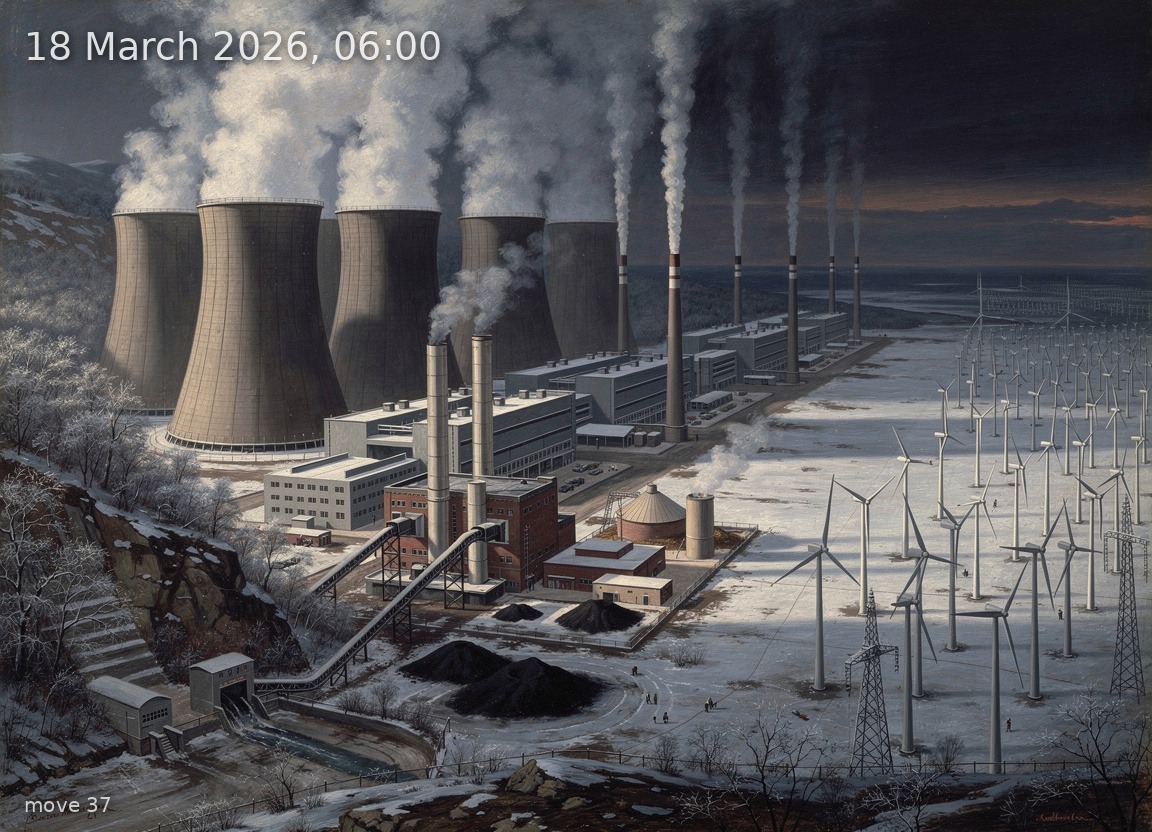
Wind leads at 25.2 GW but brown coal and gas fill the pre-dawn thermal gap as cold demand peaks.
Back
Generation mix
Wind onshore 37%
Wind offshore 9%
Solar 1%
Biomass 8%
Hydro 2%
Natural gas 13%
Hard coal 8%
Brown coal 22%
57%
Renewable share
25.3 GW
Wind (on + offshore)
0.6 GW
Solar
55.1 GW
Total generation
-3.8 GW
Net import
130.7 €/MWh
Day-ahead price
0.8°C / 2 km/h
Temp / Wind speed
Open-Meteo, Kassel (51.3°N 9.5°E)
0% / 0.0 W/m²
Cloud cover / Radiation
307
gCO₂/kWh
Image prompt
Brown coal 12.0 GW dominates the left quarter as a cluster of massive hyperbolic cooling towers with thick white steam plumes rising into the dark sky; natural gas 7.3 GW occupies the centre-left as a row of compact CCGT plants with tall single exhaust stacks emitting thin vapor; hard coal 4.6 GW appears centre as a smaller coal-fired station with twin stacks and conveyor belts; wind onshore 20.2 GW spans the entire right half of the scene as dozens of three-blade turbines on lattice and tubular towers receding into the distance across a flat plain, their rotors barely turning in the still air; wind offshore 5.0 GW is suggested by a line of turbines on the far-right horizon standing in a faintly visible grey sea; biomass 4.2 GW appears as a modest wood-chip-burning plant with a conical silo and short stack near the centre-right; hydro 1.2 GW is a small dam and powerhouse nestled in a low valley at the far left edge; solar 0.6 GW is represented by a tiny cluster of frost-covered crystalline PV panels in shadow, inert and dark. The sky is pre-dawn deep blue-grey with the faintest pale band of light emerging on the eastern horizon — no direct sunlight, no warm glow, stars still faintly visible overhead. The atmosphere is heavy and oppressive, reflecting 130.7 EUR/MWh pricing — low-hanging haze and industrial steam merge into a brooding ceiling. The ground is frozen, with light frost on bare winter fields and leafless trees. Temperature near 0 °C is conveyed by visible breath-like condensation from structures and rime ice on metal surfaces. Clear sky (0% cloud cover) allows the cold pre-dawn stars to prick through above the industrial haze. Painted in the style of a highly detailed 19th-century German Romantic oil painting — rich, dark tonal palette of Prussian blue, lamp black, and raw umber — with meticulous engineering detail on every turbine nacelle, every cooling tower's parabolic curve, every CCGT exhaust stack. Visible brushwork gives atmospheric depth and texture. The scene feels monumental, industrial, and quietly sublime. No text, no labels.