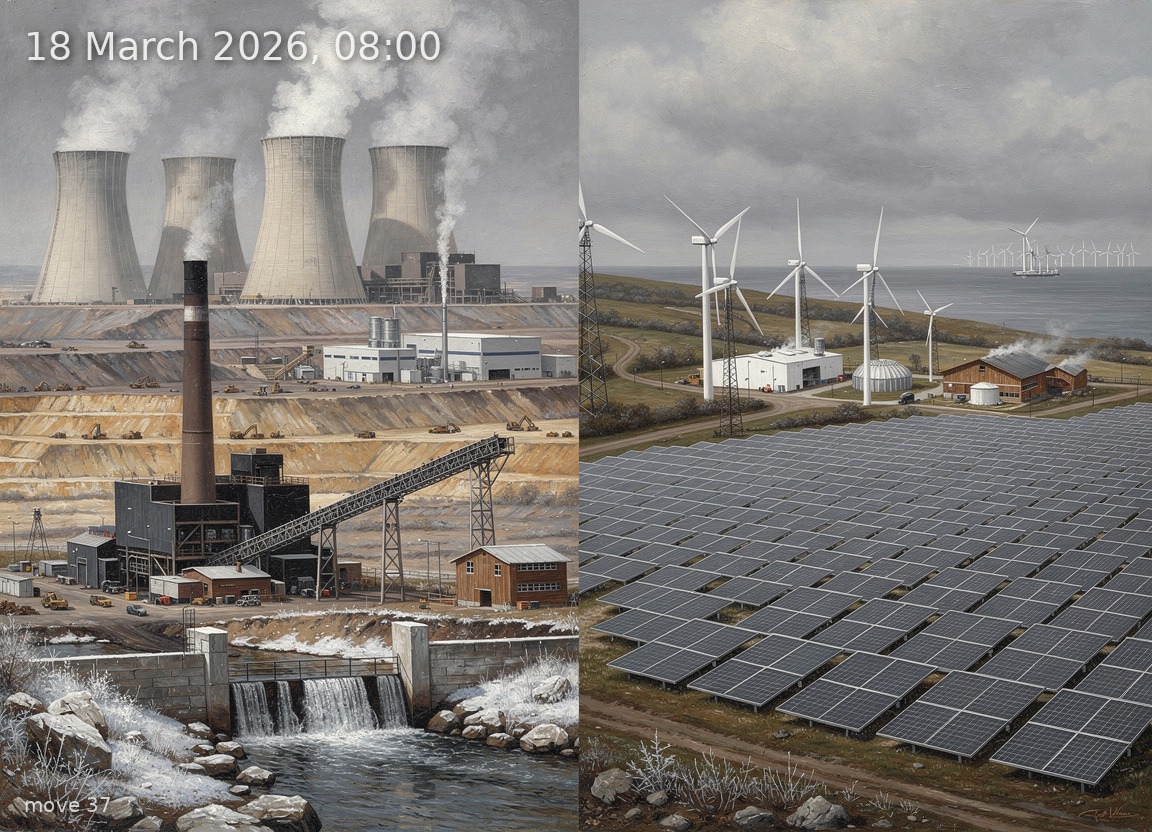
Wind and solar lead at 69.6% share, but brown coal and gas fill the cold-morning gap at elevated prices.
Back
Generation mix
Wind onshore 22%
Wind offshore 8%
Solar 32%
Biomass 7%
Hydro 2%
Natural gas 9%
Hard coal 5%
Brown coal 16%
70%
Renewable share
19.2 GW
Wind (on + offshore)
20.7 GW
Solar
65.0 GW
Total generation
-0.7 GW
Net import
99.9 €/MWh
Day-ahead price
-1.5°C / 3 km/h
Temp / Wind speed
Open-Meteo, Kassel (51.3°N 9.5°E)
100% / 10.0 W/m²
Cloud cover / Radiation
215
gCO₂/kWh
Records
#1
Ice Hour
Image prompt
Solar 20.7 GW fills the right third of the scene as vast fields of aluminium-framed crystalline silicon PV panels stretching across flat farmland, catching only flat grey diffuse light under total overcast; wind onshore 14.2 GW occupies the centre-right as dozens of three-blade turbines on tall lattice and tubular towers dotting rolling hills, their rotors barely turning in near-still air; wind offshore 5.0 GW appears as a distant cluster of offshore turbines glimpsed on a grey horizon line at far right; brown coal 10.7 GW dominates the left third as a massive lignite power station with four hyperbolic cooling towers emitting thick white steam plumes that merge into the overcast ceiling, surrounded by open-pit mine terraces of tan and ochre earth; natural gas 6.0 GW sits centre-left as two compact CCGT plants with slim exhaust stacks and smaller vapour trails; hard coal 3.1 GW appears as a single large power station with a tall chimney and conveyor belt infrastructure just left of centre; biomass 4.3 GW is rendered as a modest wood-clad CHP plant with a short stack and wood-chip storage dome near the centre; hydro 1.1 GW is a small run-of-river weir with a low concrete dam visible in a stream in the foreground. The sky is 100% overcast, a heavy uniform blanket of pewter-grey stratus pressing low over the landscape, daytime at 08:00 so the light is full but flat and cold with no shadows and no visible sun, giving an oppressive atmosphere reflecting the high electricity price. The temperature is −1.5 °C: frost coats every surface—white rime on the PV panel frames, on bare deciduous branches, on fence posts—and patches of old snow linger in furrows and along field margins; vegetation is late-winter dormant, brown grasses, leafless trees. The air is still, smoke and steam rise almost vertically. Painted in the style of a highly detailed 19th-century German Romantic oil painting—rich impasto brushwork, atmospheric aerial perspective with muted tonal recession, meticulous engineering detail on every turbine nacelle, every cooling tower flute, every solar panel cell grid—evoking Caspar David Friedrich's sense of sublime scale but applied to the modern industrial energy landscape. No text, no labels.