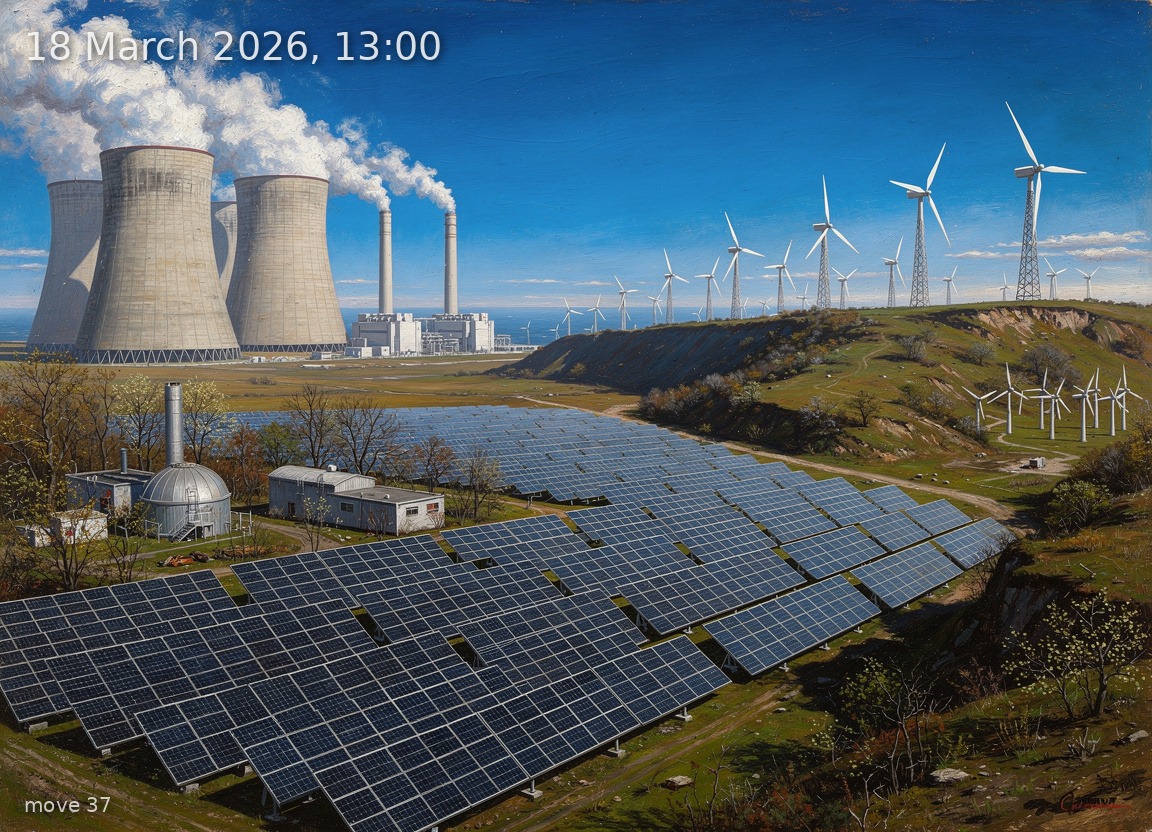
Massive 43 GW solar output under clear spring skies drives negative prices and 7.8 GW net exports.
Back
Generation mix
Wind onshore 10%
Wind offshore 3%
Solar 64%
Biomass 6%
Hydro 2%
Natural gas 5%
Hard coal 2%
Brown coal 8%
85%
Renewable share
8.8 GW
Wind (on + offshore)
43.1 GW
Solar
67.0 GW
Total generation
+7.7 GW
Net export
-2.7 €/MWh
Day-ahead price
11.8°C / 13 km/h
Temp / Wind speed
Open-Meteo, Kassel (51.3°N 9.5°E)
0% / 492.2 W/m²
Cloud cover / Radiation
107
gCO₂/kWh
Image prompt
Solar 43.1 GW dominates the scene: a vast central plain covered with thousands of aluminium-framed crystalline silicon photovoltaic panels stretching toward the horizon, their blue-black surfaces gleaming under an intensely bright midday sun in a perfectly cloudless sky. Brown coal 5.5 GW occupies the far left as a cluster of massive hyperbolic cooling towers releasing thick white steam plumes that drift gently eastward. Natural gas 3.3 GW appears as two compact CCGT power plants with tall single exhaust stacks and thinner grey exhaust streams, positioned left-centre behind the solar field. Biomass 3.8 GW is represented by a medium-sized biomass plant with a rounded storage dome and a modest smokestack, nestled among bare-branched early-spring trees at the left-centre edge. Wind onshore 7.0 GW fills the right portion of the scene as a long ridge of white three-blade turbines on lattice and tubular towers, blades turning slowly in moderate wind. Wind offshore 1.8 GW appears as a small cluster of turbines visible on the distant right horizon over a faint strip of grey-blue sea. Hydro 1.1 GW is a small concrete dam with cascading water in the far-right foreground valley. Hard coal 1.4 GW is a single modest coal plant with a square chimney barely visible behind the cooling towers on the far left. The landscape is early spring: pale green grass emerging, leafless deciduous trees just beginning to bud, temperature around 12 °C giving a mild, soft-aired quality. The sky is completely clear, deep cerulean blue, with full bright daylight casting sharp shadows from every structure. The atmosphere feels calm, open, and spacious—reflecting the negative electricity price. Highly detailed oil painting in the tradition of 19th-century German Romantic landscape painters—Caspar David Friedrich meets industrial realism—rich saturated colour, visible impasto brushwork, atmospheric aerial perspective with depth receding to a hazy horizon, meticulous engineering detail on every turbine nacelle, every PV panel frame, every cooling tower's concrete ribbing. No text, no labels.