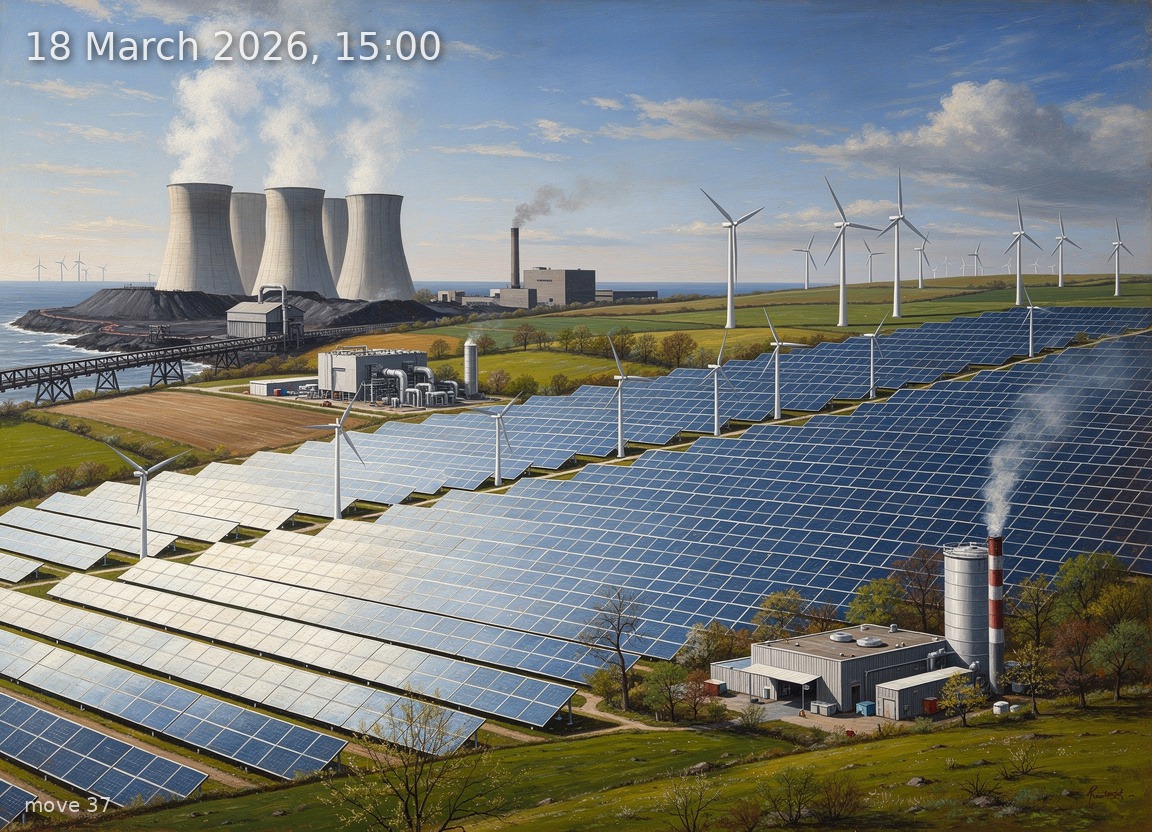
Clear skies drive 31.4 GW solar, leading a nearly 80% renewable generation mix with moderate thermal backup.
Back
Generation mix
Wind onshore 17%
Wind offshore 2%
Solar 52%
Biomass 7%
Hydro 2%
Natural gas 5%
Hard coal 3%
Brown coal 11%
80%
Renewable share
11.4 GW
Wind (on + offshore)
31.4 GW
Solar
60.1 GW
Total generation
+3.6 GW
Net export
47.2 €/MWh
Day-ahead price
13.0°C / 13 km/h
Temp / Wind speed
Open-Meteo, Kassel (51.3°N 9.5°E)
0% / 406.0 W/m²
Cloud cover / Radiation
145
gCO₂/kWh
Image prompt
Solar 31.4 GW dominates the centre and right of the composition as vast fields of aluminium-framed crystalline silicon photovoltaic panels stretching across gently rolling farmland, their surfaces blazing white-blue under direct sunlight, occupying roughly half the canvas. Brown coal 6.9 GW occupies the far left background as a cluster of massive hyperbolic concrete cooling towers with thick white steam plumes rising into the sky, flanked by a conveyor and lignite bunker. Wind onshore 10.1 GW appears as two dozen three-blade turbines with white tubular towers and nacelles spread across ridgelines in the middle distance, rotors turning gently in a light breeze. Natural gas 3.3 GW is rendered as a compact combined-cycle gas turbine plant with a slender exhaust stack and single thin heat-recovery plume, tucked between the coal complex and the wind turbines. Wind offshore 1.3 GW is suggested by a handful of turbines on the far-left horizon above a faint coastal haze line. Biomass 3.9 GW appears as a mid-sized industrial plant with a cylindrical silo and a low chimney emitting faint grey smoke, set among trees near the solar fields. Hydro 1.2 GW is depicted as a small concrete dam with water cascading into a river in the lower-left foreground. Hard coal 1.9 GW shows as a single square-stack power station with a modest dark plume beside the lignite cooling towers. Time of day is 15:00 in mid-March: full bright afternoon sunlight from the southwest, long but not extreme shadows, a perfectly cloudless vivid blue sky. Temperature 13°C and early spring: grass is greening but trees are mostly bare with the first hints of budding leaves, patches of brown earth visible. The moderate price and clear weather give the atmosphere an open, calm, luminous quality. Style: highly detailed oil painting in the tradition of 19th-century German Romantic landscape painters such as Caspar David Friedrich and Carl Blechen—rich saturated colour, visible confident brushwork, atmospheric aerial perspective deepening into blue-hazed distance, dramatic scale contrasts between tiny human infrastructure and the expansive sky. Every technology rendered with meticulous engineering accuracy: turbine nacelle housings, three-blade rotors, lattice sub-towers, panel racking, cooling tower hyperboloid geometry, steam condensation physics. No text, no labels, no people in the foreground—only the monumental industrial landscape bathed in spring light.