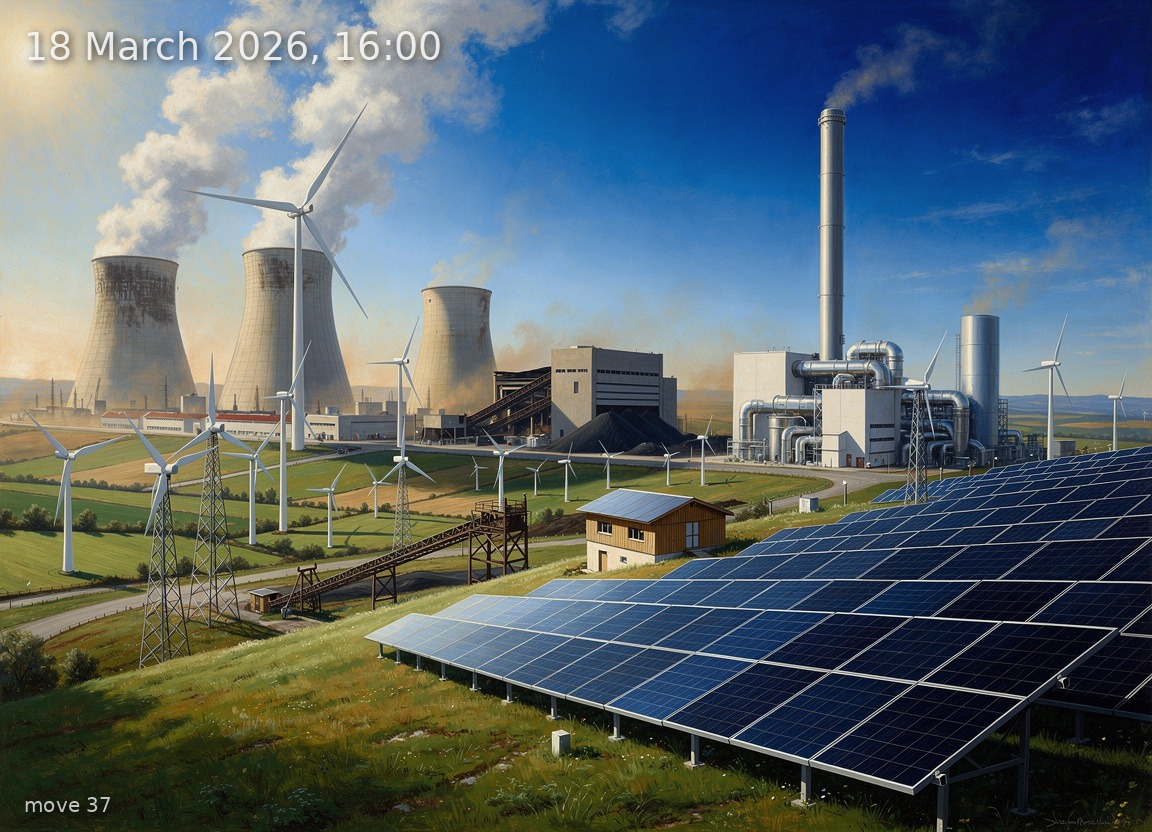
Strong solar and moderate wind meet persistent lignite and gas dispatch under clear skies, with minor net imports balancing load.
Back
Generation mix
Wind onshore 20%
Wind offshore 2%
Solar 33%
Biomass 8%
Hydro 2%
Natural gas 9%
Hard coal 7%
Brown coal 20%
65%
Renewable share
11.9 GW
Wind (on + offshore)
18.3 GW
Solar
54.6 GW
Total generation
-2.6 GW
Net import
107.0 €/MWh
Day-ahead price
13.2°C / 10 km/h
Temp / Wind speed
Open-Meteo, Kassel (51.3°N 9.5°E)
0% / 301.5 W/m²
Cloud cover / Radiation
253
gCO₂/kWh
Image prompt
Solar 18.3 GW dominates the right third of the scene as vast fields of aluminium-framed crystalline silicon photovoltaic panels stretching across gentle green hillsides, their surfaces blazing with reflected afternoon sunlight. Brown coal 10.7 GW occupies the far left as a massive lignite power station with three hyperbolic cooling towers emitting thick white-grey steam plumes rising into the sky. Wind onshore 10.7 GW fills the centre-left middle ground as dozens of three-blade turbines on lattice and tubular towers dotting rolling farmland, blades turning slowly. Natural gas 4.9 GW appears as a compact modern CCGT plant with a tall single exhaust stack and a smaller secondary stack, set between the coal complex and the wind turbines. Biomass 4.1 GW is rendered as a modest wood-clad biomass facility with a short chimney and stacked timber nearby. Hard coal 3.6 GW sits adjacent to the lignite plant as a smaller station with a single square cooling tower and conveyor belts carrying dark coal. Hydro 1.2 GW appears as a small concrete dam in a forested valley in the far background. Wind offshore 1.1 GW is suggested by a line of turbines on the distant hazy horizon where a river estuary meets the sky. The time is 16:00 in mid-March: full bright afternoon daylight under a completely clear deep blue sky, with the sun at a moderate altitude casting warm golden light across the landscape and long afternoon shadows beginning to stretch eastward. Spring vegetation is emerging — fresh light-green buds on deciduous trees, pale grass in meadows, a few early wildflowers. The atmosphere feels heavy and slightly oppressive despite the clear sky, with a subtle amber-brown industrial haze pooling near the coal stations, reflecting the high electricity price. Style: highly detailed oil painting in the tradition of 19th-century German Romantic landscape painters such as Caspar David Friedrich and Carl Blechen — rich saturated colour, visible confident brushwork, dramatic atmospheric depth and luminous sky treatment — yet rendered with meticulous engineering accuracy on every turbine nacelle, every panel frame, every cooling tower curve and steam plume. The composition balances sublime natural beauty against industrial presence. No text, no labels.